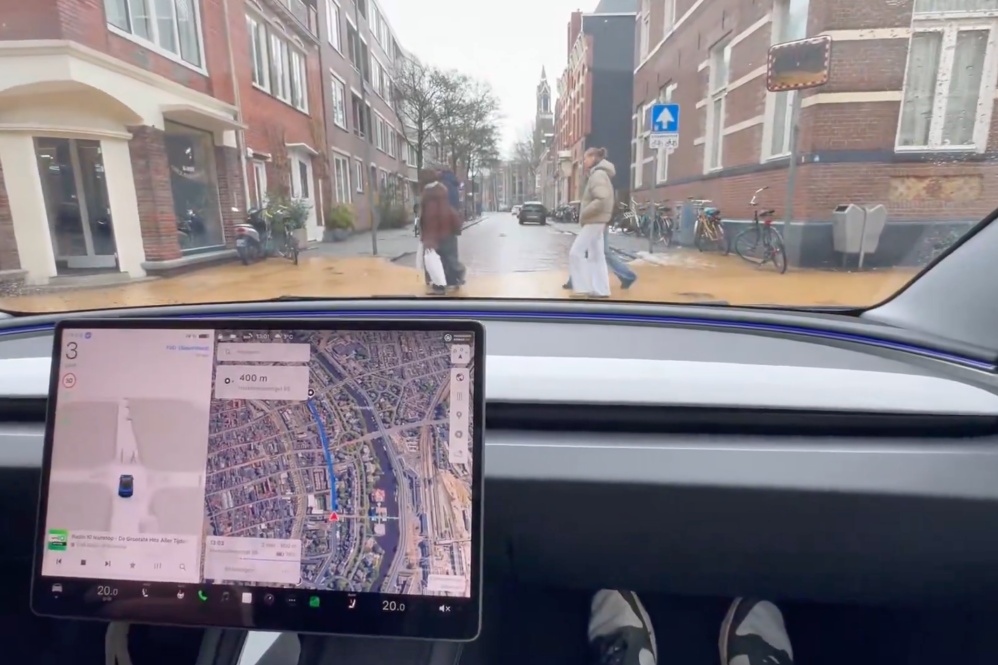
Tesla has released its first-ever European safety data for Full Self-Driving (FSD), and the results are impressive. The report comes less than two months after Tesla secured its first European approval FSD in the Netherlands.
According to Tesla, vehicles driving with FSD Supervised experienced 3.5 times fewer collisions than drivers operating manually on Dutch public roads. The data covers the period from April 10 through June 5, 2026, beginning with the system’s approval in the Netherlands and spanning nearly two months of real-world use.
The report also suggests that Dutch Tesla owners have likely accumulated far more than the previously announced 10 million kilometres on FSD. Tesla’s latest figures show FSD vehicles travelled 16.6 million km on highways and another 7.0 million kilometres on non-highway roads, for a combined total of 23.6 million kilometres during the reporting period.
Zero Highway Collisions
Perhaps the most notable statistic is the performance of FSD on highways. According to the report, vehicles using FSD travelled 16.6 million kilometres on highways without a single collision. By comparison, Tesla says manually driven vehicles equipped with Active Safety Features recorded 33 collisions over 158.7 million kilometres during the same period.
On non-highway roads, Tesla reported three collisions over 7.0 million kilometres with FSD engaged, compared to 109 collisions across 152.9 million kilometres driven manually.
Combined, Tesla says this resulted in FSD being 3.5 times safer than manual driving across all road types in the Netherlands.
Smoother and More Predictable Driving
The data also suggests FSD isn’t just avoiding collisions, it is driving more smoothly. Compared to manually driven vehicles, Tesla reported nearly 15 times fewer automatic emergency braking events, nearly 9 times less harsh acceleration, more than 7 time less harsh braking, and 8 times fewer hard swerves.
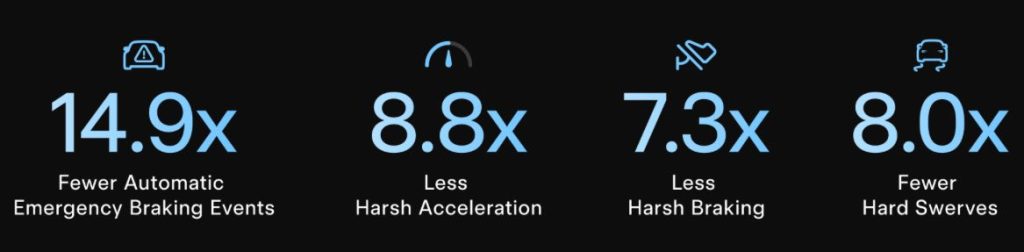
These metrics are often used as indicators of driving comfort and proactive hazard avoidance, suggesting the system is doing its job and anticipating situations earlier, thus requiring fewer abrupt interventions.
A Tougher Benchmark
At first glance, Tesla’s claim that FSD is 3.5 times safer than manual driving in the Netherlands may seem less impressive than some of the figures the company has previously reported in the United States, which have exceeded 10x. However, the Dutch data is based on a much more demanding comparison.
Tesla’s U.S. Vehicle Safety Reports compare vehicles using Autopilot or FSD against the broader driving population, which includes older vehicles with varying levels of safety technology.
In the Netherlands, Tesla used a different approach. Rather than comparing FSD-equipped vehicles to all drivers on the road, the company compared them against other Tesla vehicles equipped with the same Active Safety Features, including Automatic Emergency Braking, Forward Collision Warning, and Lane Departure Avoidance, but driven manually.
That is important because it removes many of the variables that can influence safety statistics. Both groups are driving modern Tesla vehicles with advanced safety technology, meaning the primary difference is whether FSD was engaged or not.
With that in mind, the reported 3.5x reduction in collisions may be more significant than the headline number initially suggests. Instead of outperforming the average vehicle on the road, Tesla says FSD outperformed drivers operating some of the safest production vehicles available today.
Important Milestone for Europe
The release marks the first time Tesla has publicly shared FSD safety data from a European market, which makes sense as the system has only been available in the region for less than two months. Given the continent’s cautious regulatory approach toward advanced driver-assistance systems, the data could become an important part of Tesla’s efforts to secure approvals in additional countries.
The Netherlands became the first European country to approve FSD Supervised in April, and that approval laid the groundwork for expansion into two other countries – Lithuania and Estonia. Several other governments are also watching closely. In Italy, lawmakers have recently called for a faster review process, Ireland has confirmed it is in discussions with Tesla for approval, while in Belgium the company just completed the required 5,000 km of testing on public roads last week.
In the last 2 months, FSD Supervised has been over 3x safer than manual driving on Dutch roads pic.twitter.com/nsERcFjG7R
— Tesla Europe, Middle East & Africa (@teslaeurope) June 9, 2026

Always get the latest - make Drive Tesla your preferred source on Google
Are you buying a Tesla? If you enjoy our content and we helped in your decision, use our referral link to get three months of Full Self-Driving (FSD).Drive Tesla uses affiliate links, which means we may earn a commission if you make a purchase through them, at no additional cost to you. Thank you for your support.