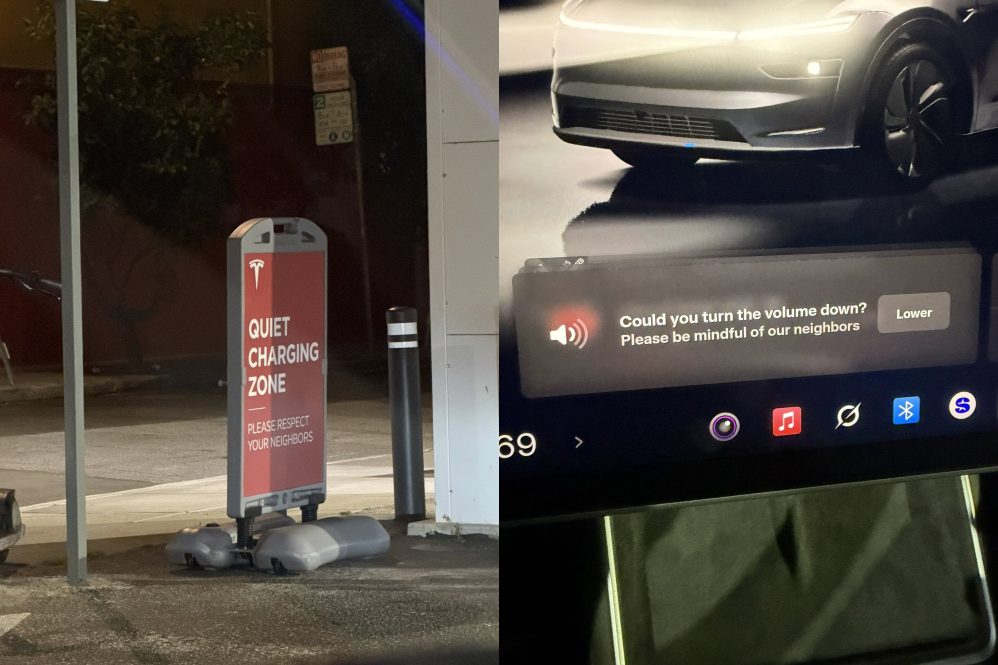
Tesla has come up with a new way to address noise complaints at one of its newest Supercharger stations in San Francisco, highlighting yet another example of the company’s ability to quickly combine software and hardware solutions through its vertically integrated ecosystem.
Drivers visiting the station on Lombard Street are now seeing a pop-up notification directly on their vehicle’s touchscreen asking them to lower their music volume while charging. The alert reads, “Could you turn the volume down? Please be mindful of our neighbors,” and includes a convenient one-tap “Lower” button that instantly reduces the audio level.
The update was pushed after nearby residents reportedly complained about excessive late-night noise at the busy urban charging location. Instead of relying solely on signage or enforcement from property management, Tesla responded with a targeted software-based solution tied specifically to that Supercharger site.
Photos shared online also show Tesla installing physical “Quiet Charging Zone” signs around the station, reminding customers to “Please Respect Your Neighbors.” Combined with the new in-car alert, the approach creates both a visual and digital reminder for drivers to keep noise levels down while charging.
Another beautiful example of Tesla’s vertical integration.
— Whole Mars Catalog (@wholemars) May 20, 2026
Neighbors were complaining about noise and commotion at this new Supercharger in San Francisco.
So Tesla pushed a software update that asks people to turn their volume down, with a button to do it in 1 tap. Smart. pic.twitter.com/8esuliuzwr
What makes the solution particularly interesting is how seamlessly Tesla was able to deploy it. Traditional automakers typically have little direct interaction between their vehicle software teams and charging infrastructure operations.
Tesla, however, controls both the vehicles and the Supercharger network, allowing the company to rapidly implement features like location-based alerts without requiring third-party coordination.
This is also another example of Tesla quietly expanding the role of software in day-to-day vehicle ownership. Over the years, the automaker has used over-the-air (OTA) updates to introduce everything from new entertainment features and driving improvements to safety enhancements and charging optimizations. In this case, the update is not about performance or range, but community relations.
Not everyone is appreciative of the new feature, however. Some Tesla owners have already criticized the pop-up as an unnecessary intrusion into the in-car experience, arguing that drivers should be free to control their own music volume without prompts from the vehicle.
Others may see it as another example of Tesla becoming increasingly proactive, or even overprotective, through software-based interventions. Still, the alert is relatively unobtrusive and can be dismissed with a single tap, and for residents living near busy 24/7 charging stations, the compromise may be viewed as a reasonable attempt to balance convenience with community concerns.
Tesla has not officially commented on whether the “Quiet Charging Zone” feature will expand to other Supercharger locations, but the rollout shows how quickly the company can react to real-world problems with a mix of infrastructure changes and software updates.

Always get the latest - make Drive Tesla your preferred source on Google
Are you buying a Tesla? If you enjoy our content and we helped in your decision, use our referral link to get three months of Full Self-Driving (FSD).Drive Tesla uses affiliate links, which means we may earn a commission if you make a purchase through them, at no additional cost to you. Thank you for your support.