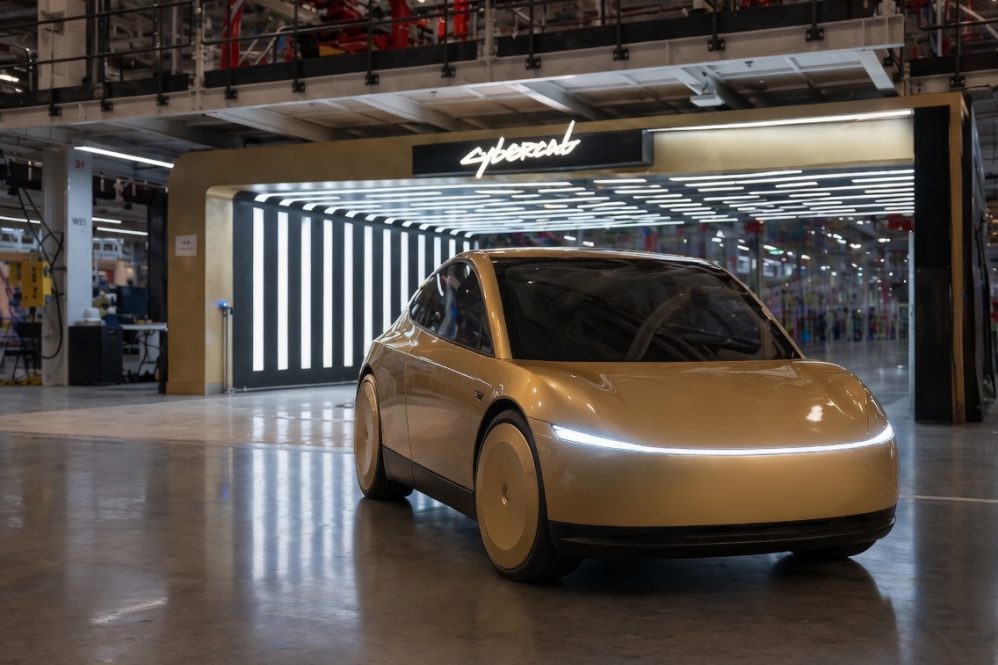
Tesla has cleared another regulatory milestone for its Cybercab, with the U.S. Environmental Protection Agency (EPA) issuing a Certificate of Conformity for the all-electric autonomous vehicle.
The approval, issued on May 26 but only published on Monday, allows the Cybercab to be legally introduced into commerce in the United States and confirms that it meets applicable federal emissions requirements for the 2026 model year.
According to the EPA documents, the Cybercab is classified as a two-seat battery electric passenger car and is covered under test group TTSLV00.0L1A. The certificate covers the 2026 model year, with the Cybercab certified as both a Zero Emission Vehicle (ZEV) and an Inherently Low Emission Vehicle (ILEV).
But perhaps more importantly, it includes several technical details Tesla has not publicly disclosed.
Lightweight Design and Modest Power Output
One of the more surprising details is the Cybercab’s weight. EPA filings list a curb weight of 3,113 pounds (1,412 kg), making it about 400 pounds (180 kg) lighter than Tesla’s currently lightest vehicle, the Model 3 RWD.
The documents also reveal a rated output of 163 kW, equivalent to approximately 219 horsepower, from a single AC permanent magnet motor. That compares to the Model 3 RWD, which a single, rear-mounted permanent magnet motor that produces 208 kW of peak power.
Unlike the Model 3 RWD, the Cybercab’s single motor is mounted at the front, as certification confirms it is a Front-Wheel Drive (FWD) vehicle, although one section of the testing documentation references All-Wheel Drive (AWD) testing.
However, this appears to be an error as regenerative braking is also listed as operating through the front wheels, further supporting the FWD configuration shown elsewhere in the filing.
Battery and Range Details
The EPA documents also shed light on the Cybercab’s battery system. Tesla lists a single lithium-ion battery pack operating at 326 volts and reports a battery energy capacity value of 146, though the agency’s reporting format differs from the usable battery capacity figures typically disclosed by automakers.
Testing data included in the filing shows the vehicle consumed 53.365 kWh during charging and achieved an equivalent all-electric range of 418.2 miles (673 km) during laboratory certification testing.
However, certification testing figures differ significantly from official EPA window-sticker ratings and are not considered an indication of the Cybercab’s final range estimate, which is expected to come in somewhere around 270 to 280 miles (434 to 450 km).
Another Step Toward Launch
The EPA certification does not answer the biggest remaining questions surrounding the Cybercab – when it will launch, and whether it will be without a steering wheel and pedals.
What it does confirm is that Tesla is continuing to move the project through the regulatory process. Combined with the growing Cybercab fleets being spotted across the U.S., this latest approval suggests Tesla is getting closer to a large-scale deployment.
Approximately 50 Cybercabs in Dallas now.
— Spencer (@scotsrule08) June 15, 2026
When do you think these will be turn on for Robotaxi? pic.twitter.com/FRlfbGVo7Q
You can read the full 15-page EPA certification document below.

Always get the latest - make Drive Tesla your preferred source on Google
Are you buying a Tesla? If you enjoy our content and we helped in your decision, use our referral link to get three months of Full Self-Driving (FSD).Drive Tesla uses affiliate links, which means we may earn a commission if you make a purchase through them, at no additional cost to you. Thank you for your support.