
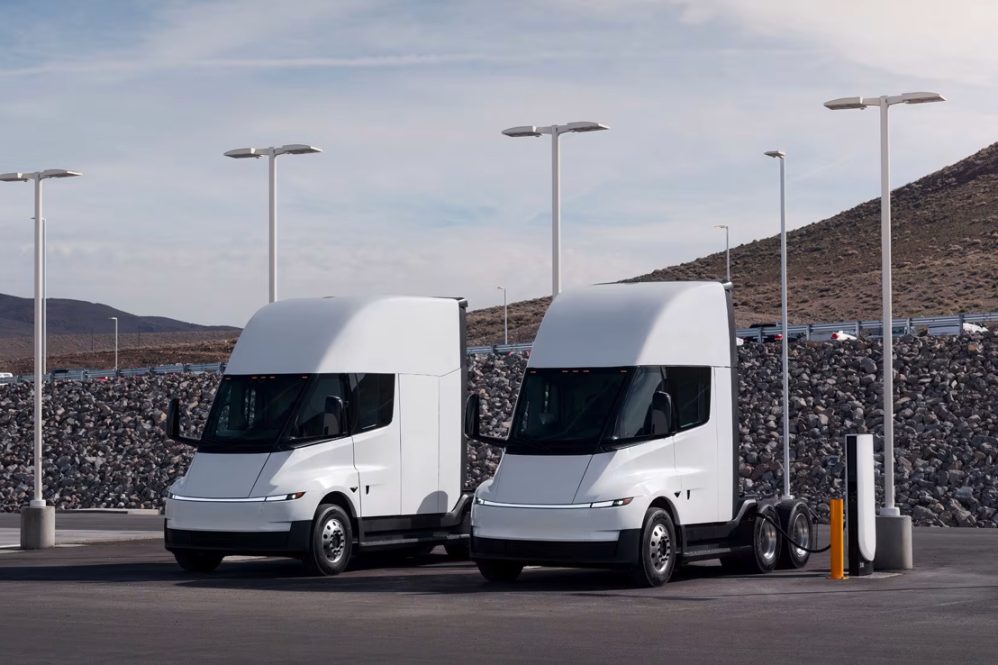
Tesla’s push toward faster charging infrastructure deployment is expanding beyond Superchargers. New permit filings in Florida reveal the company is preparing to install its first pre-assembled Megacharger units, bringing the same modular construction strategy used for its Supercharger stations to the Tesla Semi charging network.
The project, first spotted by Supercharger tracker Marco, will be located at a Flying J travel center in Fort Pierce, Florida (100 N Kings Highway). According to the site plans, Tesla intends to add two Megacharger cabinets and four charging posts, creating four dedicated charging stalls for electric semi trucks.
Florida's first Megacharging station is coming soon to Fort Pierce!!
— MarcoRP (@MarcoRPi1) June 11, 2026
Tesla recently filed plans for the addition of 2 pre-assembled Megacharger units (4 stalls total) at the Flying J located directly off Interstate 95 on N Kings Hwy. pic.twitter.com/V7wg8ksFPD
From Superchargers to Megachargers
Over the last several years Tesla has shifted toward prefabricated Supercharger installations. Rather than shipping individual components and assembling them on-site, Tesla manufactures large portions of the charging system at Giga New York. Those prefabricated Supercharger units (PSUs) are then delivered as a nearly complete unit that are simply lowered in place and the utilities connected, dramatically reducing installation time and expenses.
This approach has already evolved further with the company’s recently introduced Folding Unit (FU) Superchargers, which combine Tesla’s latest V4 charging equipment with foundations and supporting infrastructure, doubling the number of stalls compared to the traditional PSUs.
The Florida plans suggest Tesla is now applying the same philosophy to Megachargers. Engineering drawings included in the filing specifically reference a “Pre-Assembled Megacharger Unit.” The design integrates the Megacharger cabinet, charging posts, trenching, conduit pathways, and a precast concrete foundation into a single prefabricated system.
According to the plans, each completed unit weighs approximately 9,606 pounds (4,357 kg) and includes a Megacharger cabinet weighing 2,420 pounds (1,097 kg), two charging posts, protective covers, and a large precast concrete base.

Faster deployment for the Tesla Semi network
Unlike passenger vehicle Superchargers, Megachargers must support much higher power levels and larger vehicles, making installation more complex and expensive. By standardizing the design and pre-building major components off-site, Tesla could dramatically reduce construction time and, lower installation costs, increasing the pace at which it could develop its Megacharger network.
Tesla has big plans for that network, with over 60 locations planned to support the Semi, including a possible extension of the network into Ontario.
A glimpse of Tesla’s long-term charging strategy
Tesla has repeatedly shown that speed of deployment is becoming just as important as charging performance. The company’s recent rollout of Folding Unit Superchargers demonstrate how modular construction can accelerate network growth while reducing labour requirements even further.
As Tesla Semi production continues to ramp and more fleets begin adopting electric trucks, pre-assembled Megachargers could become a key piece of the infrastructure needed to support large-scale freight electrification.

Always get the latest - make Drive Tesla your preferred source on Google
Are you buying a Tesla? If you enjoy our content and we helped in your decision, use our referral link to get three months of Full Self-Driving (FSD).Drive Tesla uses affiliate links, which means we may earn a commission if you make a purchase through them, at no additional cost to you. Thank you for your support.