
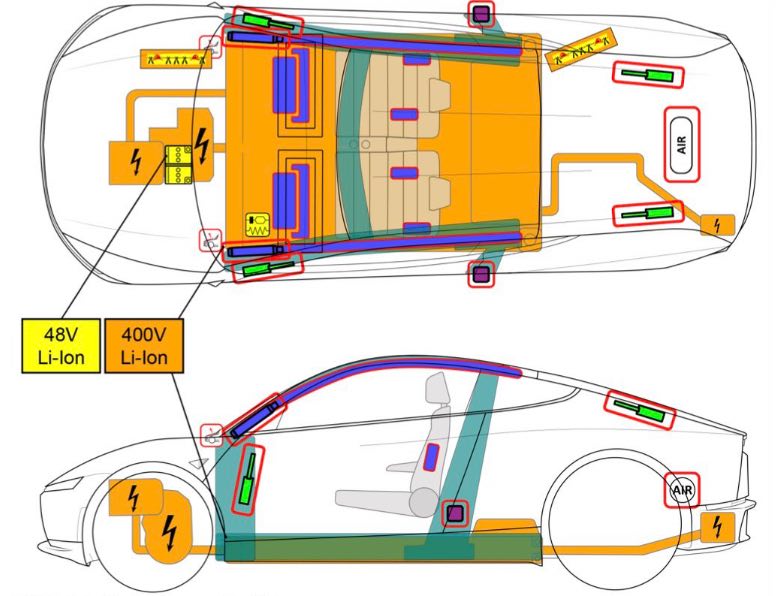
Tesla has confirmed that Cybercab will use a 48-volt low-voltage electrical architecture while retaining a traditional 400-volt high-voltage battery system, revealing more details about the technology underpinning the company’s purpose-built Robotaxi.
The information comes from Tesla’s newly released Cybercab First Responder Interaction Plan, which outlines procedures for police, firefighters, paramedics, and towing operators responding to incidents involving the autonomous vehicle.
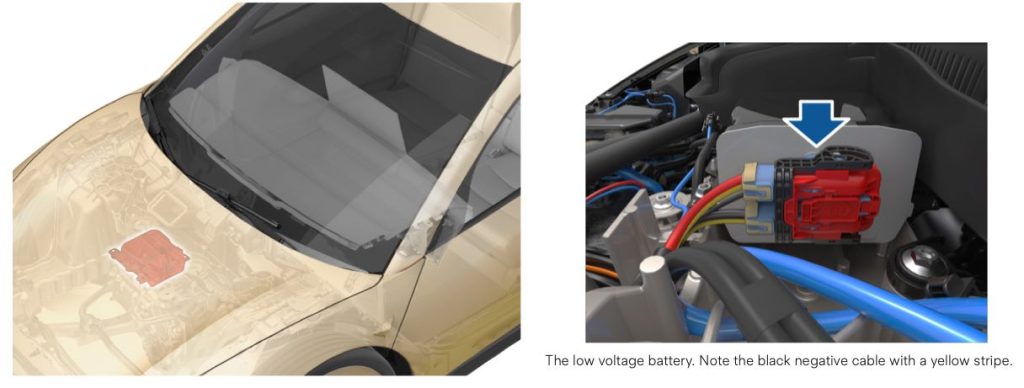
According to the guide, first responders must use an external 48V power source if low-voltage power is unavailable and access to the vehicle is required. The procedure temporarily energizes the vehicle’s low-voltage systems, allowing emergency crews to open the hood and access safety equipment and the first responder loop.
Following Cybertruck’s lead
The Cybertruck became Tesla’s first production vehicle to abandon the automotive industry’s decades-old 12V electrical standard in favour of a 48V architecture.
The move allows Tesla to reduce wiring thickness, lower electrical losses, decrease vehicle weight, and simplify manufacturing. Elon Musk has previously said Tesla intends to migrate future vehicles to 48V systems wherever possible.
Cybercab now appears set to become the second Tesla vehicle to make the transition.
Why 48V matters
While EV discussions often focus on battery size and charging speeds, the low-voltage system powers many of the features drivers use every day, including lighting, windows, infotainment systems, cameras, sensors, computers, door actuators, and communications equipment.
Increasing the voltage from 12V to 48V allows the vehicle to deliver the same amount of power using only one-quarter of the current, reducing heat generation and allowing engineers to use smaller and lighter wiring harnesses throughout the vehicle.
For a purpose-built autonomous vehicle packed with cameras, onboard computers, communications hardware, and electrically actuated systems, those efficiency gains can be significant.
Why not 800V?
The plan also reveals Tesla’s plans to retain a 400V high-voltage battery architecture for Cybercab. Many newer EVs have adopted 800V systems that can support faster charging speeds and improved efficiency under heavy loads.
Tesla has so far only implemented a 800V system for the Cybertruck. For its other vehicles, the company has instead focused on improving efficiency through lower vehicle weight, improved aerodynamics, reduced wiring complexity, and more efficient power electronics.
Given Cybercab’s relatively small battery pack and expected urban operating environment, Tesla may have determined that the additional cost and complexity of an 800V system offered little practical benefit for the vehicle’s intended mission.
The first responder guide suggests Tesla continues to see greater value in simplifying vehicle architecture and reducing manufacturing costs than in pursuing higher system voltages.

Always get the latest - make Drive Tesla your preferred source on Google
Are you buying a Tesla? If you enjoy our content and we helped in your decision, use our referral link to get three months of Full Self-Driving (FSD).Drive Tesla uses affiliate links, which means we may earn a commission if you make a purchase through them, at no additional cost to you. Thank you for your support.