Canada’s EV fast-charging network is continuing to grow in early 2026, but new data shows the focus is shifting beyond simple expansion—toward building larger, more efficient sites that can better handle rising demand, with Tesla still playing a central, but evolving, role.
A new report from Paren highlights how the country’s charging infrastructure is maturing, with operators prioritizing higher-capacity stations and improved performance over simply adding more locations. While total ports continue to climb, the strategy behind that growth is changing.
Fewer stations, more chargers per site
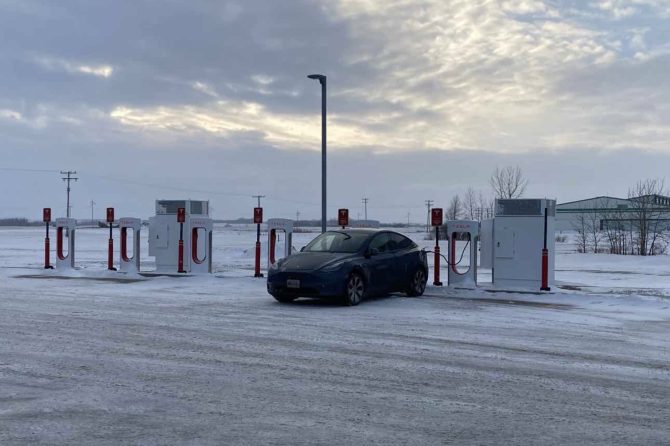
Canada added 668 new DC fast-charging ports in Q1 2026, bringing the national total to 9,472, but fewer new stations were built compared to previous quarters. That shift signals a move toward larger sites with more chargers per location—something Tesla has long led with its Supercharger network.
Tesla still leads, but competition is growing
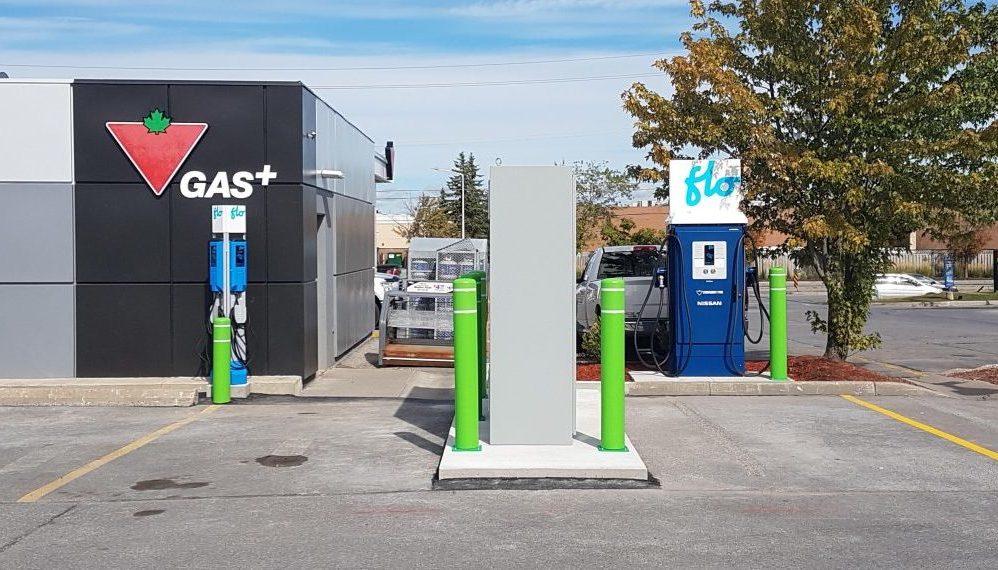
Tesla still maintains a significant presence, accounting for roughly 31% of all fast-charging infrastructure in Canada, nearly double the next largest operator, Quebec’s Circuit électrique. However, Tesla’s dominance in new deployments is starting to ease as other networks scale up. In Q1, Tesla represented about 12.6% of new builds, matching Filgo in terms of quarterly additions.
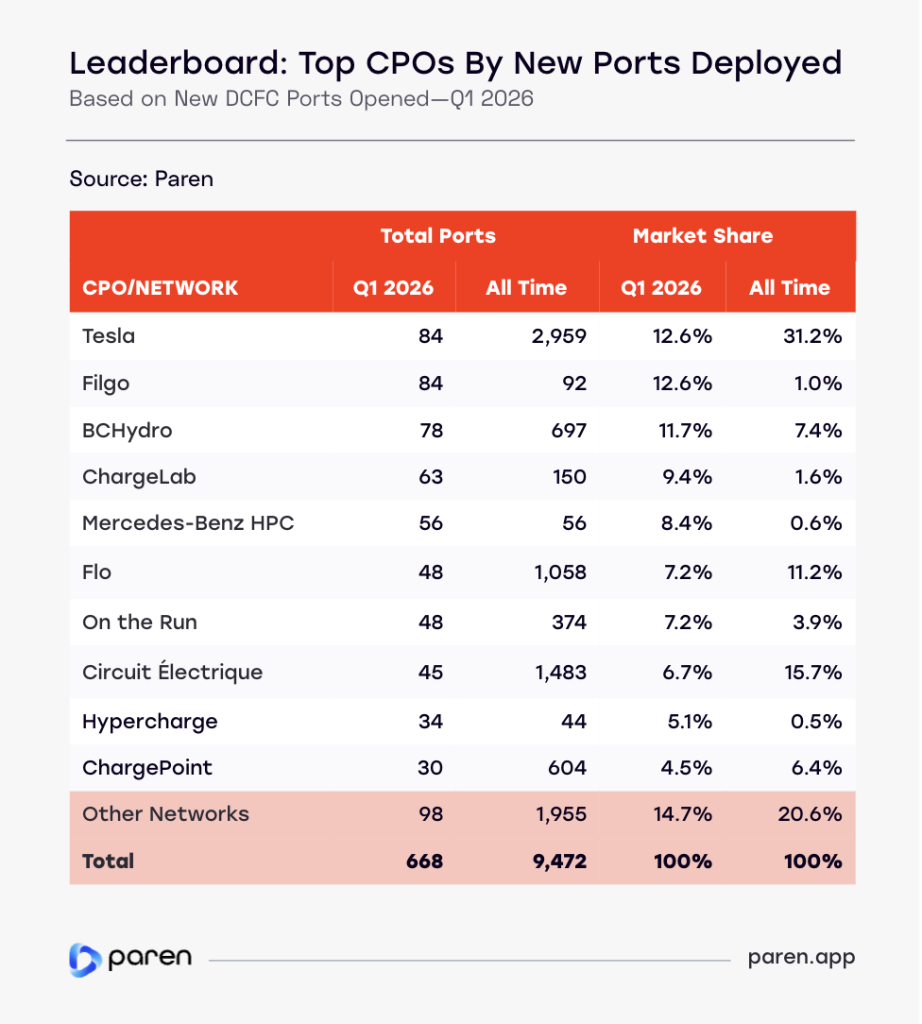
At the same time, Tesla’s approach is also evolving. The company averaged about 12 charging ports per new station in Q1, down slightly from previous peaks, reflecting a broader industry trend toward standardized, repeatable site designs. Meanwhile, non-Tesla networks are increasing their average site size, narrowing the gap and moving closer to Tesla’s high-capacity model.
Demand continues to keep pace
Despite this rapid expansion, demand continues to keep pace. Utilization held steady at around 11.3%, indicating that new infrastructure is being effectively absorbed as more EVs hit the road. Seasonal patterns still play a role, with charging activity dipping in February before rebounding in March.

Urban pressure starting to emerge
However, not all regions are equal. Urban centres—particularly in British Columbia and Ontario—are beginning to show signs of capacity pressure, even as national averages remain stable. Vancouver, for example, continues to lead the country in utilization, highlighting the growing importance of high-density charging hubs.

Pricing remains fragmented across provinces
Pricing remains another area of fragmentation. The national average held steady at about $0.48 per kWh, but provincial differences remain significant, driven largely by electricity costs and regulatory frameworks rather than short-term demand changes.
Reliability holds strong despite growth
Reliability continues to be a strong point across the network, with a national score of around 91.1. While slightly lower than late 2025, it still reflects high uptime even as networks grow more complex.
Overall, the data points to a Canadian EV charging market that is entering its next phase—less about rapid expansion, and more about optimizing performance, capacity, and user experience. And while Tesla remains a key player, the competitive landscape is quickly broadening as more operators step in to meet growing demand.

Always get the latest - make Drive Tesla your preferred source on Google
Are you buying a Tesla? If you enjoy our content and we helped in your decision, use our referral link to get three months of Full Self-Driving (FSD).Drive Tesla uses affiliate links, which means we may earn a commission if you make a purchase through them, at no additional cost to you. Thank you for your support.