Tesla has unveiled the first Cybercab with Starlink integration. We knew this was coming thanks a recent display at a Tesla showroom as well as sightings of test vehicles with crude Starlink attachments, but this is the first official look at how the company will integrate the antenna directly into the production-intent robotaxi.
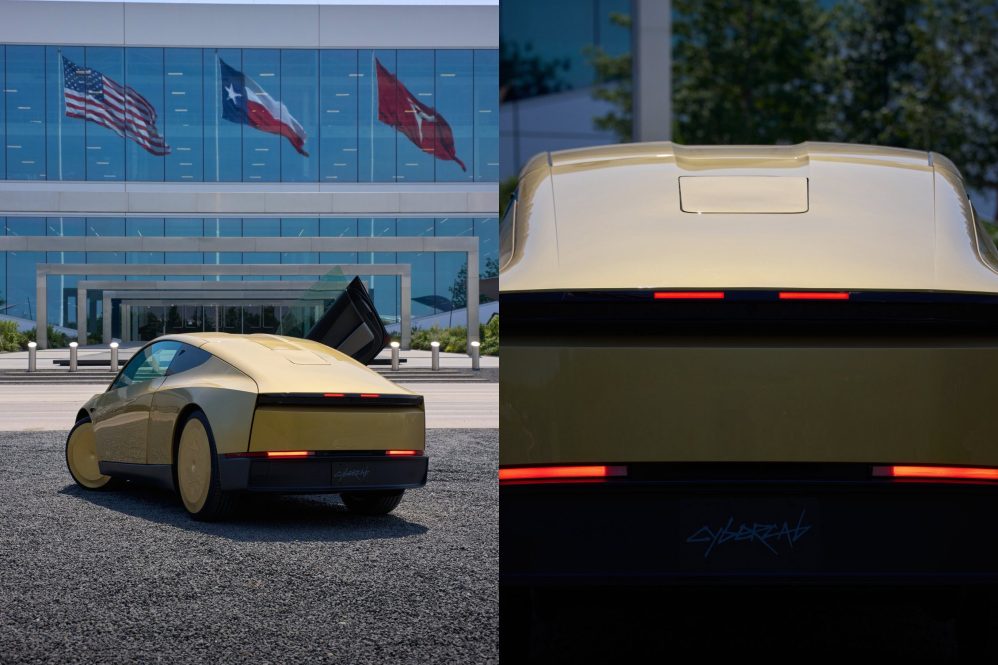
Tesla’s Robotaxi account shared new photos of a Cybercab outside Giga Texas, calling it the “First Cybercab with Starlink integration.” The images provide a close-up look at a rectangular panel installed at the rear of the roof, above the Cybercab’s taillights.
The location matches what Tesla revealed in its Cybercab hardware diagram first revealed last month, which identified the area at the rear of the vehicle as the location for “Starlink Integration.” Rather than having a conventional Starlink dish mounted externally, the new photos show the hardware neatly incorporated into the Cybercab’s bodywork, maintaining the vehicle’s streamlined appearance.
First Cybercab with @Starlink integration pic.twitter.com/8TI6LYSFjl
— Tesla Robotaxi (@robotaxi) August 10, 2026
Why does Cybercab need Starlink?
According to Elon Musk, the primary reason is reliability. During Tesla’s Q2 2026 earnings call, Musk explained that the company doesn’t want its autonomous vehicles encountering areas without cellular coverage, saying, “We can’t have robotaxis stuck in these like Bermuda Triangles of lack of cellular connectivity.”
Starlink therefore gives Cybercab another way to stay connected when terrestrial cellular service is weak or unavailable. There is also a benefit for passengers. Musk has said the high-speed connection will allow riders to stream 4K video on the Cybercab’s 21-inch display.
As we noted, this isn’t the first time we’ve seen Starlink hardware on a Cybercab. Test vehicles have previously been spotted with Starlink equipment mounted at the rear, providing an early clue that Tesla was experimenting with satellite connectivity.
Tesla’s RF-transparent roof patent
The reveal also adds another interesting layer to a recent Tesla patent detailing an RF-transparent vehicle roof. As we previously reported, the patent describes embedding satellite and cellular antennas into a polymer roof that allows radio-frequency signals to pass through without the interference created by traditional metal panels.
Tesla specifically outlined a “smart roof” capable of housing satellite communication hardware, LTE antennas, Wi-Fi and Bluetooth equipment, along with processing hardware.
The Cybercab implementation shown here isn’t necessarily the exact technology described in that patent, but there are similarities. Both approaches are aimed at integrating satellite hardware into the vehicle itself rather than relying on a traditional external antenna.

Always get the latest - make Drive Tesla your preferred source on Google
Are you buying a Tesla? If you enjoy our content and we helped in your decision, use our referral link to get three months of Full Self-Driving (FSD).Drive Tesla uses affiliate links, which means we may earn a commission if you make a purchase through them, at no additional cost to you. Thank you for your support.