Just days before its highly anticipated initial public offering (IPO), SpaceX has unveiled one of the most ambitious projects in the company’s history—a satellite designed not to provide internet access or Earth observation, but to operate as a data center in orbit.
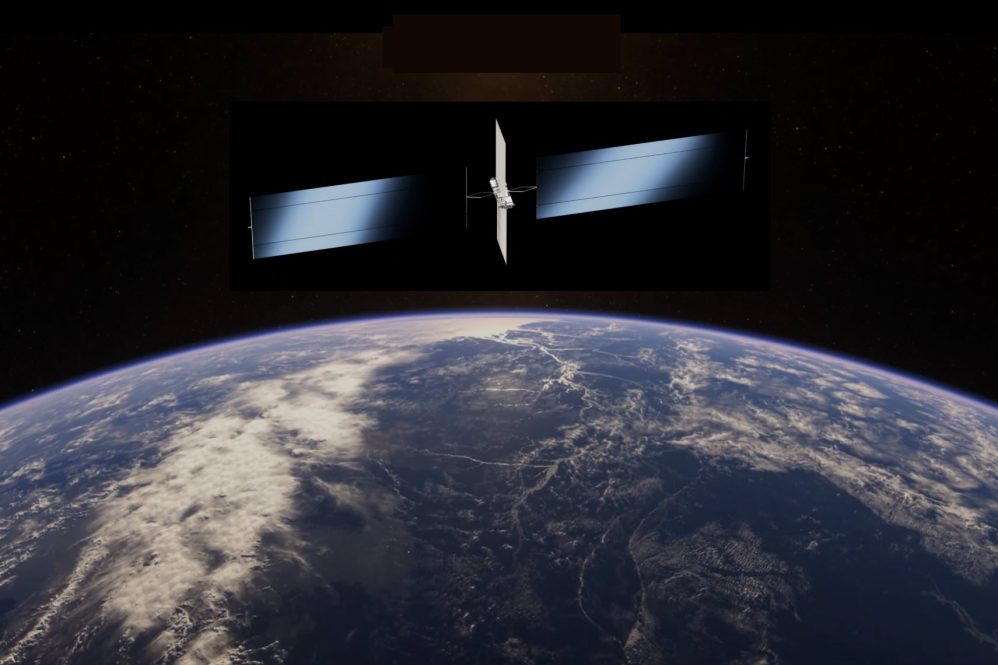
The spacecraft, known as AI1, is the first generation of what Elon Musk envisions as a future constellation of AI-powered computing satellites operating above Earth.
According to details shared by SpaceX in a video posted to X on Monday, the satellite is capable of delivering 120 kW of computing power on average and up to 150 kW at peak performance, placing it roughly on par with a modern AI server rack on the ground.
AI Data Centers Headed to Orbit
While the concept of space-based computing may sound futuristic, Musk argues it could help address one of the biggest challenges facing the artificial intelligence industry today—access to power. Data centers around the world are consuming increasing amounts of electricity as AI models become larger and more demanding.
By moving computing infrastructure into orbit, SpaceX hopes to tap into continuous solar energy while reducing pressure on terrestrial power grids.
Bigger Than a Boeing 747
AI1 is essentially an enormous spacecraft. Once fully deployed, it will stretch 70 metres (230 feet) across, making it slightly wider than a Boeing 747-8. The satellite will rely on large solar arrays capable of generating 150 kW of power, while a deployable liquid radiator system will dissipate heat generated by onboard processors.
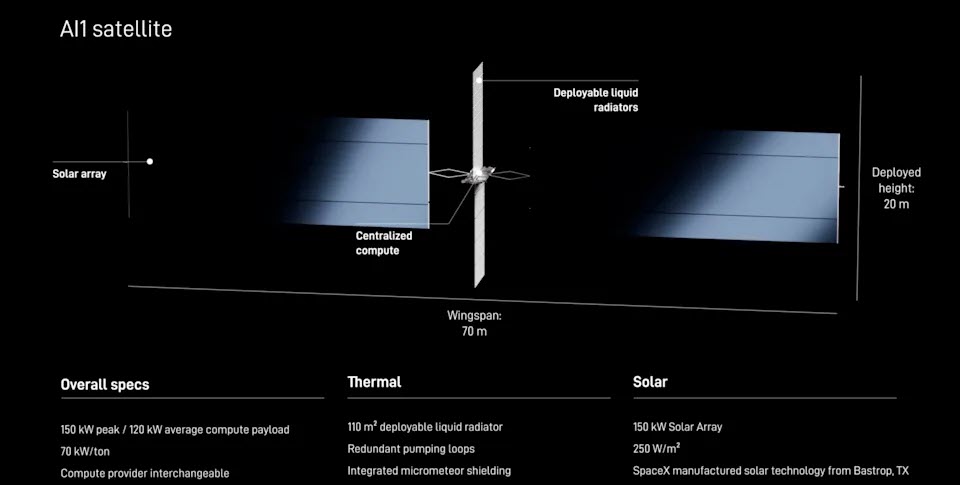
Cooling remains one of the most significant engineering hurdles for any orbital data center. Unlike facilities on Earth, satellites cannot rely on air conditioning or water-cooling systems. Instead, excess heat must be radiated into space. To address this challenge, AI1 incorporates deployable radiators, redundant pumping systems, and shielding designed to protect against micrometeoroids.
One notable feature of the design is its processor flexibility. Rather than committing to a single chip supplier, SpaceX says the compute hardware can be swapped out, allowing the company to adopt the most advanced AI processors available as technology evolves.
Despite the satellite’s massive scale, Musk suggested the design is actually less complicated than Starlink. During the presentation, he explained that AI1 largely leverages technologies SpaceX has already developed through its satellite internet program.
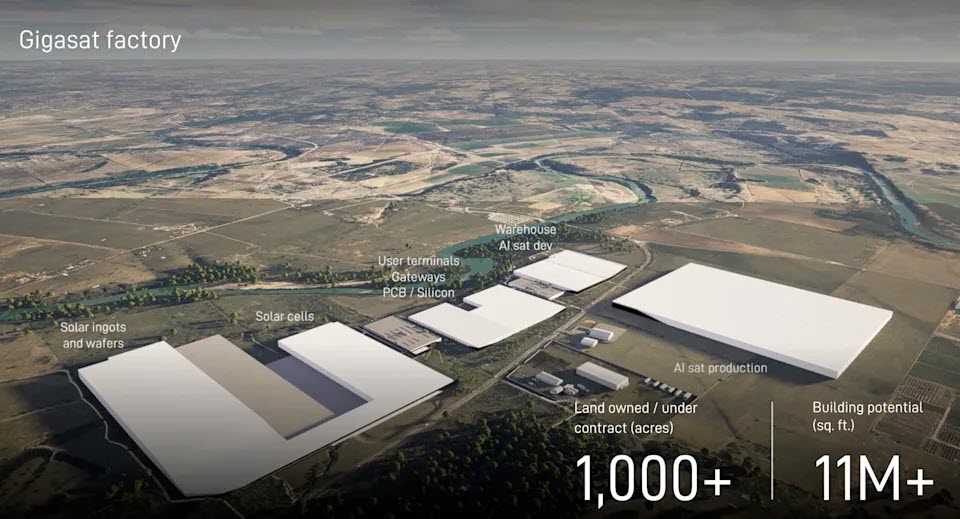
SpaceX plans to manufacture the satellites at its newly announced Gigasat facility in Bastrop, Texas, with production expected to begin by the end of 2027.
Can SpaceX Make Orbital Computing Work?
The announcement provides a glimpse into Musk’s long-term vision for AI infrastructure. However, as with many of his most ambitious projects, questions remain about timelines, scalability, and whether orbital data centers can prove economically viable at large scale.
Even Musk acknowledged that AI1 represents the company’s first attempt at solving the challenge, stopping short of providing firm deployment targets.
Still, if SpaceX can make the concept work, AI1 could mark the beginning of an entirely new category of space-based infrastructure—one designed not for communication, but for computation.
Watch @ElonMusk provide a technical update on SpaceX’s capability to manufacture, launch, and operate AI satellites at scale → https://t.co/PSCyWrNsOg pic.twitter.com/vhtr46uax7
— SpaceX (@SpaceX) June 8, 2026

Always get the latest - make Drive Tesla your preferred source on Google
Are you buying a Tesla? If you enjoy our content and we helped in your decision, use our referral link to get three months of Full Self-Driving (FSD).Drive Tesla uses affiliate links, which means we may earn a commission if you make a purchase through them, at no additional cost to you. Thank you for your support.