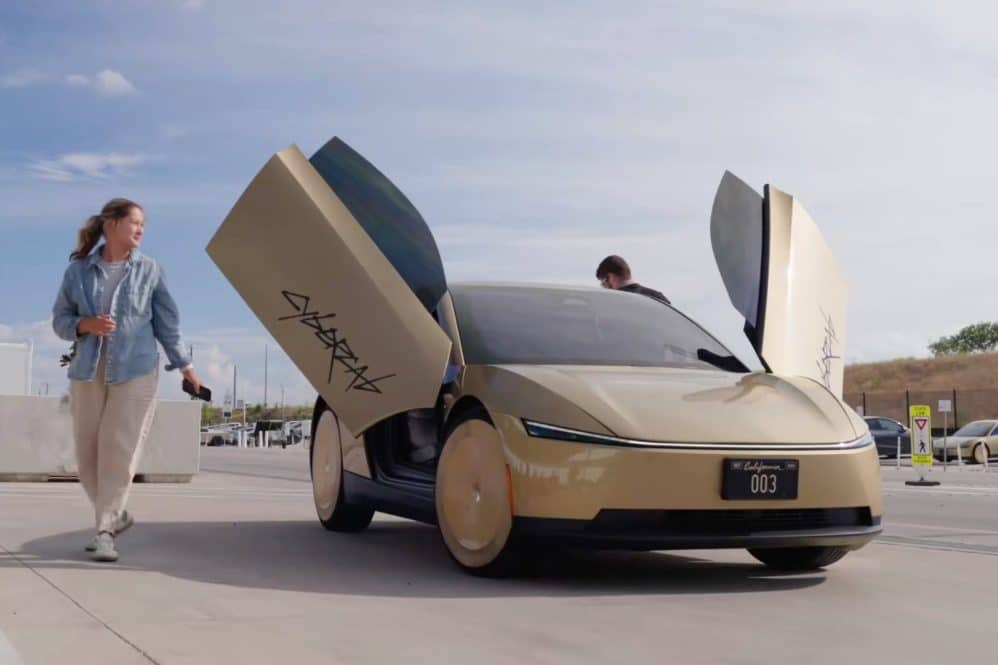
Tesla CEO Elon Musk has provided new insight into one of the biggest questions surrounding the Cybercab. If the company has already logged billions of miles with Full Self-Driving (FSD), why isn’t its purpose-built Robotaxi already being deployed at scale?
The answer, according to Musk, is that those billions of miles don’t automatically transfer to an entirely new vehicle.
The topic came up during Tesla’s Q2 2026 earnings call after analysts questioned why the company has been expanding Robotaxi service into additional cities instead of dramatically increasing the number of vehicles already operating in places like Austin.
Tesla’s Vice President of AI Software, Ashok Elluswamy, explained that the company’s current focus is demonstrating that its FSD software can operate reliably across different cities and driving environments.
“The reason we have been expanding across different cities instead of just doubling down on a single city is that we want to make sure that our stack is a very general one,” Elluswamy said. “We just want to like both prove to ourselves and to other folks that it is working across a lot of different cities without too much effort per city.”
Elluswamy also said Tesla measures progress by unsupervised miles rather than fleet size. Because Robotaxis operate almost continuously, each vehicle accumulates significantly more driving data than a privately owned car, making miles driven a better indicator of the system’s maturity than simply counting vehicles.
Why Cybercab Needs Its Own Validation
While Elluswamy described Tesla’s software stack as “very general,” Musk explained that deploying FSD on an entirely new vehicle is a separate challenge.
“One of the things for Cybercab should be noted is because it is a new vehicle chassis, we need to accumulate driving data that is specific to the Cybercab before we can put a lot of them on the road,” Musk said.
Rather than relying solely on the billions of miles collected from Model 3, Model Y, and Tesla’s other production vehicles, the company first has to validate how FSD performs on the Cybercab itself.
To do that, Tesla has been testing Cybercabs fitted with temporary steering wheels and pedals, allowing safety drivers to gather the real-world data needed to calibrate the software for the vehicle’s unique chassis.
“We actually have to accumulate miles with Cybercab that are retrofitted with steering wheels and brakes… to calibrate to the Cybercab chassis,” Musk explained.
The comments provide an important look at how Tesla develops FSD. While the AI is increasingly capable of generalizing across different roads, traffic conditions, and cities, introducing a new vehicle platform still requires additional validation to account for differences in steering, braking, suspension, weight distribution, and overall vehicle dynamics.
Cybertruck Hinted at This, Cybercab Confirms It
If you’ve been following Tesla for even just a few years, the idea isn’t entirely new. Cybertruck owners experienced a similar delay – FSD only became available nearly a year after deliveries began, with the system continuing to improve over the following year as Tesla refined its performance on the truck’s unique platform.
Until now, however, the company had never explicitly explained why that process was necessary, with most assuming it was because of the electric pickup’s four-wheel steering and larger body.
Musk’s comments effectively confirm that while Tesla’s FSD software can transfer its understanding of how to drive, it still needs real-world validation on an entirely new chassis before the company is comfortable deploying it at scale.
Good News for Tesla’s Robotaxi Plans
The encouraging takeaway is that Tesla likely won’t have to repeat this process frequently for its Robotaxi business, as the company’s autonomous ride-hailing strategy is centered on the Cybercab.
That means once the Cybercab has accumulated enough validation miles and Tesla is satisfied with its performance, the company can focus on scaling production and expanding its Robotaxi service rather than validating another purpose-built autonomous vehicle from scratch.
That appears to be exactly where Tesla is headed. As confidence in the Cybercab continues to grow, Musk expects deployments to ramp up quickly.
“So you’ll see — as we are confident about that, the number of Cybercabs in cities will increase dramatically,” he said.

Always get the latest - make Drive Tesla your preferred source on Google
Are you buying a Tesla? If you enjoy our content and we helped in your decision, use our referral link to get three months of Full Self-Driving (FSD).Drive Tesla uses affiliate links, which means we may earn a commission if you make a purchase through them, at no additional cost to you. Thank you for your support.