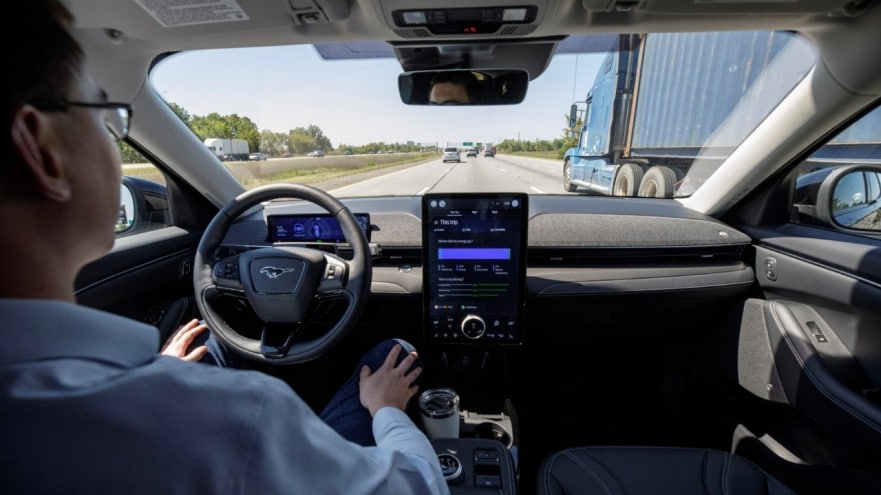
The National Transportation Safety Board (NTSB) is calling for significant safety improvements to hands-free driving systems following its investigation into two fatal crashes involving Ford’s BlueCruise technology.
In findings released this week, the agency concluded that both incidents—each involving a Ford Mustang Mach-E operating with BlueCruise engaged—highlight critical shortcomings in driver monitoring and system design, while also highlighting the risks of driver over reliance on partial automation.
Two crashes, similar failures
Both crashes occurred in 2024 and involved vehicles striking stationary traffic at highway speeds. In one case in San Antonio, a Mach-E collided with a stopped Honda CR-V, killing its driver. In another incident in Philadelphia, a Mach-E struck two stationary vehicles, resulting in two fatalities.
Investigators found that in both situations, neither the driver nor the vehicle’s advanced driver assistance system (ADAS) took evasive action before impact. No braking or steering inputs were recorded in the moments leading up to either crash.
The NTSB determined that driver distraction played a major role in both incidents. In San Antonio, the driver was reportedly focused on the infotainment system, while in Philadelphia, the driver was impaired and using a mobile phone. In both cases, investigators said drivers became disengaged from the driving task and relied too heavily on the system.
“Contributing to the crash was the inability of the Ford vehicle’s partial automation system… to detect and respond to the stationary vehicle ahead,” the NTSB said in its findings.
Driver monitoring and system limitations under scrutiny
Beyond driver behaviour, the NTSB pointed to shortcomings in how BlueCruise monitors driver attention. According to the agency, the system struggled to accurately determine whether drivers were actually watching the road or simply looking forward while distracted.
The investigation also revealed design gaps that may increase risk. Drivers can disable automatic emergency braking while using BlueCruise, and adaptive cruise control can be set up to 20 mph (32 km/h) above the speed limit—both factors that reduce the system’s ability to prevent or mitigate collisions.
In the Philadelphia crash, excessive speed was identified as a contributing factor, with the vehicle traveling well above the posted limit in a work zone.
Calls for stronger oversight and industry standards
The NTSB is now urging regulators and automakers to implement stricter standards for partial automation systems, which fall under SAE Level 2 and still require full driver attention at all times.
“This investigation highlights the urgent need for stronger safety standards and better oversight of automated driving systems,” said NTSB chair Jennifer Homendy. “Manufacturers and federal regulators must ensure these technologies are designed, monitored and implemented in ways that keep all our road users safe. We cannot take a ‘hands-off’ approach to hands-free driving technology. Lives depend on it.”
Among its recommendations, the NTSB is calling for improved driver monitoring systems, mandatory crash data recording, and limits on system configurations that allow excessive speeding.
The agency also highlighted a broader issue: the lack of federal requirements for recording data from driver assistance systems during crashes, which can limit investigators’ ability to fully understand what went wrong.
With the final report expected in the coming weeks, it will be up to regulators, including the U.S. Department of Transportation, to introduce tighter rules governing the use and performance of these systems.