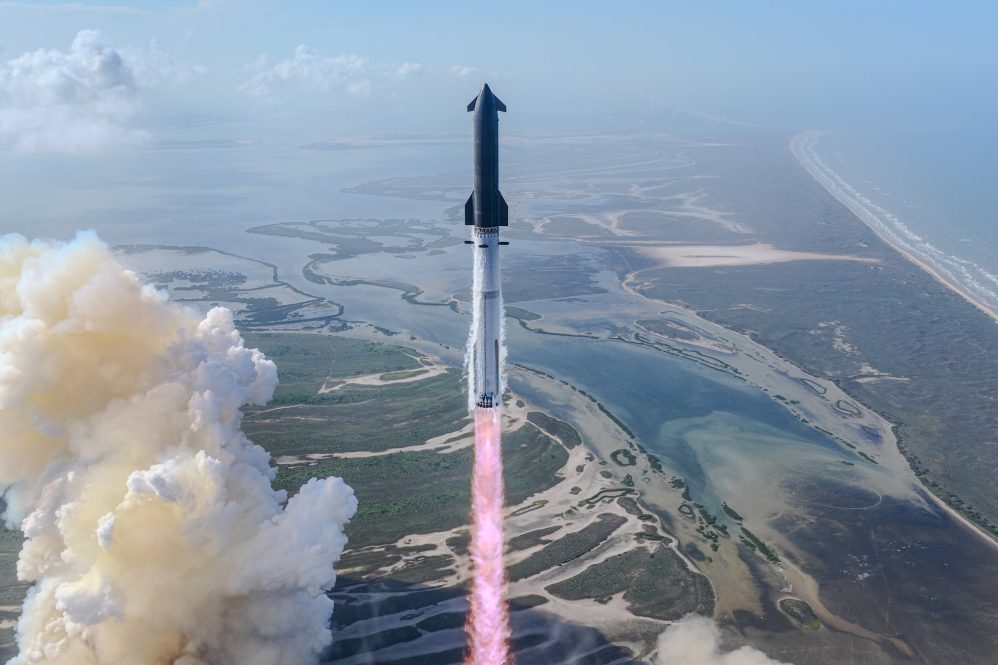
SpaceX has taken another major step toward making Starship operational, with the company successfully completing the first test flight of its upgraded Starship V3 rocket on Friday evening.
The mission, known as Flight 12, marked the first launch of the next-generation version of Starship and the company’s first Starship test in seven months. While the flight was not flawless, SpaceX achieved most of its key objectives, including payload deployment, atmospheric re-entry, and a controlled splashdown in the Indian Ocean.
Standing more than 400 feet tall, Starship V3 lifted off from SpaceX’s Starbase facility in Texas atop a Super Heavy booster powered by 33 Raptor engines. The launch initially appeared smooth, although one of the booster engines shut down during ascent, and the booster later failed to complete its planned boost-back maneuver before crashing into the Gulf of Mexico.
Liftoff of Starship! pic.twitter.com/LQLdjK5V6K
— SpaceX (@SpaceX) May 22, 2026
Despite the booster issues, the upper-stage Starship spacecraft continued its mission successfully, even after losing one of its six engines during flight. SpaceX adjusted the mission profile accordingly, cancelling a planned in-space engine relight test but still completing several high-priority objectives.
One of the biggest milestones of the flight was the successful deployment of 20 mock Starlink satellites, along with two modified satellites equipped with cameras and sensors designed to inspect Starship’s heat shield during re-entry. Spectacular footage captured the Starship vehicle in orbit as the payloads drifted away from the spacecraft.
Starship has successfully deployed our modified @Starlink satellites and simulators pic.twitter.com/0ym9RJ0J6M
— SpaceX (@SpaceX) May 22, 2026
The spacecraft later re-entered Earth’s atmosphere and completed a controlled descent into the Indian Ocean. SpaceX intentionally pushed the vehicle through several high-stress maneuvers during re-entry to collect engineering data for future missions. After touching down vertically in the ocean, the spacecraft tipped over and exploded, which SpaceX had previously indicated was an expected outcome.
Splashdown confirmed! Congratulations to the entire SpaceX team on the twelfth flight test of Starship! pic.twitter.com/XXBAtryPpL
— SpaceX (@SpaceX) May 22, 2026
“Congratulations SpaceX team on an epic first Starship V3 launch & landing!,” Elon Musk wrote on X following the mission. “You scored a goal for humanity.”
NASA Administrator Jared Isaacman, who attended the launch in person, also praised the mission afterward, writing, “One step closer to the Moon … one step closer to Mars.”
The success of Flight 12 is particularly important because Starship is central to several of SpaceX’s long-term ambitions. The rocket is expected to dramatically expand Starlink deployment capacity, support future orbital refueling operations, and eventually serve as NASA’s lunar lander for Artemis missions planned later this decade.
While several technical hurdles remain, including orbital refueling and full booster recovery, Flight 12 demonstrated that Starship V3 is capable of surviving the most critical phases of launch and re-entry. For SpaceX, that represents meaningful progress as the company pushes toward commercial readiness and prepares for increased investor scrutiny ahead of its highly anticipated IPO.

Always get the latest - make Drive Tesla your preferred source on Google
Are you buying a Tesla? If you enjoy our content and we helped in your decision, use our referral link to get three months of Full Self-Driving (FSD).Drive Tesla uses affiliate links, which means we may earn a commission if you make a purchase through them, at no additional cost to you. Thank you for your support.