
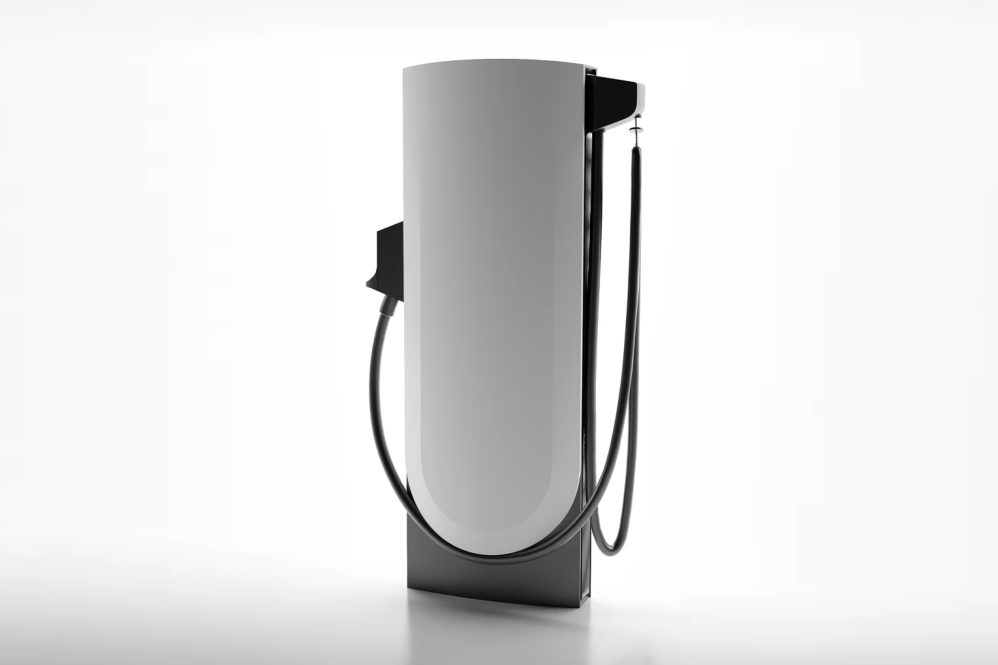
Tesla has introduced another piece of its commercial charging strategy—the Basecharger, a lower-power solution designed for fleets with longer dwell times.
While the Megacharger focuses on speed, the Basecharger is built for efficiency and flexibility, targeting depots, warehouses, and overnight charging scenarios for the Tesla Semi.
Tesla unveiled the Basecharger as part of the launch of its Semi Charging for Business program after the class 8 electric truck entered high-volume production this week after nearly a decade of delays.
A different approach to charging hardware
One of the most notable aspects of the Basecharger is its design. Unlike the Megacharger, which relies on a large external cabinet, the Basecharger integrates its power electronics directly into the charging post itself.
According to Tesla, this was made possible by adapting technology from its latest V4 Supercharger architecture.
“Although it looks just like a V4 post, the Basecharger doesn’t have a cabinet at all. We were able to put one of the 16 trays from the V4 cabinet inside the post,” said Max de Zegher.
Lower costs and improved flexibility
Tesla says the Basecharger is designed with economics in mind—an important factor for fleet operators evaluating the switch to electric.
By eliminating the need for a separate cabinet and leveraging existing manufacturing processes, the company can reduce both upfront costs and installation timelines. The system also supports open communication standards and optional payment terminals, making it adaptable for both private and semi-public use.
Tesla says up to 3 Basechargers can be daisy-chained on a single breaker to further reduce installation and operational costs.
Same ecosystem, different use case
Despite its lower power output, delivering up to 125 kW of power, the Basecharger can still add approximately 60% of range in about four hours—making it ideal for trucks parked between shifts or during extended loading periods.
The Basecharger also integrates into Tesla’s broader charging ecosystem. That includes over-the-air updates, remote monitoring, and the same software platform used across Tesla’s charging network.
Businesses can manage pricing, track usage, and monitor performance through Tesla’s portal, while the company handles service and maintenance to ensure consistent uptime.
Complementing the Megacharger network
Rather than replacing Megachargers, the Basecharger is designed to complement them. Together, the two solutions cover a wide range of use cases—from high-speed highway charging to slower, more cost-effective depot charging.
With production of the Semi finally underway and deliveries of the Basecharger expected to begin in early 2027, Tesla is clearly building out a comprehensive charging strategy for heavy-duty transport.


Always get the latest - make Drive Tesla your preferred source on Google
Are you buying a Tesla? If you enjoy our content and we helped in your decision, use our referral link to get three months of Full Self-Driving (FSD).Drive Tesla uses affiliate links, which means we may earn a commission if you make a purchase through them, at no additional cost to you. Thank you for your support.