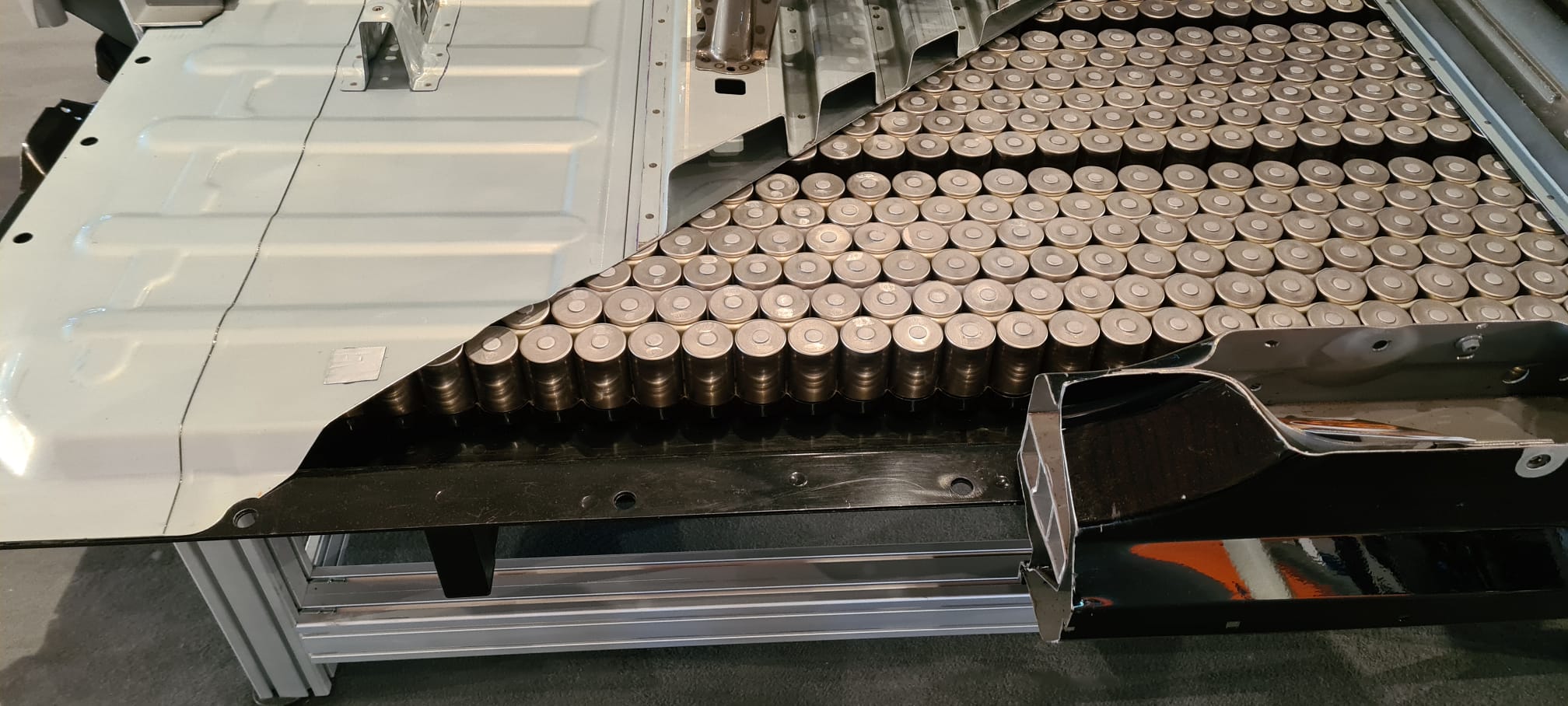
Tesla’s long-awaited dry electrode battery technology appears to have crossed a major milestone. Over the weekend, CEO Elon Musk confirmed that Tesla has successfully made the dry electrode manufacturing process work at scale—an achievement widely viewed as one of the most difficult challenges in lithium-ion battery production, and one that could significantly lower battery costs.
Making the dry electrode process work at scale, which is a major breakthrough in lithium battery production technology, was incredibly difficult.
— Elon Musk (@elonmusk) February 1, 2026
Congratulations to the @Tesla engineering, production and supply chain teams and our strategic partner suppliers for this excellent…
The comment came in response to the publication of a new patent continuation that reveals how Tesla is protecting not just battery performance, but the manufacturing process itself. Rather than focusing solely on chemistry, Tesla is patenting the precise sequence of steps, material constraints, and production methods required to make dry electrodes viable at industrial volumes.
Why Dry Electrodes Are a Big Deal
Traditional lithium-ion battery production relies on wet slurry manufacturing, which mixes active materials with toxic solvents before coating them onto metal foil. These solvents must then be baked out using massive drying ovens—an expensive, energy-intensive step that dominates both factory space and operating costs.
Tesla’s dry electrode process eliminates those solvents entirely. By forming electrodes directly from dry powders, Tesla can remove entire sections of the production line. The result is a battery manufacturing process that is cheaper, faster, and far more compact.
According to details outlined in the patent and reinforced by Musk’s comments, the advantages are significant:
- Lower production costs: Eliminating solvents and large drying ovens reduces energy consumption, capital expenditures, and ongoing operating costs.
- Smaller factories: Without long drying tunnels, battery lines can fit into tighter spaces, enabling higher output per square metre and easier factory expansion.
- Higher energy density: Tesla’s process uses extremely low binder content—reported as low as 1.25%—leaving more room for active materials that actually store energy, translating directly into longer driving range.
- Longer battery life: Gentle, nondestructive mixing preserves particle integrity, supporting long cycle life, with examples showing around 90% capacity retention after 2,000 charge cycles.
- Faster throughput: The process forms self-supporting electrode sheets in just a few calendering passes, increasing line speed and overall output.
An Advantage Competitors Can’t Copy
What makes this development especially important is Tesla’s decision to patent the method, not just the result. The filing defines strict rules around particle size, binder type, carbon content, and the order of mixing operations. Together, these constraints make it extremely difficult for competitors to replicate Tesla’s most efficient version of dry electrode manufacturing without running into patent barriers.
Even if rivals understand the chemistry, they may be forced into slower, more expensive processes that can’t match Tesla’s cost structure or scale.
What This Means
By cutting battery production costs while improving performance and longevity, Tesla’s dry electrode breakthrough could directly impact vehicle pricing and competitiveness. Cheaper batteries open the door to lower-priced EVs (but will Tesla develop them?), better margins, or both.
The benefits extend beyond electric vehicles (EVs). The simplified process is also well-suited to Tesla’s fast-growing grid-scale energy storage business, where cost per kilowatt-hour and manufacturing speed are critical.
Related Stories:
• Tesla aiming to implement 4680 with dry electrodes by the end of the year: Report
• Tesla’s 4680 Model Y is making a return
• Tesla sells Maxwell Technologies two years after acquiring it, but maintains dry electrode technology

Always get the latest - make Drive Tesla your preferred source on Google
Are you buying a Tesla? If you enjoy our content and we helped in your decision, use our referral link to get three months of Full Self-Driving (FSD).Drive Tesla uses affiliate links, which means we may earn a commission if you make a purchase through them, at no additional cost to you. Thank you for your support.