Tesla’s performance in Europe remains under pressure to start 2026, with new registration data showing the automaker trailing fast-growing competitors despite continued expansion of the region’s electric vehicle (EV) market.
According to figures released by the European Automobile Manufacturers’ Association (ACEA), Tesla registered 8,075 vehicles across Europe in January. That represents a 17% decline compared to the same period last year and marks the company’s 13th consecutive month of year-over-year (YoY) sales declines in the region.
Tesla’s market share also slipped to 0.8%, down from 1.0% a year ago and significantly lower than the 3.0% share it achieved just one month earlier in December 2025.
EV Market Growing — But Tesla Losing Momentum
The downturn comes despite continued growth in EV adoption across Europe. Overall vehicle registrations fell 3.5% YoY in January, but battery electric vehicles (BEVs) moved in the opposite direction.
BEVs accounted for 19.3% of all new EU vehicle registrations during the month, up from 14.9% a year earlier, with total EV registrations increasing by nearly 14%. Plug-in hybrids also posted strong gains, while gas and diesel vehicles continued to decline sharply.
Most notably, Chinese automaker BYD, which could soon be selling its EVs in Canada, registered 18,242 vehicles in January, more than double Tesla’s total. That figure represents a massive 165% year-over-year increase and pushed BYD’s regional market share to 1.9%.
Product Strategy and Market Pressures
Several factors appear to be contributing to Tesla’s softer performance in Europe. Unlike many rivals, Tesla sells only fully electric vehicles, while competitors such as BYD offer a mix of BEVs and plug-in hybrids that appeal to buyers transitioning away from combustion vehicles.
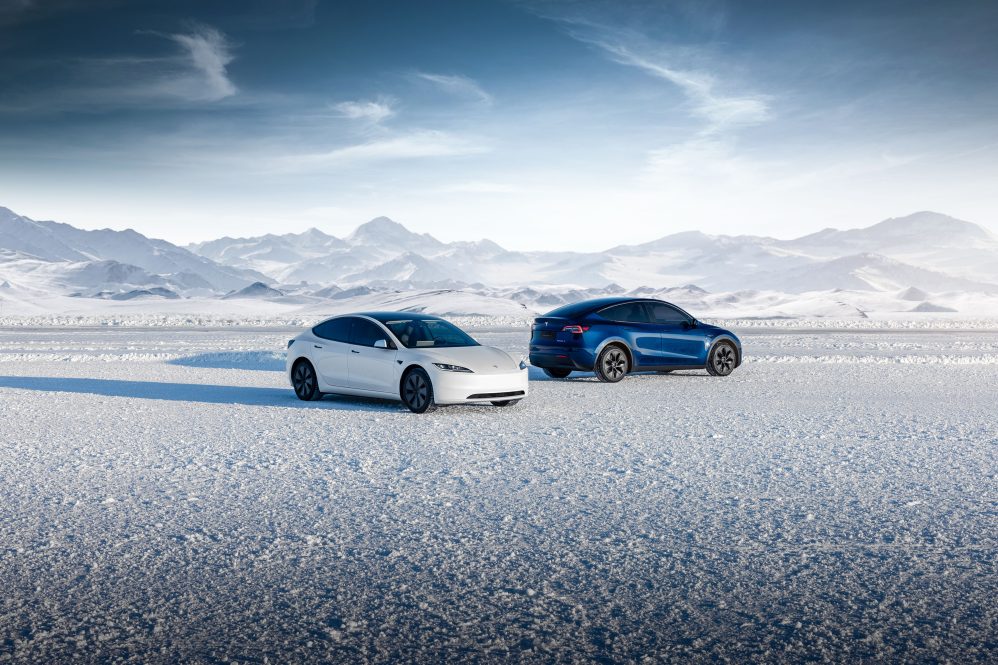
At the same time, Tesla’s lineup in Europe is mostly comprised of just two models, the Model 3 and Model Y, which continues to carry the bulk of sales while lower-cost competitors enter the market.
The EU-only data shows a similar trend. Tesla registrations dipped slightly by 1.6% to 7,187 units in January, maintaining a 0.9% share of the market, while BYD surged 175% during the same period.
Globally, the contrast has also emerged in annual results, with BYD’s pure EV sales growing nearly 28% in 2025 while Tesla’s declined by roughly 8.5%.