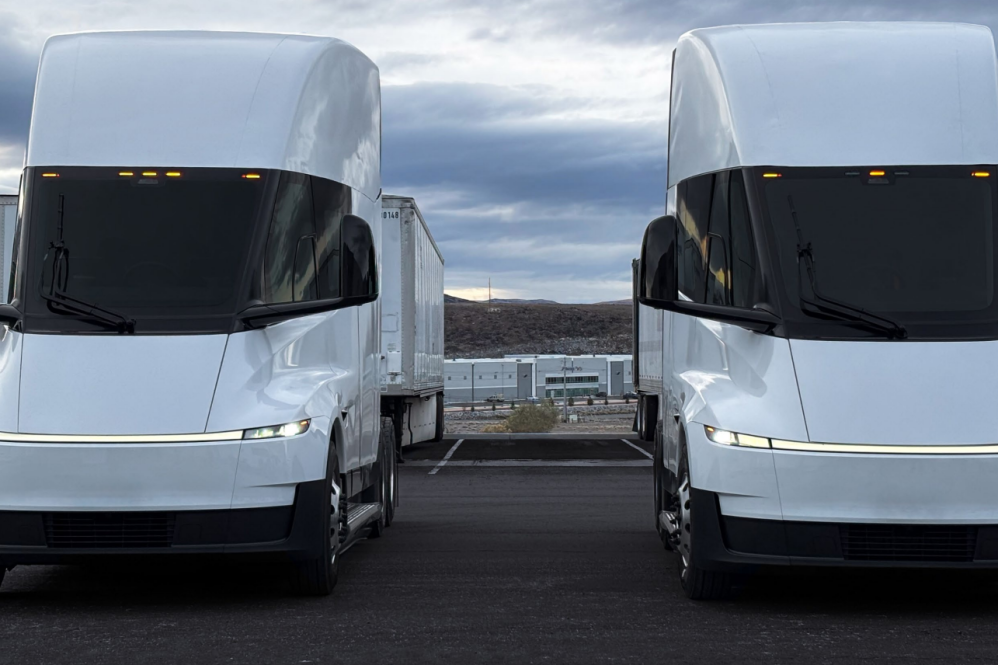
Tesla has officially revealed the final production specifications for its long-awaited Semi truck. The updated specs, published on Tesla’s Semi website, confirm major changes from the original 2017 prototype have made it into production.
One of the most important announcements is confirmation that the Tesla Semi will come in two variants—Standard Range and Long Range—capable of traveling 325 miles (523 km) and 500 miles (805 km) respectively, even while carrying the maximum legal gross combination weight of 82,000 lbs permitted on U.S. highways without special permits.
Tri-Motor Powertrain
One of the most significant changes between the prototype and production model is the shift to a tri-motor configuration.
When Tesla first unveiled the Semi in 2017, the prototype used four motors—two on each rear axle—derived from the Model 3. This setup was designed to maximize redundancy and torque. However, as we have known for some time, the production version now uses three independent motors on the rear axles, likely based on Tesla’s high-performance Plaid architecture.
This tri-motor system enables a more efficient operating strategy. One motor can handle steady highway cruising, while the additional motors engage only when needed for acceleration, hill climbs, or heavy loads. The result is reduced complexity, lower weight, and improved efficiency, without compromising the truck’s ability to haul full payloads.
Tesla lists total drive power at up to 800 kW, equivalent to roughly 1,073 horsepower—far exceeding conventional diesel semi-trucks.
Charging Performance
Tesla has also finalized charging specifications, confirming compatibility with the Megawatt Charging System (MCS 3.2) standard.
Both versions of the Semi can recover up to 60% of their range in 30 minutes. For the Long Range model, that translates to approximately 300 miles (483 km) of driving range added during a half-hour charging session. The Long Range version supports peak charging speeds of up to 1.2 megawatts (1,200 kW), as shown in a recently released video.
While Tesla previously claimed the Semi could add 400 miles (643 km) of range in 30 minutes, the updated figures likely reflect real-world thermal management and charging curve limitations associated with megawatt-level charging.
Weight and Efficiency
Tesla has also disclosed curb weights for the first time, addressing one of the most important aspects of electric trucking.
The Standard Range model weighs less than 20,000 lbs, while the Long Range version comes in at approximately 23,000 lbs, in line with many typical diesel Class 8 trucks.
Efficiency is rated at just 1.7 kWh per mile, even under maximum load conditions—an important metric that directly impacts operating costs for fleet operators.
Built For Autonomy And Fleet Integration
Both Semi trims include support for electric Power Take-Off (ePTO) systems delivering up to 25 kW, allowing the truck to power refrigeration units and auxiliary equipment without diesel engines. Tesla also notes the Semi is “designed for autonomy,” positioning it to take advantage of future Full Self-Driving (FSD) developments for freight operations.
With finalized specs now revealed, Tesla appears poised to officially begin deliveries of the Semi in 2026. Those new Semi trucks will be rolling out of the company’s new dedicated factory in Nevada, which will have a production capacity of 50,000 trucks per year.