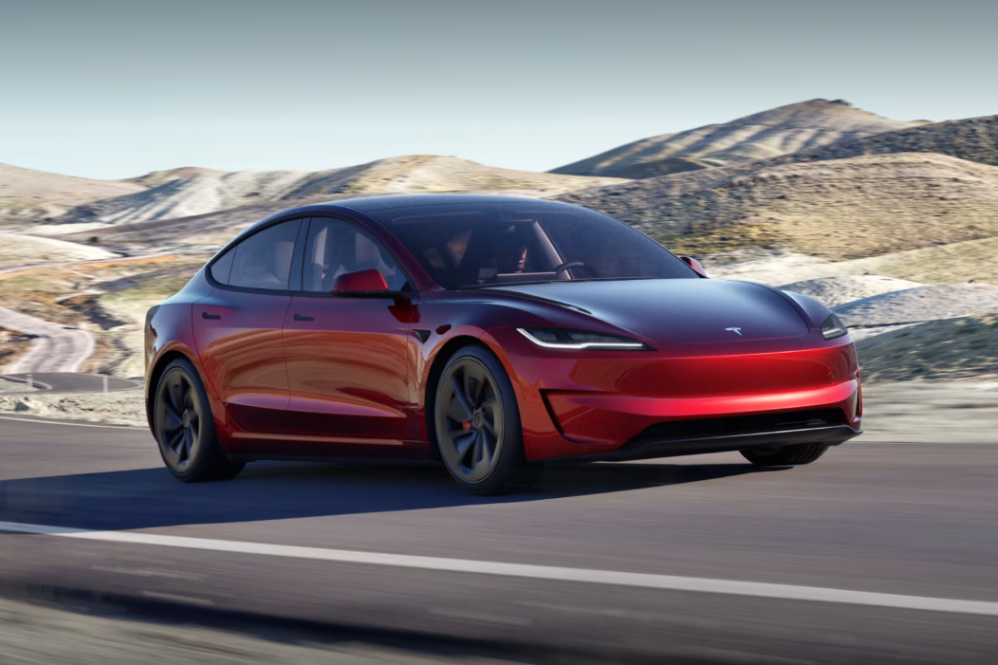
Tesla appears to have quietly upgraded the Model 3’s underlying power electronics, a change that could lay the groundwork for new features like vehicle-to-load (V2L) capability in the future.
Recent updates to Tesla’s service documentation reveal the addition of a new component called PCS2Lite, or Power Conversion System 2 Lite, in newer Model 3 builds. While Tesla has not publicly announced the change, its inclusion in official service manuals suggests the updated hardware is already present in production vehicles.
What is PCS2Lite?
The Power Conversion System is a critical part of any Tesla, responsible for managing how electricity flows between the battery, charging system, and low-voltage components. It handles tasks like converting AC power from the grid into DC energy for the battery, as well as supplying power to the vehicle’s electronics.
The introduction of PCS2Lite represents a simplified, more integrated version of Tesla’s next-generation power electronics, PCS, first introduced on the Tesla Cybertruck. Compared to that system, the ‘lite’ version is likely adapted to suit the Model 3’s different electrical architecture, and as we’ll tell you more about later, also on the Model Y.
Not part of the original Highland launch
Interestingly, there is no evidence that PCS2Lite was included in the initial release of the refreshed Model 3 “Highland” in late 2023. The first confirmed references only appeared in Tesla’s service documentation through an update earlier this month to add a 190-step guide on how to remove and replace the new hardware..
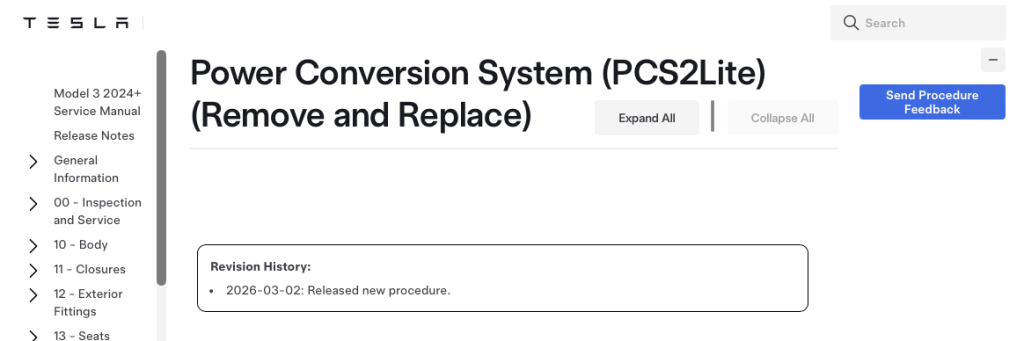
That timing suggests Tesla may have quietly introduced the updated hardware during production in recent weeks, continuing its well-known strategy of rolling out incremental improvements without formal announcements or model year changes.
Not the first Tesla with PCS2Lite
The addition of PCS2Lite to the Model 3 is not an isolated change. Similar updates have surfaced in Tesla’s Model Y documentation, with some variants such as the Performance and Model Y L already supporting vehicle-to-load (V2L) functionality.
But those Model Y variants weren’t the first Tesla’s to get V2L support. That was the Cybertruck, which debuted the company’s next-generation Power Conversion System (PCS2), enabling bidirectional power capabilities like powering external devices, charging other electric vehicles, and even supplying energy to a home through its Powershare functionality. Unlike PCS2Lite in the Model 3 and Model Y, the Cybertruck uses the full PCS2 architecture alongside a more advanced 48V low-voltage system.
While the Model 3 and Model Y still operate on a 400-volt architecture—unlike the Cybertruck’s more advanced system—the introduction of PCS2Lite indicates Tesla is bringing key aspects of that newer technology to its mass-market lineup in a more cost-effective and scalable form, though not across all trims just yet.
Could this enable V2L?
Tesla has yet to offer V2L functionality on the Model 3, and as we’ve mentioned, it is only currently available on the Cybertruck, Model Y Performance, and Model Y L. However, enabling V2L requires more than just software—it depends heavily on the vehicle’s power conversion hardware.
With PCS2 and PCS2Lite already appearing in Tesla’s only vehicles that support V2L, the company may be laying the groundwork for bidirectional energy capabilities for the Model 3 with this latest addition, even if they are not immediately activated. At a minimum, the updated system could provide the flexibility needed to support external power output through a future software update.
This would follow a familiar pattern where Tesla quietly introduces new hardware, then unlock new features later. If past rollouts are any indication, V2L would likely debut on the Model 3 Performance.