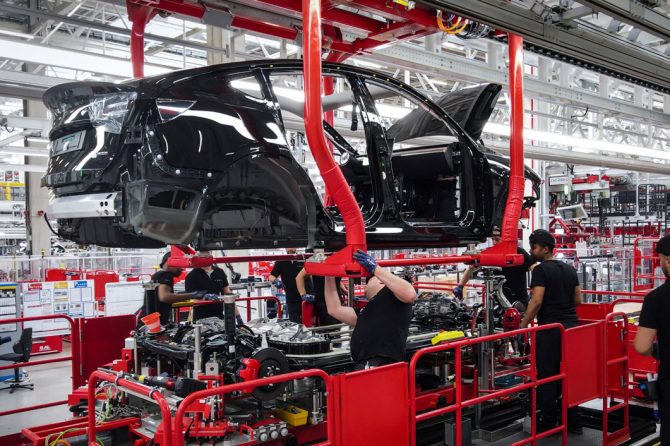
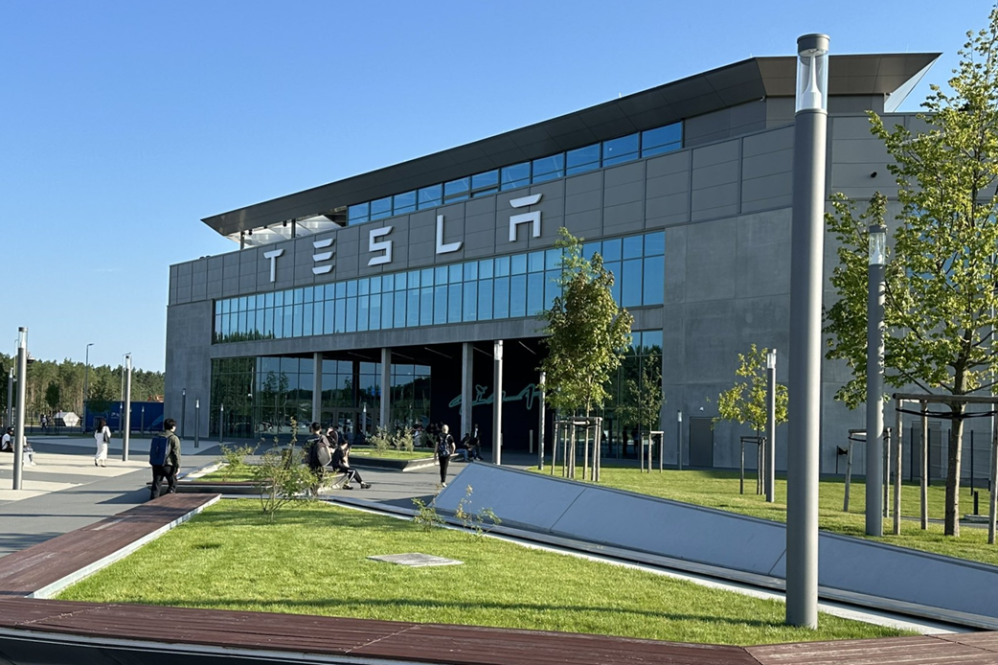
Tesla’s Gigafactory Berlin is facing renewed labour tensions as Germany’s largest industrial union ramps up pressure on the automaker to adopt a collective bargaining agreement and shorten the workweek, setting the stage for a high-stakes clash over how Tesla operates in Europe.
The dispute centers on Tesla’s factory in Grünheide, where IG Metall is pushing for higher wages aligned with traditional German automakers and a shift to a 35-hour workweek. Tesla, however, is firmly resisting both demands, arguing that its current compensation structure already outpaces industry norms and that rigid labour agreements would undermine the site’s competitiveness.
Plant manager André Thierig has drawn a clear line on the issue of working hours, framing the debate as an existential one for the factory’s future direction.
“The discussion about a 35-hour week is a red line for me. We will not cross it,” Thierig said in an interview with the DPA news agency. “(The election) will determine whether we can continue our successful path in the future in an independent, flexible, and unbureaucratic manner. Personally, I cannot imagine that the decision-makers in the USA will continue to push ahead with the factory expansion if the election results favor IG Metall.”
Tesla’s position is built around pay growth rather than formal collective agreements. According to Thierig, workers at Giga Berlin recently received 4% wage increases, an amount that exceeds those negotiated elsewhere in Germany’s auto sector.
“There was a pay increase of two percent in the relevant collective agreement this year,” he said. “Because we are in a different economic situation than the entire industry, we were able to raise wages by twice as much – by four percent. Since the start of production, there has been a pay increase of more than 25 percent in less than four years.”
IG Metall strongly disputes Tesla’s framing, arguing that without a collective agreement, employees remain at a long-term disadvantage compared to peers at other German car plants.
“Without a collective agreement, pay at Tesla will remain well below the level in other car plants in Germany,” said Jan Otto, the union’s district manager for Berlin-Brandenburg-Saxony. “The Tesla management is badmouthing the collective agreement by using its lowest pay group. In automotive plants, however, the lowest two pay groups are not assigned at all.”
The tension is unlikely to fade anytime soon. A works council election scheduled for 2026 could reshape labour dynamics at the site, and Thierig has made it clear he views the outcome as pivotal. In the previous election held in 2024, IG Metall emerged as the largest single faction, but non-union representatives ultimately secured a majority of seats.
Related Stories:
• Tesla boosts battery production efforts at Giga Berlin
• Tesla gives Giga Berlin employees a 4% pay raise
• Tesla celebrates one year without wastewater discharge at Giga Berlin