Tesla has officially completed stress testing and fully opened its massive Oasis Supercharger in Lost Hills, California, cementing the site as the largest Tesla charging station in the world—and one of the most ambitious energy projects the company has ever built.
Ahead of the holiday travel season, Tesla invited local owners to participate in a live resiliency and capacity stress test on December 17, offering free charging, snacks, and small thank-you gifts. During the one-hour test window, the site successfully delivered 7.5 MW of real-world charging load, validating the system’s ability to handle extreme demand.
Tesla Charging described the test as part of its efforts to prepare the site for peak traffic while ensuring reliability and redundancy.
The Worlds Largest Tesla Supercharger is officially open!
— Zack (@BLKMDL3) December 17, 2025
Tesla Oasis is the worlds first majority off grid charger featuring 10 Tesla Megapacks and 11 MW Solar, allowing 15.8MW of total peak usage and battery storage.
This site has 164 stalls including 12 towing stalls,… pic.twitter.com/QdWKLxmWWy
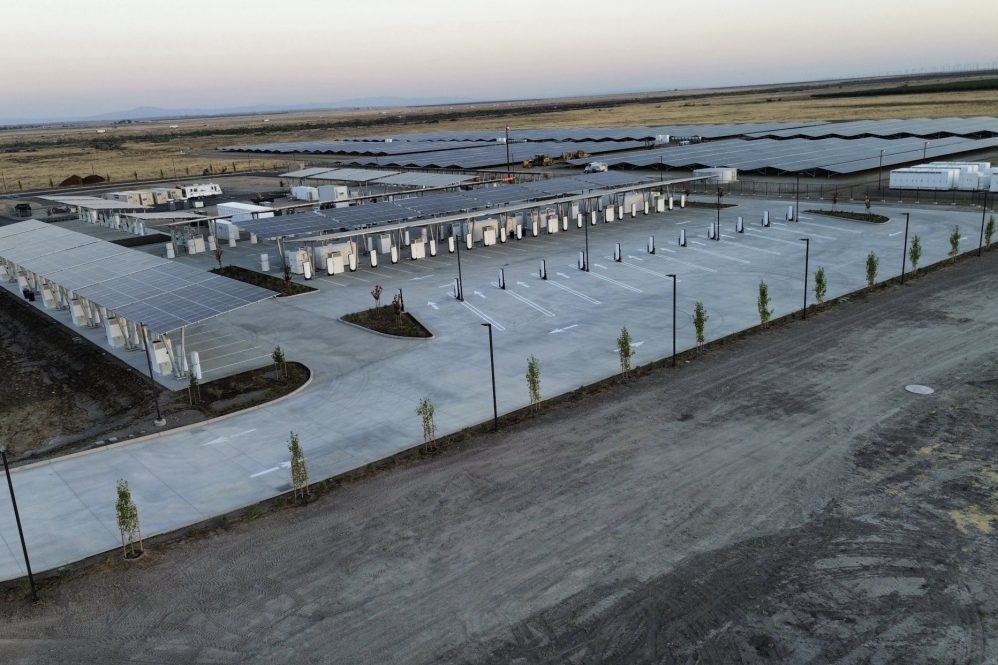
Located just off Interstate 5, a critical corridor for California travel, the Tesla Oasis site now features 164 V4 Supercharger stalls, including 12 pull-through stalls designed for trailers and towing. The station also includes restrooms, a dedicated lounge, seating areas with synthetic grass, and other amenities designed to make long-distance charging more comfortable during peak travel periods.
What truly sets Oasis apart, however, is its energy system. Tesla Oasis is the world’s first majority off-grid Supercharger, powered by 11 megawatts (MW) of on-site solar generation paired with 10 Tesla Megapacks. Together, the system supports up to 15.8 MW of total peak usage and battery-backed capacity, allowing the site to operate independently of the electrical grid.
Tesla first partially opened Oasis in July, just in time for the Fourth of July travel rush. At that time, 84 stalls were operational, while construction continued on the remaining chargers and driver amenities. The project itself moved at remarkable speed—Tesla broke ground in October and brought the site online in stages over roughly eight months, despite its massive scale.
The solar installation spans approximately 30 acres, combining ground-mounted arrays with solar canopies over parking areas. Energy captured during the day is stored in Megapacks with a combined capacity of 39 megawatt-hours (MWh), enabling round-the-clock charging even after sunset or during high-demand periods.