Lucid has quietly reached a major milestone as it looks to expand its lineup beyond the ultra-premium segment. The California-based EV maker has now assembled the first full prototypes of its long-awaited mid-size vehicles, the first of which is planned to launch later this year.
The early builds are taking place at Lucid’s Casa Grande, Arizona facility, where the company currently manufactures the Lucid Air sedan and the newly launched Gravity SUV. The update was shared by Lucid’s Head of Communications, Nick Twork, who said that despite the lower price point, this new line of vehicles will share the same “Lucid DNA as Air and Gravity.”
Spent time in our prototype build area today watching the first full Lucid midsize vehicles come together. Same Lucid DNA as Air and Gravity – space, efficiency, dynamics, and range – paired with dramatically improved manufacturability and cost structure. These are going to… pic.twitter.com/3K4qQ7b3oC
— Nick Twork (@ntwork) January 23, 2026
Lucid has previously confirmed plans to develop not just one, but three mid-size models. The goal is to enter a far more competitive price bracket, with vehicles expected to start around US$50,000. That would place them roughly US$20,000 below the current entry point of the Lucid Air, opening the brand to a much wider audience.
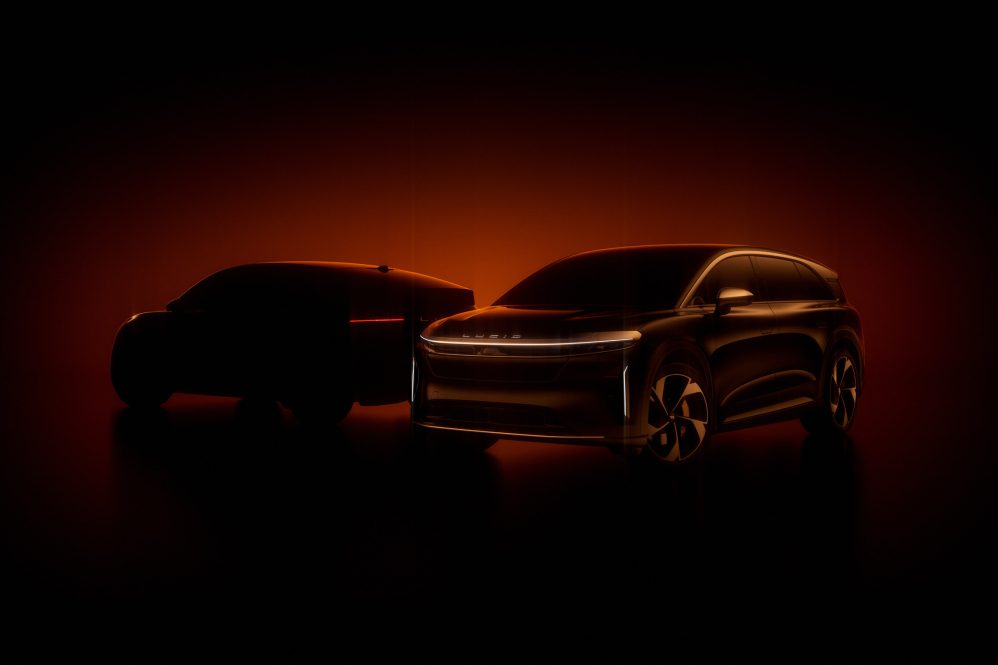
While details remain tightly controlled, previously released teaser images offer subtle hints. Shown in shadow alongside the larger Lucid Gravity above, the vehicle appears more compact, with a noticeably steeper rear window line, similar to Tesla’s Model Y, also seen below. That design choice points toward a five-seat configuration rather than the Gravity’s available three-row layout, reinforcing expectations that this is the first look at Lucid’s mid-size SUV.

With the first mid-size prototypes now assembled, Lucid is moving from long-term planning to reality. The real test will be whether the company can last long enough to deliver its trademark efficiency, range, and performance at a dramatically lower price point—something few EV startups have managed successfully.