
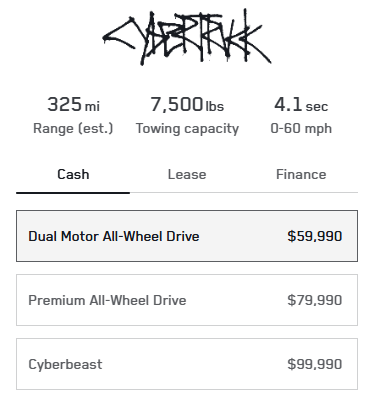
When Tesla unveiled the new $59,990 Dual Motor AWD Cybertruck for the U.S. market earlier this week, it felt like a long-awaited reset moment for the struggling vehicle program. The pricing finally aligned with what many believed should have been the sweet spot all along, and in mayn ways exceeded the original 2019 package.
Then Elon Musk added a curveball, saying a few hours after the announcement that the configuration would be available “only for the next 10 days,” instantly shifting the narrative from excitement to uncertainty.
Now, Musk has offered a bit more clarity.
When asked what the truck would cost after the 10-day window, Musk responded that it “depends on how much demand we see at this price level.” That answer strongly suggests the configuration itself isn’t disappearing. Instead, the $59,990 price appears to be temporary — and subject to increase depending on order volume.
Depends on how much demand we see at this price level
— Elon Musk (@elonmusk) February 20, 2026
Is 10 Days Enough to Test Demand?
If this is truly about measuring demand at $59,990, the bigger question becomes whether a 10-day window is sufficient — especially given how the announcement was delivered.
So far, the messaging has largely lived on X. There has been no broad marketing push, no messaging on Tesla’s website or online configurator about the limited-time price, and of course no traditional advertising blitz. Outside of Tesla’s most engaged followers on X, many mainstream buyers likely have no idea the sub-$60K AWD Cybertruck even exists — let alone that they have a 10-day (now 8) decision window.
That matters, because demand testing only works cleanly when awareness is widespread. A short window, paired with limited distribution of the announcement, risks capturing only the most online, most engaged slice of potential buyers. That’s not necessarily representative of broader market interest.
For a vehicle as polarizing as the Cybertruck, 10 days may be too short a timeframe to accurately gauge sustained market interest.
Urgency Distorts The Picture
As we said before, introducing a time limit also creates urgency. Buyers who were on the fence may feel compelled to act quickly to lock in the $59,990 price. But it also introduces hesitation. Some may wait to see what happens after the window closes rather than rush into a purchase under artificial pressure.
If the goal is to gather clean demand data at this price point, the imposed deadline complicates the equation. Orders during the window could reflect urgency-driven behavior rather than organic demand. Conversely, some buyers may sit out entirely because they don’t trust the stability of the pricing.
Tesla has a long history of dynamic pricing adjustments. That part isn’t new. What is new is openly tying a near-term price change directly to observed demand within such a compressed timeframe.
At this point, the picture is clearer than it was: the most compelling version of the Cybertruck likely isn’t going away — but the $59,990 price might, which is what made it so compelling to begin with. Whether 10 days is enough to determine its true market value remains to be seen.