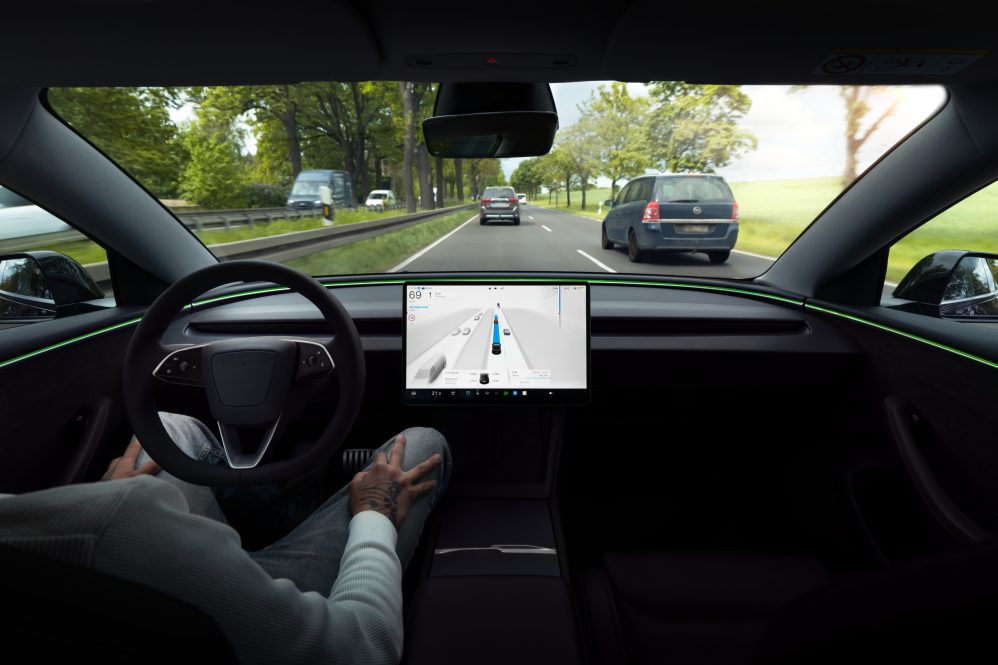
Tesla’s Full Self-Driving (FSD) has recorded a significantly lower collision rate than human-driven Teslas since the system was approved in Belgium this summer, according to new figures presented to the Flemish Parliament.
Flemish Mobility Minister Annick De Ridder shared the results on Thursday. The data, supplied by Tesla as part of the conditions attached to its Belgian approval, covers driving between June 11 and August 31.
Over that period, Tesla vehicles travelled 24.6 million km with FSD engaged. The largest difference was recorded away from highways, where there was one collision across 9.5 million km of assisted driving.
By comparison, manually driven Teslas were involved in 150 collisions over 146.9 million km. Based on those figures, the collision risk was approximately 9.6 times lower when FSD was active.
The difference was smaller on highways but still favoured Tesla’s driver-assistance technology. Four incidents occurred during 15.1 million km with FSD engaged, compared with 32 incidents across 95.1 million km under manual control. That works out to an improvement of roughly 30 percent.
Five accidents involving participating vehicles were reported to the Flemish administration. FSD was inactive in one, although the driver had disengaged it prematurely while exiting a roundabout. Investigators reportedly found no link between FSD and the other four accidents – all were minor, low-speed collisions without injuries. (via HLN)
Tesla’s data also showed 93 percent fewer automatic emergency braking activations and between 82 and 90 percent fewer abrupt manoeuvres, including hard braking and sharp steering inputs.
The figures add to Tesla’s growing European dataset, which was made public earlier this month, as regulators prepare for a broader EU decision on the technology on October 6.
“New technology deserves critical follow-up, but if the data shows that it can make our roads safer, we must also dare to use that potential,” De Ridder said. “It turns out that road safety and innovation can go hand in hand.”
Before receiving approval in June, Tesla completed 5,000 km of testing on Belgian roads in roughly one month. The testing evaluated how FSD responds to infrastructure and driving conditions specific to Belgium, including tram networks, bicycle streets, advisory bike lanes, supplemental signage, and temporary traffic controls in construction zones.
FSD is already approved in five European countries – the Netherlands, Denmark, Belgium, Estonia, and Lithuania – where more than 70,000 customers are using it for over one million km each day.

Always get the latest - make Drive Tesla your preferred source on Google
Are you buying a Tesla? If you enjoy our content and we helped in your decision, use our referral link to get three months of Full Self-Driving (FSD).Drive Tesla uses affiliate links, which means we may earn a commission if you make a purchase through them, at no additional cost to you. Thank you for your support.