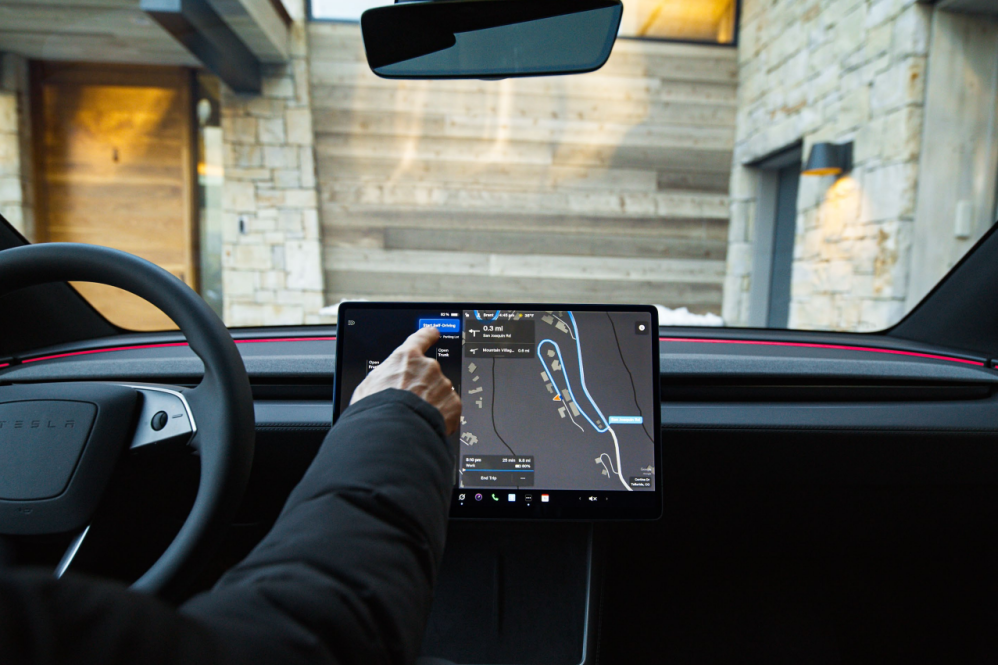
It arrived a few days later than expected, but Tesla has officially begun rolling out its latest Full Self-Driving (Supervised) update, FSD v14.3 for vehicles equipped with HW4/AI4. The update is currently being deployed to early testers, including in Canada.
The update, which is now appearing on customer vehicles through 2026.2.9.6, introduces a wide range of improvements focused on decision-making, perception, and real-world driving behavior. Early indications suggest Tesla is continuing its shift toward more advanced, human-like reasoning rather than relying strictly on pre-mapped data.
We noticed a new Tesla software update 2026.2.9.6 on Model Y RWD LR (2026) in New York, United States. View the rollout of this update here: https://t.co/54dBLNdyQO
— Teslascope (@teslascope) April 7, 2026
According to the release notes, one of the biggest changes in v14.3 is a complete rewrite of Tesla’s AI compiler and runtime using MLIR (Multi-Level Intermediate Representation), which the company says results in a 20% improvement in reaction time while also accelerating how quickly the system can be iterated and improved. That foundational change supports a broader upgrade to the system’s reinforcement learning (RL) training, allowing the neural network to perform better across a wider range of driving scenarios.
Tesla has also enhanced the vehicle’s vision capabilities, upgrading the neural network encoder to better interpret difficult environments. This includes improved performance in low-visibility conditions, stronger 3D spatial understanding, and expanded recognition of traffic signs.
On the road, the improvements are aimed at refining everyday driving behaviour while also tackling edge cases. Tesla says FSD v14.3 is better at responding to emergency vehicles, school buses, and drivers who violate right-of-way rules. It also reduces issues like unnecessary lane positioning and minor tailgating, two behaviors that have been common points of feedback from users.
The update also leans heavily into rare and unpredictable scenarios. Tesla says the system is now better equipped to handle unusual objects encroaching into the driving path, as well as small animals, thanks to training on more challenging real-world examples sourced from the fleet.
Complex intersections are another focus area, with improved handling of multi-light setups, curved roads, and yellow light decisions. At the same time, Tesla has made the system more resilient, allowing it to maintain control and recover automatically from temporary system degradations, reducing unnecessary disengagements.
Parking behavior has also seen noticeable upgrades. The system is now more decisive when selecting parking spots and maneuvering into them, while a new map-based “P” icon improves how parking locations are displayed and predicted.
While not included in this release, Tesla has outlined several features still in development, including expanding reasoning capabilities beyond navigation tasks, adding pothole avoidance, and improving driver monitoring through more accurate eye-tracking and better performance in varying lighting conditions.
As with all FSD releases, rollout will likely be gradual, first appearing for early testers, and if all goes well, a wider deployment within the next few weeks.
Here are the full 2026.2.9.6 release notes.
Full Self-Driving (Supervised) v14.3
Full Self-Driving (Supervised) v14.3 includes:
- Upgraded the Reinforcement Learning (RL) stage of training the FSD neural network, resulting in improvements in a wide variety of driving scenarios.
- Upgraded the neural network vision encoder, improving understanding in rare and low-visibility scenarios, strengthening 3D geometry understanding, and expanding traffic sign understanding.
- Rewrote the AI compiler and runtime from the ground up with MLIR, resulting in 20% faster reaction time and improving model iteration speed.
- Mitigated unnecessary lane biasing and minor tailgating behaviors.
- Increased decisiveness of parking spot selection and maneuvering.
- Improved parking location pin prediction, now shown on a map with a P icon.
- Enhanced response to emergency vehicles, school buses, right-of-way violators, and other rare vehicles.
- Improved handling of small animals by focusing RL training on harder examples and adding rewards for better proactive safety.
- Improved traffic light handling at complex intersections with compound lights, curved roads, and yellow light stopping — driven by training on hard RL examples sourced from the Tesla fleet.
- Improved handling for rare and unusual objects extending, hanging, or leaning into the vehicle path by sourcing infrequent events from the fleet.
- Improved handling of temporary system degradations by maintaining control and automatically recovering without driver intervention, reducing unnecessary disengagements.
Upcoming Improvements
- Expand reasoning to all behaviors beyond destination handling.
- Add pothole avoidance.
- Improve driver monitoring system sensitivity with better eye gaze tracking, eye wear handling, and higher accuracy in variable lighting conditions.

Always get the latest - make Drive Tesla your preferred source on Google
Are you buying a Tesla? If you enjoy our content and we helped in your decision, use our referral link to get three months of Full Self-Driving (FSD).Drive Tesla uses affiliate links, which means we may earn a commission if you make a purchase through them, at no additional cost to you. Thank you for your support.