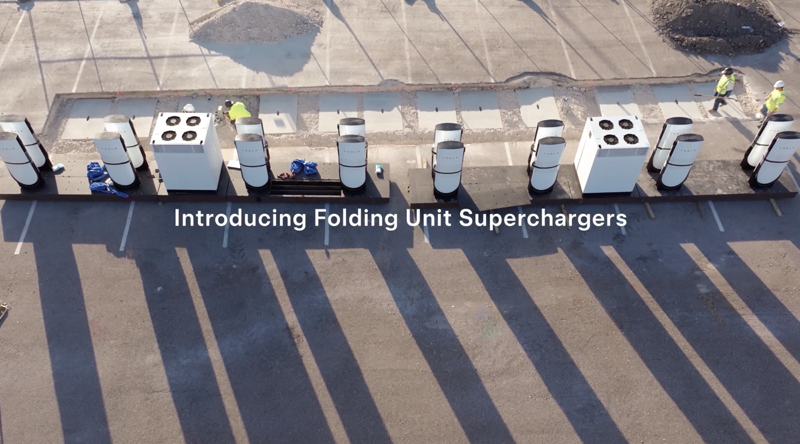
Tesla is rethinking how its Supercharger network is built. After first introducing Prefabricated Supercharger Units (PSUs) the company has taken it to the next level, introducing a new “Folding Unit” Supercharger.
The new design focuses on reducing installation time, cutting costs, and simplifying deployment even further—key factors as Tesla works to rapidly expand charging infrastructure to support growing EV adoption.
Announced by Tesla’s charging team on X, the new system combines several advancements into a more modular and transport-friendly package. Each Folding Unit features a V4 cabinet capable of delivering up to 500kW, paired with eight charging posts per unit, twice the number of stalls compared to PSUs.
Two of these units can be transported on a single truck, allowing Tesla to deploy up to 16 Supercharger stalls in one shipment—up from the previous limit of 12. They can be installed as-is in a back-to-back configuration, or unfolded into a side-by-side layout with all 16 Supercharger posts in a single row.
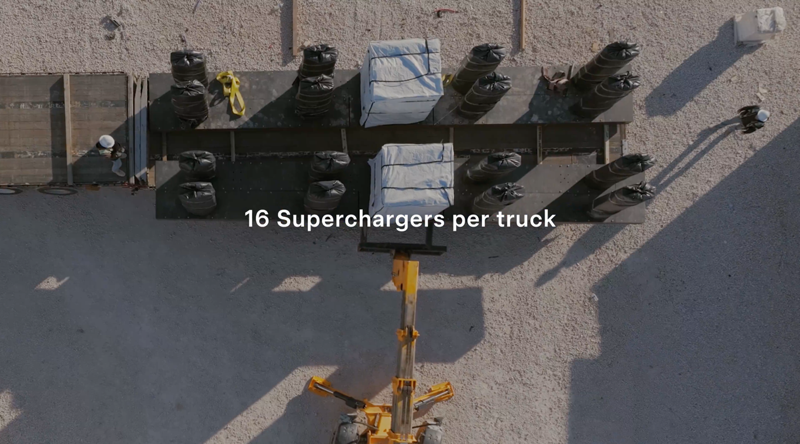
Like its PSUs, Tesla says the Folding Unit design reduces the amount of civil and electrical work required during installation, which has historically been one of the most time-consuming and expensive parts of building new charging stations.
According to Max de Zegher, Tesla’s Director of Charging for North America, these improvements translate into more than 20% cost savings and allow sites to be deployed twice as fast.
“Our FU Superchargers (Folding Unit) save 20%+ on cost, improve build quality, and deploy 2X faster,” de Zegher explained. “The majority of cost savings are in civil, electrical and logistics cost.”
Introducing Folding Unit Superchargers
— Tesla Charging (@TeslaCharging) March 25, 2026
– V4 cabinet with 500kW charging
– 8 posts per unit
– 2 units per truck
– 2 configurations: folded, unfolded
Faster. Cheaper. Better. pic.twitter.com/YyALz0U5cA
By shifting more of the assembly process off-site, Tesla is also reducing the need for specialized labour during installation. The company notes that the new system eliminates the need for DC busbar connections on-site and removes the requirement for Tesla service technicians during commissioning. This streamlined process not only accelerates timelines but could also improve consistency and quality across installations.
Logistics is another area where the new design shines. Packing more stalls per truck reduces transportation costs, to the point where Tesla says shipping fully assembled units is now cheaper than building stations using traditional methods.
The Folding Unit Superchargers are launching as a first-generation product, but Tesla is already looking ahead. “This is just Rev1, we’ll have Rev3 by next quarter. Every little improvement matters for the scale needed for 100% EV adoption,” de Zegher added.

Always get the latest - make Drive Tesla your preferred source on Google
Are you buying a Tesla? If you enjoy our content and we helped in your decision, use our referral link to get three months of Full Self-Driving (FSD).Drive Tesla uses affiliate links, which means we may earn a commission if you make a purchase through them, at no additional cost to you. Thank you for your support.