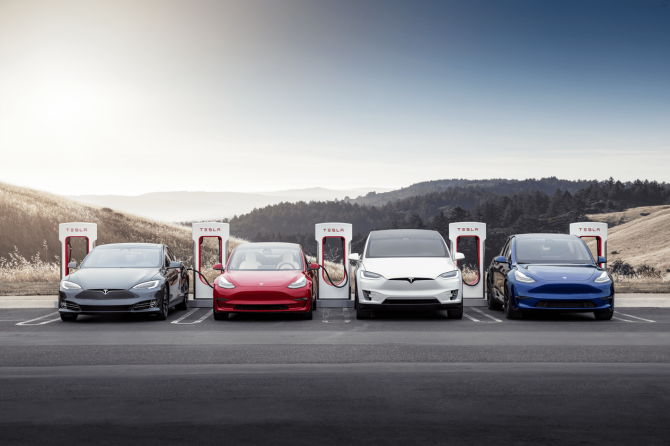

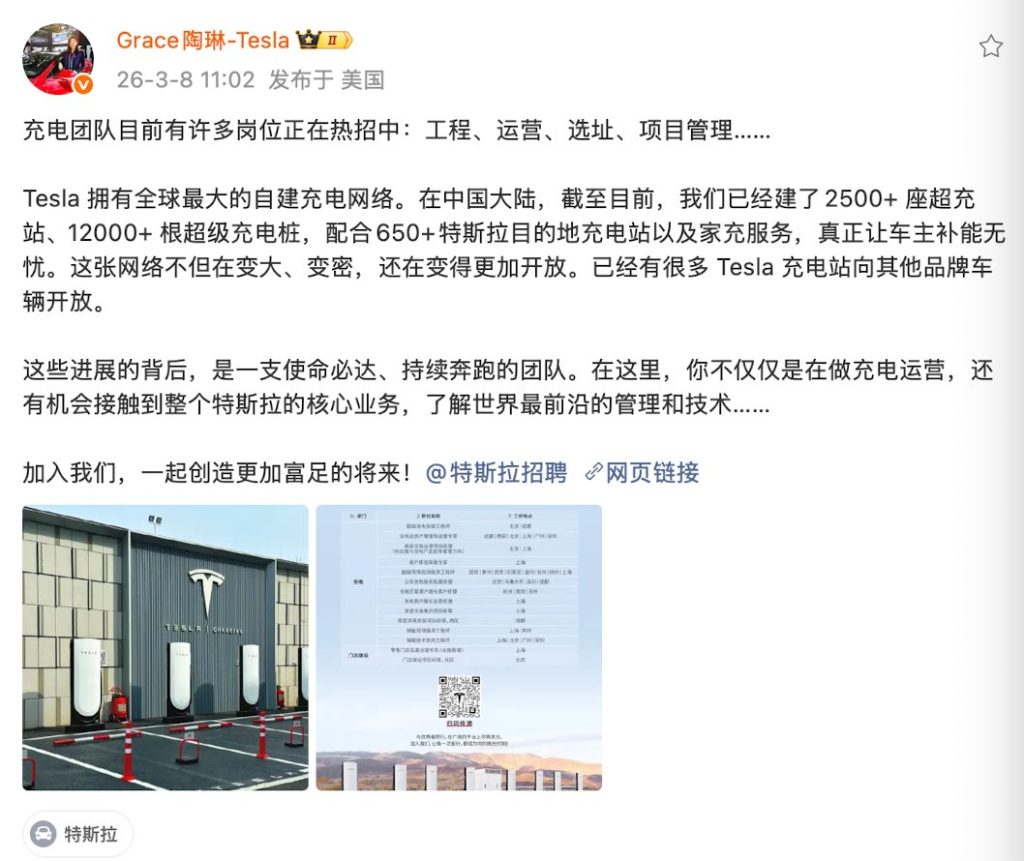
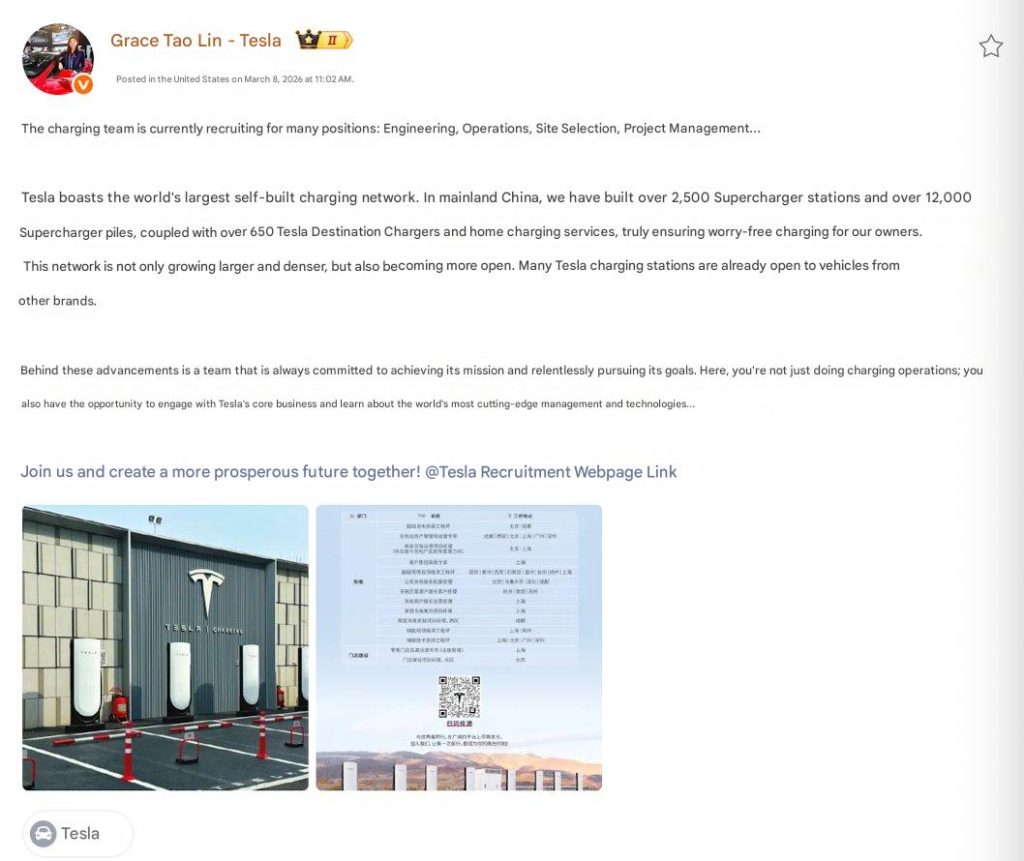
Tesla’s charging network in China keeps growing, as the latest update shows Tesla has now deployed more than 2,500 Supercharger stations across mainland China.
The milestone was shared by Tesla Vice President Grace Tao in a recent post on Weibo, highlighting the continued buildout of the company’s energy ecosystem in the region, while also encouraging people to apply to join Tesla China’s charging team.
According to Tao, Tesla’s Supercharging network has expanded significantly since entering the Chinese market, with more than 12,000 individual Supercharger stalls now operating nationwide.
In addition to its fast-charging network, Tesla has also developed a broader charging ecosystem designed to support drivers both on long-distance trips and at everyday destinations. The company has installed over 650 Destination Charging locations across China, typically placed at hotels, office buildings, and shopping centers where vehicles can charge while parked for longer periods.
Together with home charging solutions, Tao says this combination forms a comprehensive infrastructure network aimed at making EV ownership more convenient for drivers across the country.
Tesla has also begun introducing its latest generation V4 Superchargers in China. The rollout started in mid-2025 and has already reached several cities and regions, including Shanghai, Gansu, Zhejiang, and Chongqing.
The V4 system represents a major upgrade over the previous V3 generation, support charging speeds of up to 500 kW for passenger vehicles and as much as 1.2 MW for the Tesla Semi. However, Tesla has not yet installed the supporting V4 cabinets in China that unlock these higher charging speeds.
While not yet deployed in China, and while most passenger vehicles currently charging at lower peak rates, the V4 hardware still offers notable improvements in terms of hardware to improve compatibility with other electric vehicles (EVs). The V4 Supercharger units feature longer charging cables and CCS connectors, allowing non-Tesla EVs to plug in directly without adapters. Some stations also include integrated payment terminals, making it easier for drivers of other brands to access the network.
The company has gradually opened parts of its Supercharger network in China to other EV manufacturers, a move that mirrors similar expansions in North America and Europe.

Always get the latest - make Drive Tesla your preferred source on Google
Are you buying a Tesla? If you enjoy our content and we helped in your decision, use our referral link to get three months of Full Self-Driving (FSD).