
SpaceX has quietly changed how some customers can use its Starlink satellite internet service, disabling in-motion connectivity for subscribers on the ultra-cheap $5 per month Standby Mode plan.
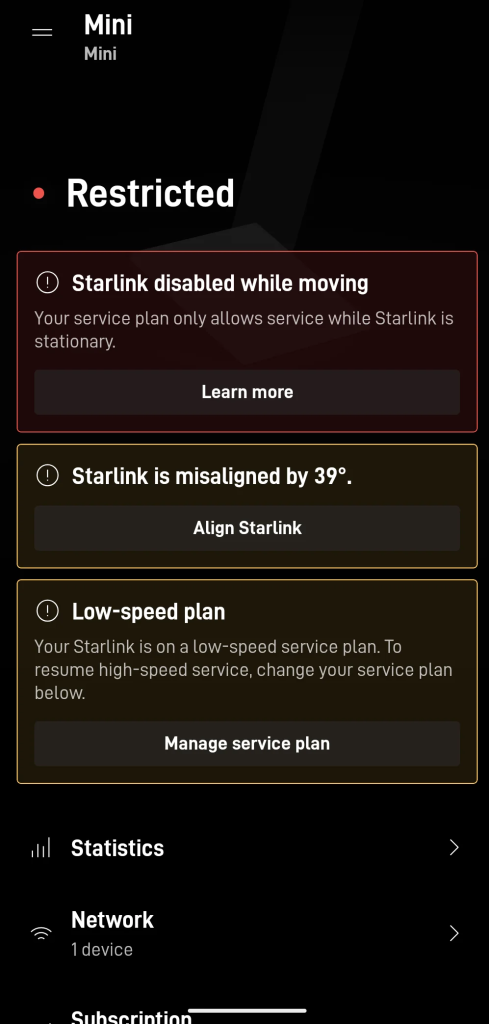
The change began appearing late last week, when users reported seeing a new warning in the Starlink mobile app reading “Starlink Disabled while moving.” The message appears when the system detects motion while the account is using the Standby plan.
While the change was not formally announced, Starlink has updated its support documentation to clarify the restriction, stating: “Pausing your service with Standby Mode is not intended for in-motion use.” (via Reddit)
Standby Mode was introduced last year as a way for customers to temporarily pause their primary Starlink subscription without fully canceling service. For $5 per month, users could keep their hardware active and still access the network with unlimited data, although speeds were capped at just 500 Kbps.
Those speeds are far slower than Starlink’s standard plans, but they were often sufficient for basic tasks such as messaging, navigation updates, and light web browsing.
That limitation didn’t stop users from discovering a creative workaround. When paired with the compact Starlink Mini dish, the low-cost plan became a surprisingly useful option for travelers driving through areas without cellular coverage. The setup gained popularity among road-trippers, RV owners, and even Tesla drivers looking for backup connectivity in remote locations.
With the latest update, that workaround appears to be over. When the dish detects movement while on Standby Mode, the connection is now automatically disabled.
Roam Plans Now Required for Mobile Use
Customers who want to continue using Starlink while driving will now need to upgrade to one of the company’s mobile service tiers.
The lowest-priced option is the Roam plan, which starts at $50 per month. These plans are designed specifically for mobile connectivity and allow Starlink hardware to remain connected while vehicles are in motion.
The change effectively shifts travelers who previously relied on the $5 standby option into higher-priced mobility subscriptions.
New Speed Limits for Mobile Connectivity
The restrictions don’t stop there. SpaceX has also introduced a speed-based limitation on standard mobile plans.
Starlink now enforces a 100 mph (about 160 km/h) maximum speed limit for in-motion connectivity on both Roam and Priority plans. If the system detects speeds beyond that threshold, service will be disabled.
The cap primarily affects small aircraft owners and private pilots who had been using consumer Starlink hardware during flights.
To accommodate those users, SpaceX has introduced new aviation-specific subscription tiers. These include an Aviation 300 mph plan priced at $250 per month and a faster Aviation 450 mph plan that costs $1,000 per month.
Mixed reaction from customers
The sudden changes have sparked debate across online forums and social media, with some users suggesting the low-cost plan had simply become too popular for its intended purpose.
Others expressed disappointment, noting that Standby Mode had become a convenient emergency connectivity option during long drives through cellular dead zones.
For now, the plan still functions exactly as before when the dish is stationary. But for travelers hoping to stay connected while on the move, the days of doing so for $5 per month appear to be over.

Always get the latest - make Drive Tesla your preferred source on Google
Are you buying a Tesla? If you enjoy our content and we helped in your decision, use our referral link to get three months of Full Self-Driving (FSD).