

Tesla has taken a notable step toward greater transparency by publishing its company-compiled delivery consensus directly on its Investor Relations website for the first time. Previously this information was only shared within the company and some institutional analysts and major investors, but it still usually made its way out into the public view. Now it has been posted publicly for everyday investors.
According to the company compiled consensus, posted to Tesla’s Investor Relations website, analysts expect Tesla to deliver 422,850 vehicles in Q4 2025, alongside 13.4 GWh of energy storage deployments during the quarter. While Tesla is careful to note that it does not endorse these analyst opinions or conclusions, the company’s decision to host the data itself marks a meaningful shift in how this information is distributed.
A Clearer View Into Expectations
The Q4 2025 delivery estimate represents a sequential decline from Q3 2025’s actual total of 497,099 vehicles, which is consistent with historical seasonality and production balancing late in the year. Of the expected Q4 deliveries, 388,002 units are forecast to come from the Model 3 and Model Y, while 34,848 vehicles are projected from Tesla’s other models, a seemingly high figure that includes the Model S, Model X, and Cybertruck, which have averaged around 12,500 deliveries over the last three quarters.
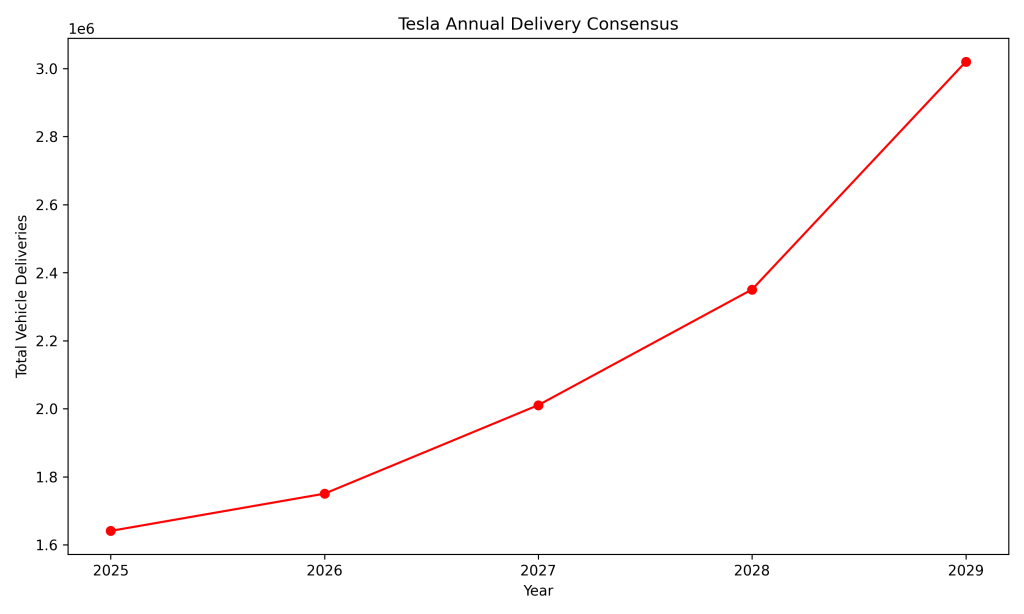
For the full year 2025, analysts collectively estimate 1.64 million total deliveries, a dip from the 1.79 million and 1.81 million delivered in 2024 and 2023 respectively.
Tesla also included forward-looking estimates. The consensus outlook climbs to 1.75 million vehicles in 2026, just over 2.0 million in 2027, and more than 3.0 million annually by 2029.
Energy Storage Continues To Shine
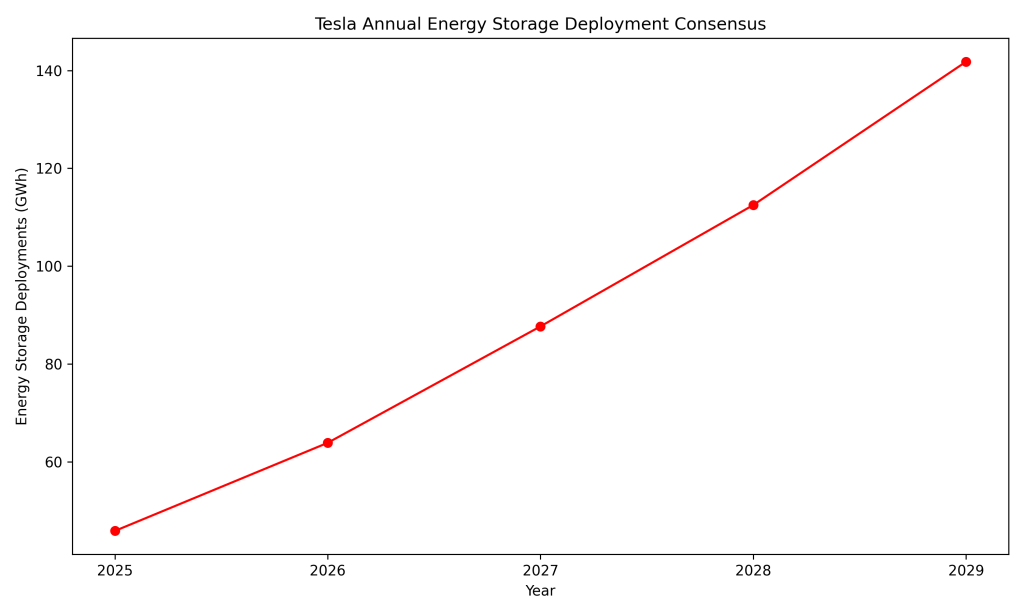
Beyond vehicles, Tesla’s energy business remains a key bright spot. Analysts expect 45.9 GWh of energy storage deployments in 2025, rising sharply to 63.9 GWh in 2026 and 87.7 GWh in 2027, with long-term estimates reaching 141.8 GWh by 2029.
This steady upward trend highlights the growing importance of Megapack and Powerwall deployments as grid-scale storage demand increases worldwide.
Will This Continue?
Until now, Tesla’s delivery expectations were affected by information asymmetry, where institutional investors and analysts had access to compiled consensus data through private platforms, while retail investors relied on scattered estimates shared after the fact. That often led to confusion about which numbers reflected true market consensus versus individual analyst opinions.
By publishing its company-compiled delivery consensus directly on its investor relations website, Tesla reduces that imbalance and gives all investors access to the same baseline expectations at the same time. The added context—such as the number of estimates, median values, and standard deviation—also helps investors better understand both the consensus itself and the level of agreement behind it.
It’s a small change with meaningful implications for transparency, and one that will become a regular fixture of Tesla’s investor communications going forward.

Always get the latest - make Drive Tesla your preferred source on Google
Are you buying a Tesla? If you enjoy our content and we helped in your decision, use our referral link to get three months of Full Self-Driving (FSD).Drive Tesla uses affiliate links, which means we may earn a commission if you make a purchase through them, at no additional cost to you. Thank you for your support.