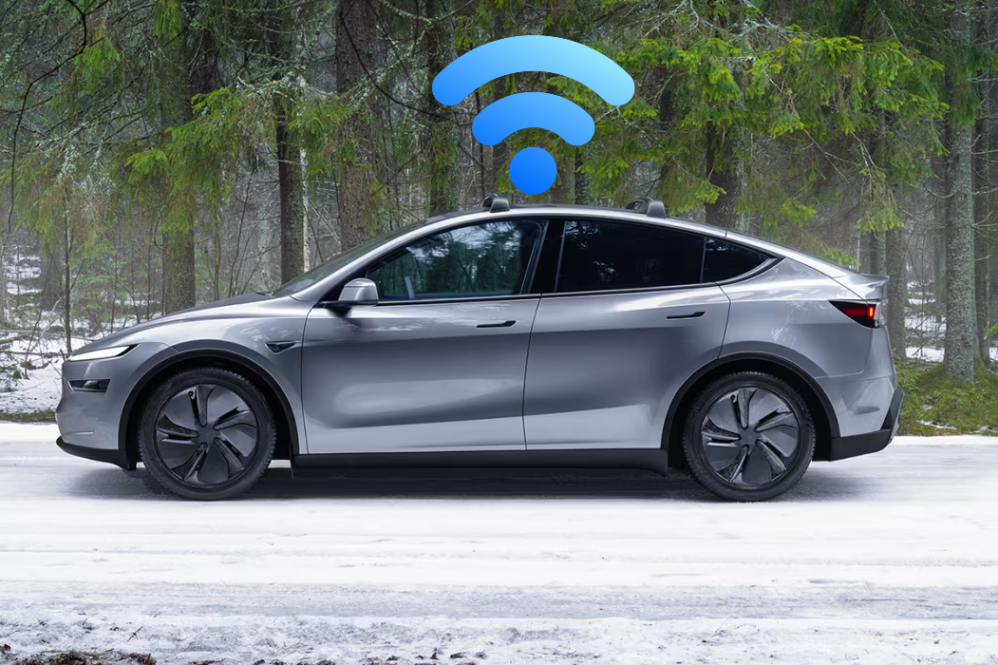
Tesla may be laying early groundwork for Starlink-enabled vehicles. In a newly published patent application, the company describes an RF-transparent roof assembly capable of embedding satellite and cellular communication hardware directly into the vehicle’s structure—potentially creating a native platform for satellite connectivity alongside existing cellular networks.
The application, filed May 29, 2024 and published December 4, 2025, describes replacing a traditional metal or glass roof with a radio frequency (RF) transparent polymer panel—materials like polycarbonate (PC), ABS, or ASA—specifically so antennas and electronics can be integrated directly into the roof without signal-blocking “metallic occlusion.” (h/t: @Chansoo)
The stated goal is clearer RF performance while consolidating multiple overhead systems into a single module.
Tesla also frames the invention as a solution to the “shark fin” problem. Conventional vehicles mount LTE/GNSS (Global Navigation Satellite System) antennas externally because metal roofs act as RF barriers. In Tesla’s approach, the roof itself becomes the RF-friendly environment, enabling interior and exterior facing wireless modules to live in the same roof assembly without the typical compromises in packaging, cable runs, or connector count.
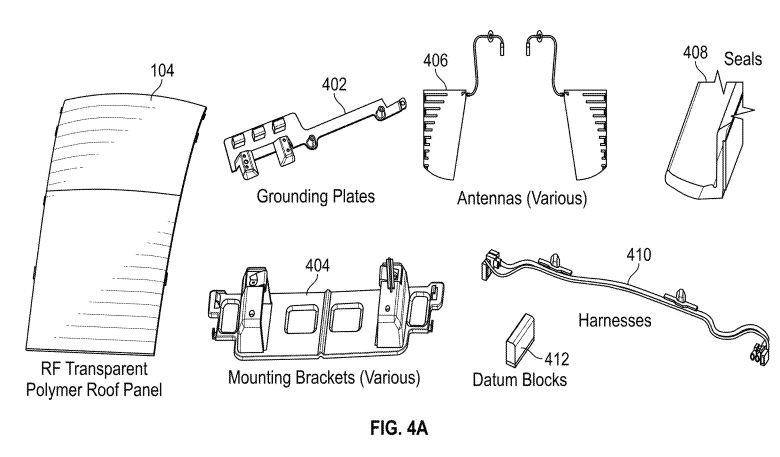
What’s particularly notable is how explicit the patent gets about the roof being pre-populated with electronics before it ever reaches the vehicle. Tesla describes a roof subassembly that can be built on a horizontal surface, installed as a single unit, and potentially assembled with full automation. The filing even claims the approach could produce a 3 to 5-fold reduction in assembly effort and time by consolidating components and eliminating overhead install steps for workers.
“Factory ergonomics are improved as the roof assembly can be pre-assembled on a horizontal surface upside down, allowing for a layered install sequence without the need for overhead installation processes. The design also facilitates factory automation by enabling a fully automated layered assembly of the roof sub-system,” the patent reads.
Then there’s the “smart roof” electronics list. Tesla’s antenna module and mounting housing includes a satellite communication component and satellite antenna, LTE component and LTE antenna, plus Wi-Fi/Bluetooth antennas, a processor, connectivity card, microphone, speaker, fan and air ducting, map light, and even a hazard switch. A component diagram connects the roof electronics to the vehicle’s cabin radar and car computer, positioning the roof as a centralized hub rather than just a passive mounting point.
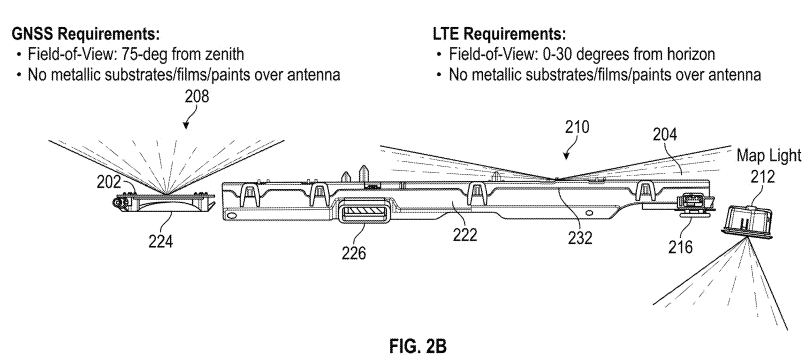
Tesla also spells out antenna field-of-view targets: 0–30 degrees from the horizon for LTE, and 75 degrees from zenith for GNSS—suggesting careful engineering around signal geometry. The patent even notes designs intended to maintain performance in ice or snow without needing a heater grid or wipe zone.
Connectivity aside, the filing includes a safety angle: a polymer “membrane effect” that allows the roof and headliner to stroke together through deflection during impacts, helping meet head injury standards while potentially reducing headliner thickness and improving headroom. The roof can also be made opaque to reduce solar load, while integrated foam layers improve thermal and acoustic insulation.
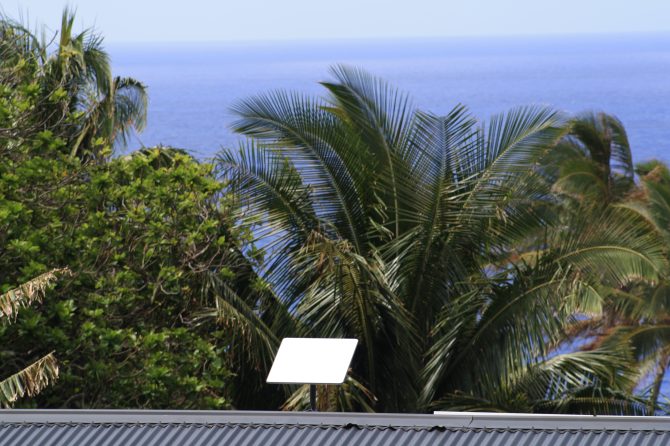
While the patent stops short of naming Starlink outright, the architecture Tesla describes closely mirrors what an integrated Starlink solution would require. A roof designed specifically for satellite field-of-view, free of metallic interference, with onboard processing and connectivity hardware already consolidated into a single module, aligns neatly with SpaceX’s low-Earth-orbit network.
As Starlink continues expanding beyond homes and RVs into mobile and automotive use cases, Tesla’s “smart roof” concept looks less like a theoretical exercise and more like foundational infrastructure for satellite connectivity built directly into future vehicles.
You can read the full patent application below.

Always get the latest - make Drive Tesla your preferred source on Google
Are you buying a Tesla? If you enjoy our content and we helped in your decision, use our referral link to get three months of Full Self-Driving (FSD).Drive Tesla uses affiliate links, which means we may earn a commission if you make a purchase through them, at no additional cost to you. Thank you for your support.