Tesla has published its 2025 year in charging review, offering a detailed look at how its Supercharger network expanded, evolved, and delivered record levels of energy over the past year. The update highlights major infrastructure milestones, new market launches, and technology upgrades that collectively made 2025 one of the most important years yet for Tesla’s global charging operations.
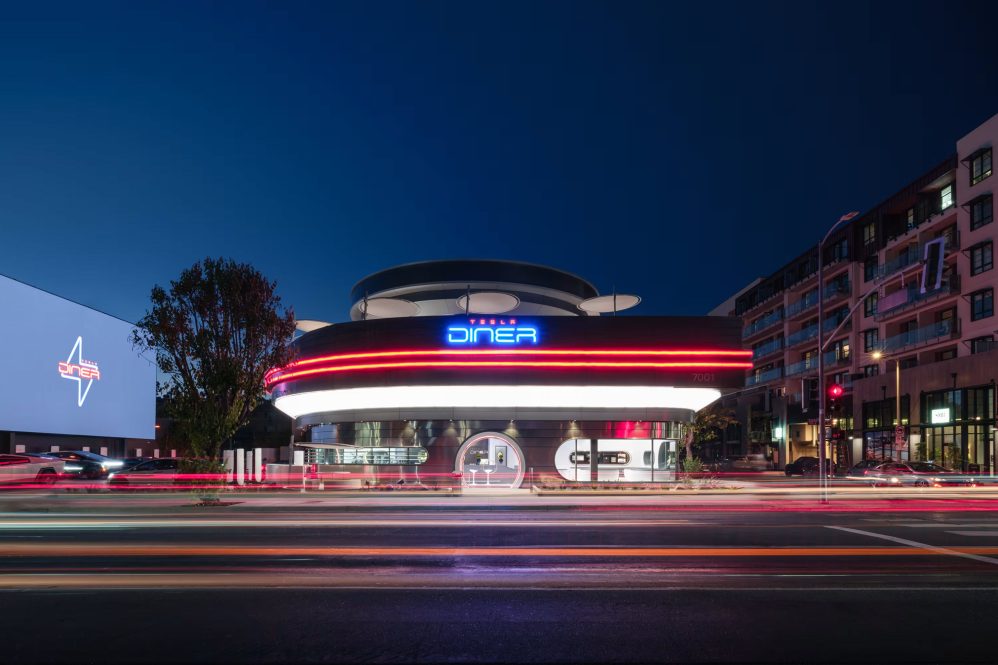
One of the most visible milestones came in Los Angeles with the opening of the Tesla Diner & Supercharger, a retro-futuristic charging hub combining 24/7 Supercharging with in-car ordering and a full diner experience. The site is emblematic of Tesla’s push to transform charging from a necessity into a destination—an approach that also played out at a much larger scale in California’s Central Valley.
Alongside the first-ever Diner & Supercharger, Tesla also brought the Oasis Supercharger online, officially the largest Supercharger station in the world. With 164 stalls, the site is powered by 11 MW of solar generation and supported by 10 Tesla Megapacks, allowing the station to operate entirely off-grid. Built in just eight months, Oasis set a new benchmark for how quickly utility-scale charging infrastructure can be deployed when paired with on-site energy storage.
Beyond individual sites, Tesla also made meaningful progress in regions where charging expansion had been stalled for years. In Portugal, long-awaited regulatory changes were approved in 2025, unlocking a rapid buildout that expanded Tesla’s Supercharger network by roughly 70 percent in a matter of weeks. New and upgraded locations, many featuring V4 hardware, are now moving ahead across the country after 4.5 years of delays.
Globally, Tesla continued to enter new markets. First Superchargers opened in countries such as Saudi Arabia and India, while additional expansion plans were announced across Chile, the Philippines, and parts of Eastern Europe and the Baltics.
At the same time, Tesla introduced MultiPass in several European countries, allowing drivers to use the Tesla app or key card to charge at third-party networks—an important step toward a more unified charging experience.
2025 also marked major technical progress. Tesla deployed its first V4 Supercharger cabinets, enabling significantly higher power density and paving the way for up to 500 kilowatts (kW) charging for passenger vehicles and 1.2 megawatts (MW) for the Tesla Semi.
Additionally, live availability rolled out to Google Maps and Apple Maps for non-Tesla drivers, while features like live pricing and employer-provided charge card support helped improve utilization and reduce wait times.
All of this growth translated into real-world impact. Tesla reports its Supercharger network delivered 6.7 terawatt-hours of energy in 2025, while surpassing 75,000 Supercharger posts worldwide.