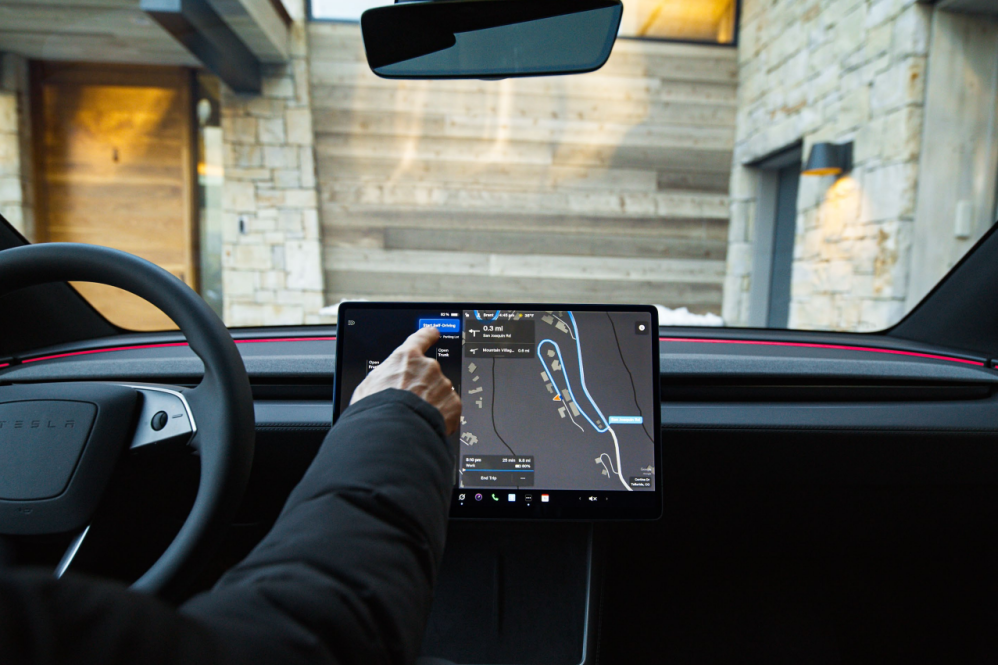
Tesla CEO Elon Musk has confirmed that Full Self-Driving (FSD) will soon support spoken driving instructions, introducing what could become one of the most important usability upgrades to the system to date.
The confirmation came in response to a Tesla owner on X who described FSD’s inability to accept detailed verbal instructions as its “greatest shortcoming.” In typical Musk fashion, the CEO replied with a single word: “Coming.”
Though brief, that response indicates a significant change is coming in how drivers interact with FSD. Instead of simply supervising the system and stepping in when it makes an undesirable choice, owners may soon be able to guide the vehicle in real time using plain English.
A Shift Toward Verbal Collaboration
Currently, FSD operates based on a destination entered into navigation. From there, it calculates and executes a route using GPS data, onboard cameras, and neural network processing. While impressive, the system cannot yet respond to situational preferences once a drive is underway.
That limitation has been a recurring frustration among users. FSD may select a route involving a difficult unprotected left turn, choose an inconvenient lane, or stop at a general map pin rather than a preferred entrance. The only way to override those decisions today is to disengage, manually correct the path, and then re-engage FSD — interrupting the experience (and affecting your FSD stats).
Voice-enabled driving prompts would change that dynamic. Drivers could potentially say things like, “turn right at the next block,” or “find a parking spot near the door.”
Instead of guessing driver intent or assuming the best option via simple navigation, the vehicle would interpret the spoken instruction and adjust its driving behaviour accordingly — all without requiring manual intervention.
Grok Could Be the Bridge
The upcoming feature is widely expected to build on Tesla’s integration of xAI’s Grok assistant, which began rolling out to North American vehicles in 2025 and expanded to Europe with the 2026.2.6 software update. Grok already allows drivers to set destinations and add stops using conversational input.
However, it currently functions more as a navigation helper. It cannot influence core driving decisions like lane selection, braking behaviour, or parking strategy. Enabling voice commands that directly affect FSD’s actions would close that gap, converting spoken requests into real-time driving adjustments.
That said, execution will be critical. Some Tesla owners have reported inconsistencies with Grok’s navigation features, including commands that are acknowledged but not properly carried out. Extending voice interaction into active vehicle control will require a much higher standard of reliability.