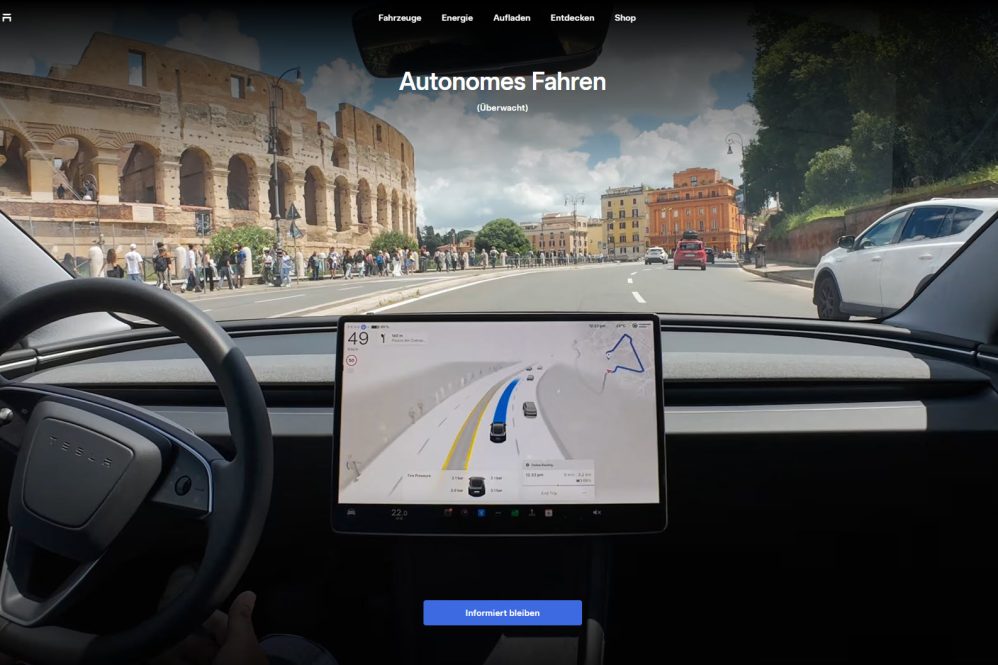
Tesla’s Full Self-Driving (Supervised) ride-along program in Europe has proven to be far more popular than expected. After opening limited sessions late last month, the automaker has quietly extended the demo window by an additional three months, with new availability now running from December 1, 2025 through March 31, 2026 across Germany, France, and Italy.
The expanded window will dramatically increase the number of Europeans who will get their first real-world look at FSD, a system Tesla hopes to bring to the region more broadly once it secures approval under Europe’s strict UNECE framework.
Tesla’s website show FSD Demo Drives available across major cities including Stuttgart, Cologne, Frankfurt, Düsseldorf, Paris, Lyon, Rome, Milan, and others.
A Passenger-Seat First Look at FSD in Europe
Unlike in North America, where owners can try FSD directly, Tesla’s European demo program is intentionally conservative. Customers sit in the passenger seat while a trained Tesla employee occupies the driver’s seat and oversees the system.
It’s a controlled format, but one designed to do several things at once: give potential customers a firsthand look at the software, demonstrate consistency and predictability to regulators, and gather data across a range of European road networks—many of which are narrower, denser, and more unpredictable than their North American counterparts.
Why Europe Requires a Different Strategy
When Tesla first launched the program in late November, it did so with an important caveat. Europe’s regulatory environment is far more centralized and restrictive, with automated driving features approved through UNECE rather than individual countries. That means the bar is significantly higher, and the path to wide deployment requires showing compliance across dozens of markets at once.
Historically, this has resulted in a reduced feature set for Autopilot and Navigate on Autopilot in Europe compared to Canada or the U.S. FSD (Supervised), which replaces the earlier “stack” entirely, goes well beyond those capabilities—making regulatory acceptance a tougher but more consequential hurdle.
Tesla is currently focusing its approval efforts in the Netherlands, where it is aiming for a potential green light as early as February 2026. A positive decision there could serve as the cornerstone for a broader EU-wide rollout, similar to how Tesla leveraged Dutch approvals for prior Autopilot updates.