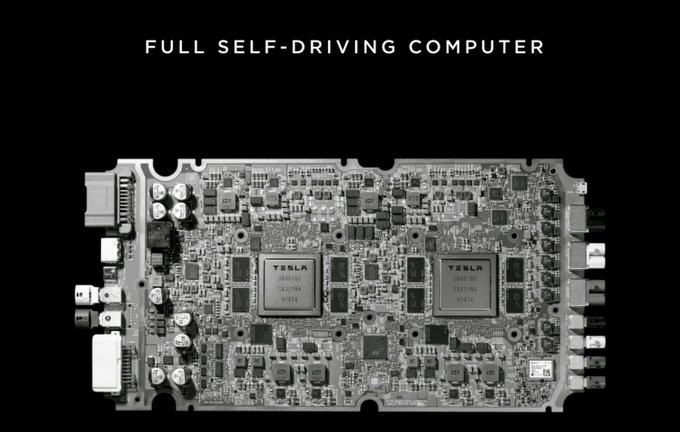
One of the biggest worries for Tesla owners has been hardware obsolescence. You buy a car advertised as “Full Self-Driving capable,” only to watch a new computer arrive a few years, or even a few weeks later that seems to leave your vehicle behind. But a newly published Tesla patent suggests the company may have found a way to stretch the life of its Hardware 3 (HW3/AI3) computers without swapping out a single chip.
On January 15, 2026, Tesla published patent US20260017503A1, titled “Bit-Augmented Arithmetic Convolution,” first shared and explained by X user @tslaming. While the name sounds intimidating and like it has nothing to do with FSD, the goal is simple: let modern, high-precision AI models run on older, lower-precision hardware using clever math and software, instead of requiring brand-new silicon.
This creates a realistic upgrade path where AI3 can be pushed toward AI4-class capability using software alone. Rather than forcing Tesla to abandon millions of older vehicles or hold back its newest neural networks, the same advanced Full Self-Driving software can scale across AI3, AI4, and future AI5 systems — just with different efficiency levels.
The Problem
Tesla first introduced AI3 in 2019, when most neural networks worked well with simple 8-bit math. Today’s newer, more advanced driving models prefer 16-bit or even 32-bit precision. That extra detail makes the AI more stable and accurate, but it doesn’t fit naturally on older chips like AI3.
Traditionally, companies solve this by shrinking the models to fit the hardware, which costs performance and safety margin. Tesla’s patent shows a way to avoid that compromise.
Tesla’s Workaround
Instead of forcing high-precision data into low-precision hardware, Tesla splits the data into smaller chunks that AI3 can handle.
A 16-bit number becomes two 8-bit pieces: a “big part” and a “detail part.” The FSD computer processes each piece separately using its existing hardware, then stitches the results back together to recreate the high-precision answer. Importantly, Tesla uses the neural network accelerator itself — the same hardware that normally detects cars, lanes, and pedestrians — to do this splitting and recombining at full speed.
In simple terms, the 8-bit chip behaves like a 16-bit or even 32-bit system by running a few extra lightweight operations, instead of needing bigger, hotter, more power-hungry silicon.
Why This Matters
This approach means Tesla doesn’t have to choose between abandoning older cars or holding back its newest AI models. The same sophisticated software stack can evolve forward while still running on AI3, preserving a meaningful upgrade path for existing owners, without upgrading the computer.
The solution is not perfect however, and there are trade-offs. These include slightly higher latency and more power use, and camera hardware limits still apply — but the payoff is huge. Millions of Teslas can keep getting smarter instead of aging out.