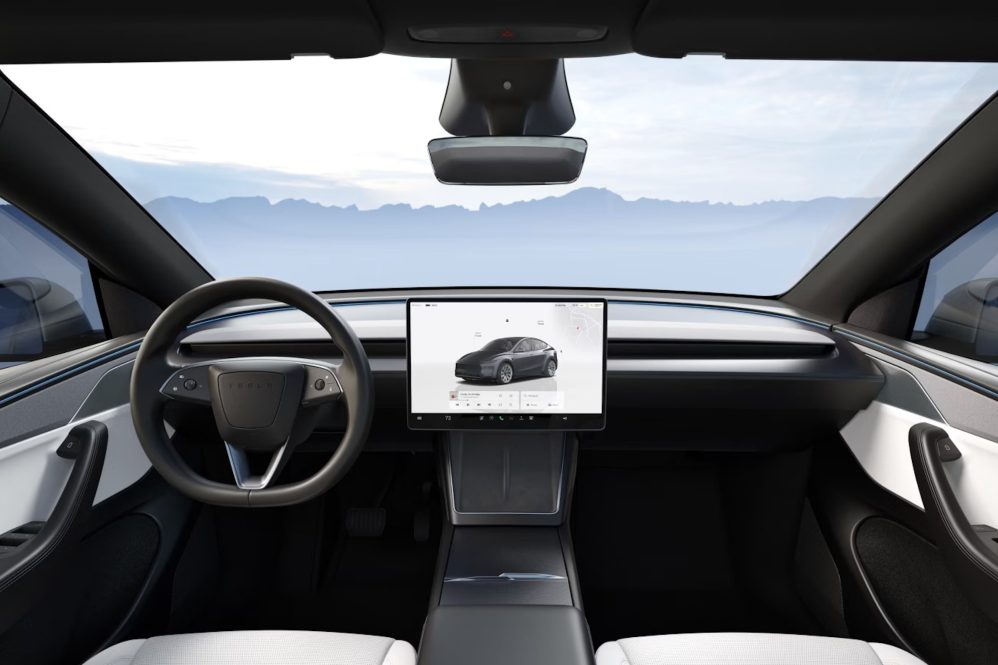
China is preparing a yet another overhaul of interior car design standards that will significantly reduce automakers’ reliance on touchscreens and electronic-only controls.
The country’s Ministry of Industry and Information Technology (MIIT) has released draft revisions that would require physical controls for a wide range of essential vehicle functions, with the updated standards expected to apply to newly manufactured vehicles beginning July 1, 2027.
According to a report from Car News China, the new regulations would make automakers move away from the minimalist cockpit trend that has defined China’s booming EV market in recent years. Many new vehicles have embraced expansive central control screens—sometimes paired with passenger displays—while eliminating traditional buttons and switches almost entirely.
Under the revised national standard GB4094—2016, regulators will mandate physical activation methods for critical systems, ensuring they can be operated without requiring drivers to look at a screen. Functions that must have dedicated physical controls include turn signals, hazard lights, horn, windshield wipers, defrosters, power windows, gear selection (P/R/N/D), and activation of advanced driver assistance systems (ADAS).
The updated rules also outline detailed technical requirements. Physical buttons must meet minimum size standards (at least 10 mm by 10 mm), remain in fixed positions, and provide tactile or audible feedback. Crucially, essential controls must continue functioning even if the vehicle’s main system crashes or loses power.
Yoke Steering Wheels and Flush Door Handles Also Targeted
These changes follow two other high-profile safety updates that we have previously told you about that are also set to take effect in 2027.
China is moving to ban yoke-style steering wheels by introducing stricter impact testing requirements. Steering wheels will need to pass crash tests at ten specific points around a continuous rim—criteria that yoke designs, which lack an upper section, cannot easily satisfy. Regulators cited crash data indicating that roughly 46% of driver injuries in collisions involve impacts with the steering system.
Separately, China has approved new rules requiring mechanical door handles with emergency releases that function even after a crash or power failure. Fully flush or power-dependent exterior handles—popularized by Tesla and widely adopted across the EV industry—will no longer comply unless redesigned to include mechanical operation.
Tesla has already said it is redesigning its door handles, however the changes to ban yoke steering wheels won’t have much of an impact on the Texas-based automaker as it is discontinuing the Model S and Model X well before the regulations would take effect.