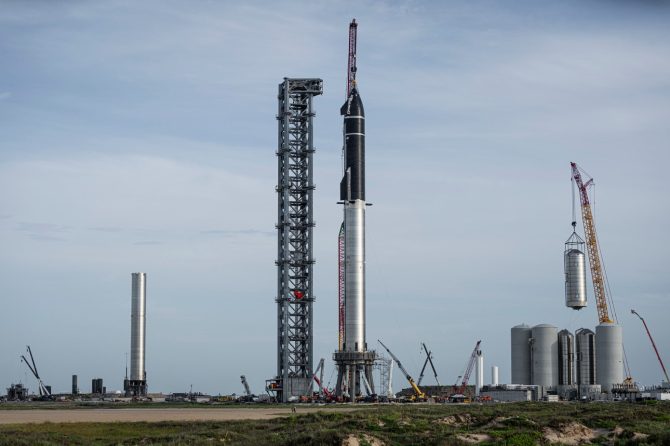

Blue Origin has officially filed an application with the Federal Communications Commission (FCC) seeking approval to deploy a large-scale satellite constellation designed to host data centers in orbit. The proposal, known as Project Sunrise, follows an approach that closely mirrors concepts recently criticized by Amazon in its opposition to SpaceX’s own orbital data center plans.
The project, known as Project Sunrise, outlines plans for up to 51,600 satellites operating in low Earth orbit. According to the filing, the constellation would support artificial intelligence (AI) and cloud computing workloads by leveraging near-constant solar energy available in sun-synchronous orbits between 500 km and 1,800 km in altitude.
This latest development comes just days after Amazon—founded by Blue Origin’s Jeff Bezos—publicly criticized SpaceX’s much larger proposal for a one-million-satellite data center network. In its filing, Amazon argued that SpaceX’s plan lacked sufficient technical detail and could take “centuries” to complete.
Now, Blue Origin is putting forward its own vision, complete with detailed technical parameters and deployment strategy.
A Different Approach to Space-Based Compute
Unlike traditional satellite constellations focused on communications, Project Sunrise is centered on processing data in orbit. Blue Origin says the system would rely primarily on optical (laser) links between satellites, forming a high-speed mesh network that routes data through its TeraWave architecture before transmitting it to Earth.
The company highlights the potential environmental benefits of shifting compute workloads off the ground. As noted in the application, “space-based data centers could relieve pressure on Earth’s power grids and water usage,” a growing concern as AI-driven demand for computing infrastructure continues to surge.
By operating in space, these satellites could take advantage of continuous solar power without the constraints of terrestrial infrastructure, potentially reducing both energy consumption and cooling requirements compared to traditional data centers.
Technical Scope and Scale
Project Sunrise would consist of multiple satellite variants, each equipped with different antenna configurations to meet varying coverage needs. Despite these differences, the constellation is designed to maintain consistent radio frequency requirements across the network.
Each orbital plane could contain between 300 and 1,000 satellites, forming a dense and highly scalable architecture, according to Amazon. While the system will primarily use optical communication, it will also rely on Ka-band spectrum for telemetry, tracking, and command functions, ensuring operational reliability during critical mission phases.
Competition in Orbit Is Heating Up
The timing of Amazon’s application is notable. Through its Project Kuiper program, the company is already under pressure to meet FCC deployment deadlines for its own broadband satellite network. At the same time, SpaceX continues to expand Starlink at a rapid pace while pushing forward with its own orbital data center concept with 1 million satellites.
Regulators have yet to rule on either of these proposals.

Always get the latest - make Drive Tesla your preferred source on Google
Are you buying a Tesla? If you enjoy our content and we helped in your decision, use our referral link to get three months of Full Self-Driving (FSD).Drive Tesla uses affiliate links, which means we may earn a commission if you make a purchase through them, at no additional cost to you. Thank you for your support.