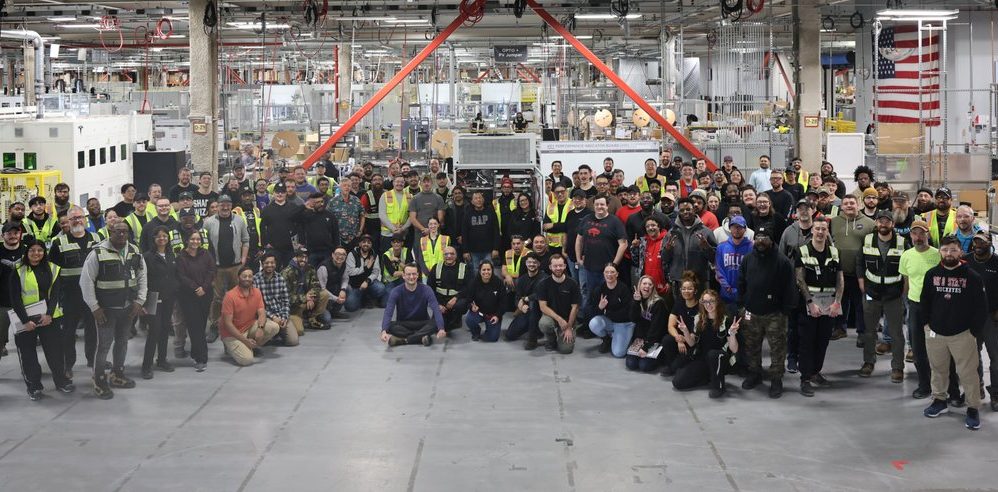
Tesla has officially ended production of one of the key components behind its Supercharger network. The company confirmed that the final V3 Supercharger cabinet has rolled off the production line at Gigafactory New York, bringing to a close seven years of manufacturing for the hardware that helped power Tesla’s rapid charging network expansion.
According to Tesla, more than 15,000 V3 cabinets were produced during that period, supporting thousands of Supercharger stations around the world.
“Gigafactory New York built their last V3 Supercharger cabinet, marking the end to 15k+ V3 cabinets over 7 years,” Tesla Charging announced on social media. “V4 cabinet line is ramping up!”
The transition means that all new Supercharger cabinets produced at Giga New York will now be the V4 design.
Gigafactory New York built their last V3 Supercharger cabinet, marking the end to 15k+ V3 cabinets over 7 years.
— Tesla Charging (@TeslaCharging) March 16, 2026
V4 cabinet line is ramping up! pic.twitter.com/o8WYE8Im8S
The V3 cabinet, introduced in 2019, was a significant leap forward for Tesla’s charging network. At the time it delivered up to 250kW of power shared across four stalls and introduced improvements like reduced power sharing and faster peak charging speeds for Tesla vehicles. The hardware became the backbone of Tesla’s global charging rollout during a period when EV adoption accelerated dramatically.
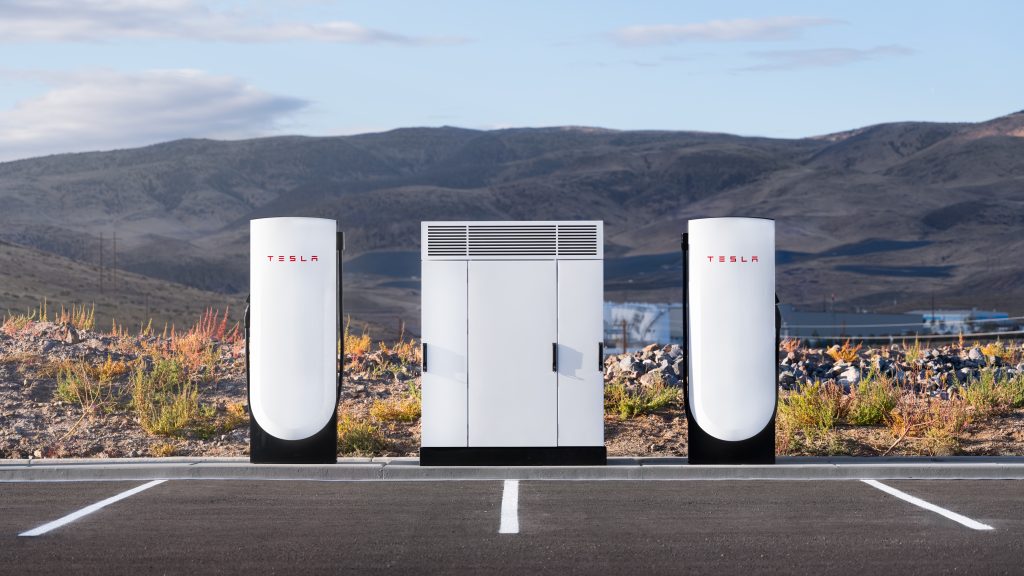
But Tesla’s next step goes even further. The new V4 Supercharger cabinet operates at up to 1,000 volts and can deliver as much as 1.2 megawatts of total power. That capacity allows it to support up to eight charging stalls per cabinet, doubling the number of stalls compared to V3 hardware while significantly increasing total power output.
For passenger vehicles, V4 cabinets can support peak charging speeds of up to 500 kW for compatible EVs, while Tesla’s upcoming Semi truck can charge at up to 1.2 MW. Tesla says the system is designed to support vehicle architectures ranging from 400V to 1000V, making the hardware compatible with a broader range of electric vehicles.
Despite the higher power levels, Tesla says V4 hardware is also cheaper to deploy. The company claims the cost comes in at under $40,000 per stall, making it the most affordable Supercharger installation yet. Combined with its ability to power twice as many stalls per cabinet, the new system could help Tesla expand the network more quickly while reducing infrastructure costs.
Another key advantage is improved reliability and efficiency. Tesla says the new power electronics deliver three times the power density of previous hardware, allowing higher throughput while maintaining lower operating costs.
A complete V4 Supercharger installation includes both the V4 cabinet and the newer V4 charging stalls, which feature cables roughly three feet longer than earlier versions. The longer cables make the stations easier to use for EVs with charging ports in different locations, particularly non-Tesla EVs now gaining access to the network.
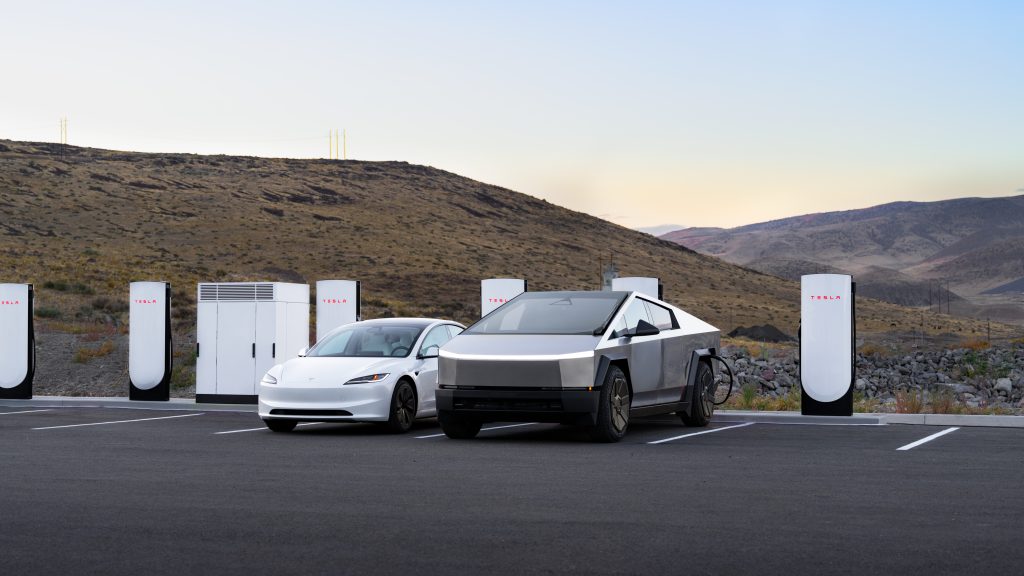
In recent years, Tesla has been blending elements of the two generations at newer Supercharger locations. Many newer sites have been built with older V3 power cabinets, but paired with the newer V4 charging stalls, a configuration Tesla refers to internally as “V3.5” stations. While these locations feature the longer V4 cables designed to better accommodate vehicles with different charge port locations, the underlying V3 cabinets still limit peak charging speeds to 325 kW – higher than the 250kW on with V3 stalls, but less than the 500kW on true V4 Supercharger stations.
Fully deployed V4 installations, which include both the V4 cabinet and stall hardware, are required to unlock the higher power levels. At the moment, there are only a handful of fully V4 sites in operation, but with Tesla now retiring the V3 cabinet, more of these true V4 Supercharger stations should be appearing in the coming months.
All in on V4 cabinets! So cool to see how far we've come from V1. The brand new V4 cabinet line at Giga New York is automotive-grade and spooling up for charging ubiquity around the world https://t.co/ovfPLr2qfR pic.twitter.com/RswjL3ACPI
— Max (@MdeZegher) March 16, 2026

Always get the latest - make Drive Tesla your preferred source on Google
Are you buying a Tesla? If you enjoy our content and we helped in your decision, use our referral link to get three months of Full Self-Driving (FSD).Drive Tesla uses affiliate links, which means we may earn a commission if you make a purchase through them, at no additional cost to you. Thank you for your support.