The Federal Communications Commission has officially cleared a major regulatory hurdle for Tesla, granting the automaker a waiver that allows it to deploy Ultra-Wideband (UWB) radio technology in its upcoming wireless EV charging system—technology expected to debut with the Cybercab.
The decision, released on February 18, gives Tesla approval to use UWB radios in a way that current rules would normally not allow. Specifically, Section 15.519(a) requires UWB devices to be handheld, while Section 15.519(a)(2) does not allow antennas mounted on outdoor fixed infrastructure.
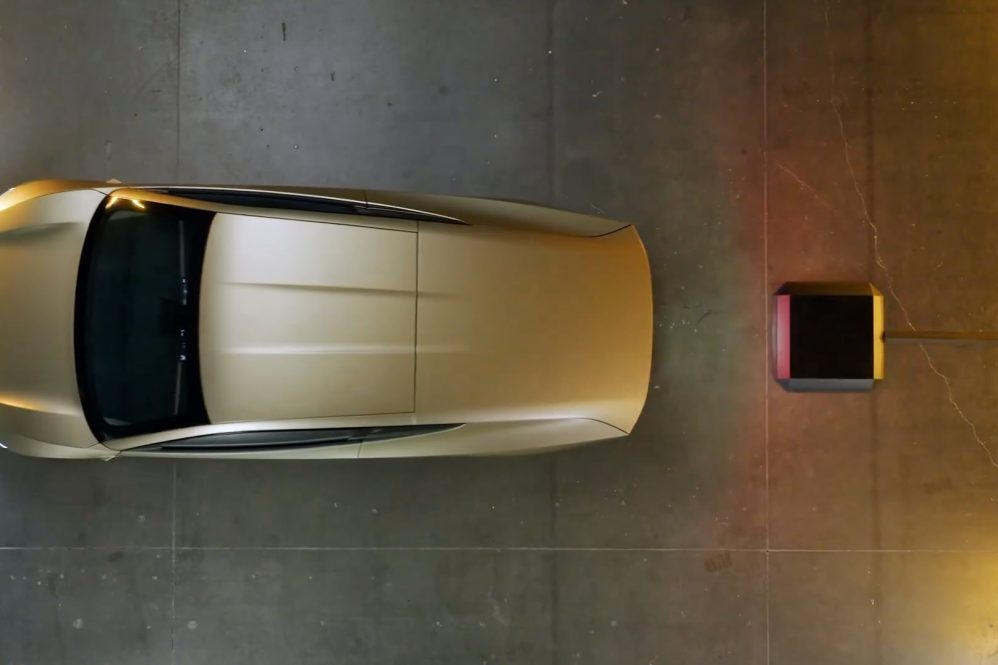
Tesla’s design meanwhile features ground-mounted wireless charging pads—designed to sit flush with parking surfaces and potentially operate outdoors—which don’t fit within those constraints.
After reviewing Tesla’s request, the FCC determined there was “good cause” to grant the waiver.
How Tesla’s Wireless Charging Positioning System Works
Central to the FCC’s approval is Tesla’s precision positioning system, which relies on impulse-based UWB radio signals to guide a vehicle into the exact position required over a ground pad before wireless charging can begin.
According to the FCC filing:
“The Tesla positioning system is an impulse UWB radio system that enables peer-to-peer communications between a UWB transceiver installed on an electric vehicle (EV) and a second UWB transceiver installed on a ground-level pad — which could be located outdoors — to achieve optimal positioning for the EV to charge wirelessly.”
The system does not immediately activate UWB. Instead, the vehicle first locates the charging pad using Bluetooth Low Energy (BLE), which handles initial discovery and data exchange. Only when the vehicle is close does UWB engage briefly to fine-tune alignment.
“When the vehicle approaches the ground pad, the UWB transceivers will operate to track the position of the vehicle to determine when the optimal position has been achieved over the pad before enabling wireless power charging.”
Tesla emphasized that the UWB signal operates for extremely short durations—typically under 150 milliseconds—and only at close range near ground level. Once the vehicle is correctly positioned and parked, the UWB transmission shuts off entirely.
Why the FCC Approved the Waiver
The FCC concluded that Tesla’s system does not resemble a wide-area communications network—the primary concern behind the original restrictions. Instead, it involves short-range, low-power, one-to-one communication between a single vehicle and a single pad.
The signal operates within the 7.7–8.3 GHz band and remains subject to all existing Part 15 power limits. Tesla is not receiving any exception to emission levels, only to the handheld and outdoor infrastructure requirements.
While the FCC did grant the waiver, it did so with the following operational safeguards, including:
- UWB activation only after a Bluetooth connection is established
- Automatic shutdown once positioning is complete
- Frequency restrictions to 7.7–8.3 GHz
- Notification requirements for commercial installations near sensitive federal and radio astronomy sites
A Key Step Toward Autonomous Charging
For Tesla, this approval bring the Cybercab one step closer to reality. A purpose-built vehicle like the Cybercab, designed without pedals or steering controls, will need fully automated charging to operate at scale.
By clearing the way for fixed outdoor UWB positioning systems, the FCC has effectively enabled Tesla to move forward with commercial wireless charging deployments—both at home and potentially at public or fleet facilities.

Always get the latest - make Drive Tesla your preferred source on Google
Are you buying a Tesla? If you enjoy our content and we helped in your decision, use our referral link to get three months of Full Self-Driving (FSD).Drive Tesla uses affiliate links, which means we may earn a commission if you make a purchase through them, at no additional cost to you. Thank you for your support.