

Starlink has wrapped up 2025 with its strongest year yet, cementing its position as the world’s fastest-growing satellite internet network. According to a newly released progress report from SpaceX, Starlink added more than 4.6 million new active customers this year alone, pushing its global subscriber base past 9.2 million users.
The pace of growth accelerated sharply toward the end of the year. Since surpassing the 9-million-customer mark, Starlink has been adding an average of 22,222 new customers per day, a new company record that eclipses its previous high. Just nine days earlier, the network was sitting at 9 million users, and as recently as November 2025, it had crossed the 8-million threshold—highlighting how rapidly adoption is accelerating.
Starlink’s reach expanded across nearly every sector in 2025. According to the company, more than 20 million cruise passengers and 21 million airline passengers used the service during the year, while over 1,400 commercial aircraft are now equipped with Starlink—almost four times the number installed in 2024. Business aviation also saw significant uptake, with over 800 business jets across 36 airframes now flying with Starlink hardware.
On the maritime side, the network is connecting more than 150,000 vessels, ranging from cargo ships and tankers to fishing boats, patrol craft, and offshore supply vessels. Meanwhile, Starlink added 35 new markets and added 4.6 million new customers in 2025, further broadening its global footprint.

One of the year’s most transformative developments came from Starlink’s Direct to Cell initiative. The service now supports more than 6 million monthly active users, including in Canada, while over 400 million people across 22 countries and six continents have access to satellite-to-phone connectivity.
In total, Starlink says Direct to Cell has connected more than 12 million people at least once, often providing critical communication in areas without terrestrial coverage.
Behind the scenes, SpaceX dramatically scaled its infrastructure to support this growth. The company launched 120 dedicated Starlink missions aboard Falcon 9 in 2025 and surpassed 600 terabits per second of cumulative network capacity. Starlink also began deploying V2 Mini Optimized satellites, which are significantly lighter than earlier versions and offer improved reliability, while successful in-orbit laser tests demonstrated data transfer speeds exceeding 25 Gbps.
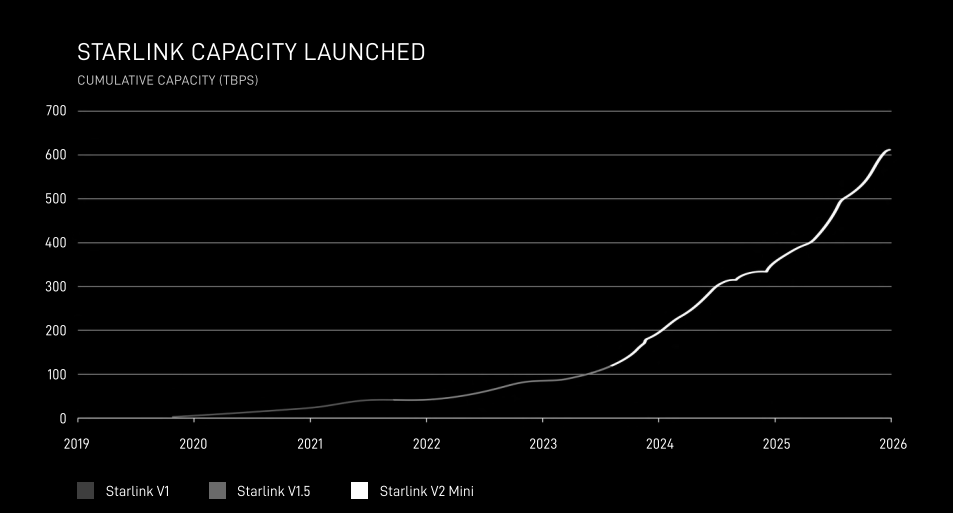
Network performance improved alongside capacity. In 2025, median peak-hour download speeds rose by more than 50 percent, averaging over 200 Mbps, with uploads exceeding 30 Mbps and global latency hovering around 26 milliseconds.
Starlink isn’t resting on its laurels, and is already preparing for even higher demand. In 2026, the company plans to double Starlink kit production at its Bastrop, Texas facility. As SpaceX stated, “This expansion will further scale our vertical integration in injection molding, die-casting, PCBs, and PCBA assembly, aligning with our strategy to diversify the supply chain and deliver products Engineered by SpaceX and Made in the U.S.”
With record customer growth, faster speeds, and expanding coverage across land, sea, air, and smartphones, 2025 may be remembered as the year Starlink firmly transitioned from rapid expansion to global infrastructure backbone.
You can read the full progress report on Starlink’s website.

Always get the latest - make Drive Tesla your preferred source on Google
Are you buying a Tesla? If you enjoy our content and we helped in your decision, use our referral link to get three months of Full Self-Driving (FSD).Drive Tesla uses affiliate links, which means we may earn a commission if you make a purchase through them, at no additional cost to you. Thank you for your support.