Two major automakers that have historically relied on Tesla to help meet European emissions regulations appear to be going their own way starting in 2026.
Recent filings related to the European Union’s CO₂ compliance pooling system show that Toyota and Stellantis are no longer listed as participants in Tesla’s regulatory pool, while several other manufacturers—including Ford—remain part of the group.
The credit pool allows automakers that lagged in electric vehicle (EV) adoption to purchase regulatory credits from manufacturers with lower fleet emissions—most notably Tesla.
Tesla’s 2026 EU Emissions Pool
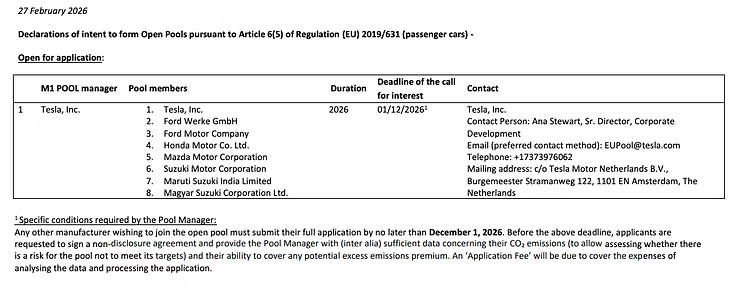
According to the EU declaration of intent for open pooling under Regulation (EU) 2019/631 dated February 27, 2026, Tesla remains the pool manager for a group of automakers that will collectively account for their fleet emissions. The companies currently listed in Tesla’s 2026 pool include: (via Matthias Schmidt)
- Ford Motor Company
- Honda Motor Co., Ltd.
- Mazda Motor Corporation
- Suzuki Motor Corporation
- Maruti Suzuki India Limited
- Magyar Suzuki Corporation Ltd.
While the group still includes several global automakers, the absence of Toyota and Stellantis is significant. Both companies have historically contributed to Tesla’s regulatory credit revenue by purchasing emissions offsets through pooling agreements.
Other manufacturers can still join the pool, but must submit their applications by December 1, 2026.
Why Toyota and Stellantis May be Leaving
While neither automaker has officially announced their decision, the most likely reason why they chose to depart is that they no longer need Tesla’s credits to meet EU fleet emissions limits.
Toyota has steadily increased the share of electrified vehicles in its lineup, particularly hybrids, which significantly reduce fleet-average CO₂ emissions. The company is also planning to expand its battery electric vehicle lineup in 2026.
Stellantis’ decision is more complicated. While the automaker has scaled back some of its EV plans after saying it overestimated how quickly consumers would transition to electric vehicles, it could still benefit from the rollout of EV technology linked to Chinese partner Leapmotor, as well as localized European production.
A Changing Regulatory Credit Landscape
Tesla has long benefited from selling regulatory credits to other automakers, generating billions in revenue over the years. However, that income stream has recently begun to face pressure.
During its most recent shareholder letter for Q4 2025, Tesla pointed to declining regulatory credit revenue as a factor affecting profitability during the quarter. The trend is expected to accelerate as more automakers introduce their own battery electric vehicles (BEVs) to comply with the EU’s tightening emissions targets.
Europe’s current rules allow automakers to average emissions over a three-year period between 2025 and 2027 under a “bank and borrow” system. As companies increase EV production to meet these requirements, reliance on credit purchases from Tesla could decline.
At the same time, regulatory credit income in the United States may also weaken as environmental regulations are loosened in certain areas by the Trump administration.