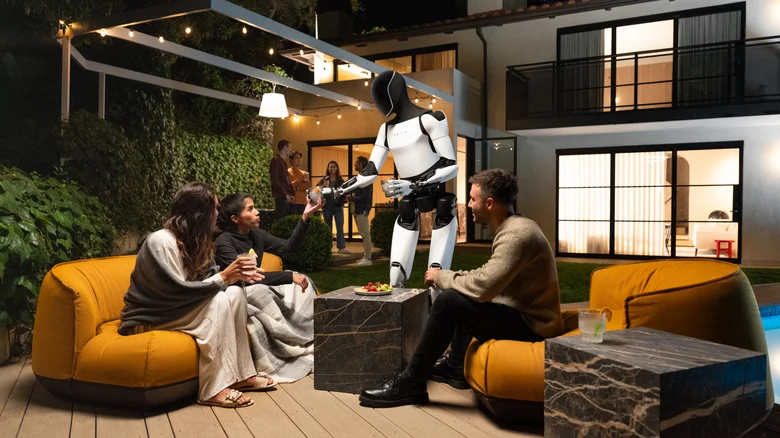
Tesla’s push to accelerate development of Optimus continues to attract high-profile talent from across the tech world. The latest notable addition is Yilun Chen, who revealed this week that he has left Apple after nearly four years to join Tesla’s Optimus AI team.
In his announcement on X, Chen described his departure from Apple as the end of “an unforgettable chapter,” sharing gratitude for mentors, colleagues, and the opportunity to build products—some still unreleased.
Chen’s background makes him one of the more uniquely equipped engineers to contribute to Tesla’s humanoid program. Before joining Tesla in November, he spent nearly four years at Apple, most recently as a Research Scientist with the Apple Robotics Research Team. There, he worked on embodied AI, robotics foundation models, sim2real, vision-language-action (VLA) models, dexterous manipulation, and full-body humanoid control—exactly the kind of foundational technologies Tesla is building into Optimus.
Prior to that, he served as a Machine Learning Engineer in Apple’s Special Projects Group, focusing on photorealistic scene generation, generative agent modeling, and reinforcement learning for autonomy systems.
Chen also brings experience from Lyft’s self-driving division, where he helped deliver the lane-change feature for Lyft’s self-driving vehicle program and co-designed the company’s first ML-driven end-to-end planner—a machine-learning-based decision system that selects a vehicle’s next action by learning from real-world driving data rather than relying on hand-crafted rules – skills that map almost perfectly to Tesla’s vision for Optimus.
Chen said he was “totally blown away” after visiting Tesla’s Optimus lab, pointing to its scale, rapid iteration culture, and the openness of its engineering environment. His first week, he added, was filled with deep technical discussions, fast-paced prototyping, and what he described as a clear sense of shared purpose. “You can feel the energy to change the world here.”
His decision to leave Apple also highlights how Tesla’s strategy with Optimus is beginning to separate itself from the rest of the field. While other companies are releasing robots that excel at a few curated tasks, Tesla is focused on solving far more fundamental challenges—such as human-level manipulation and whole-body control—required for a truly general-purpose humanoid platform. Those deeper ambitions come with slower timelines, but they also avoid the dead-end path of producing specialized machines that can’t meaningfully evolve.
Another differentiator is Tesla’s manufacturing strength. Once the company finalizes the right architecture for Optimus, Tesla’s ability to produce complex systems at scale could put it years ahead of competitors who can build impressive prototypes but lack the means to manufacture them efficiently.
Tesla is also gearing up for its next major milestone with the Optimus robot itself. The company is expected to unveil Optimus V3 in early 2026, with Elon Musk previously suggesting a reveal “probably in Q1 2026.” While the timeline isn’t locked in and could shift depending on development progress, the upcoming version is anticipated to showcase a substantial leap in capability and refinement.