
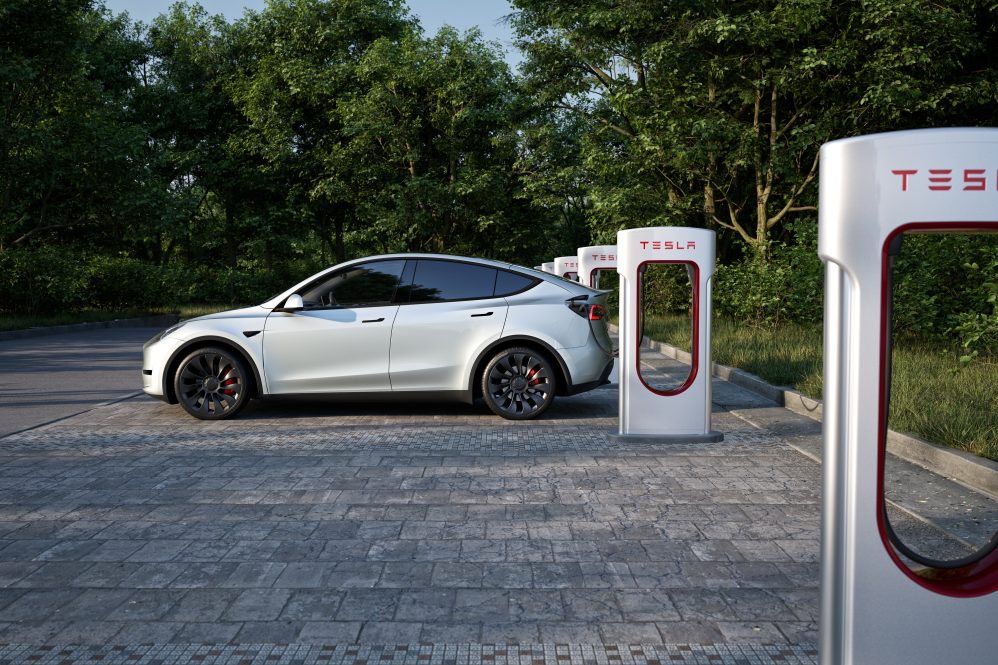
Tesla recently updated the Tesla Y owner’s manual with helpful battery maintenance tips, and one of the key points is not to rely on Superchargers all the time.
To improve battery health, Tesla now explicitly advises owners to use Supercharging mainly for long road trips and Level 1 and Level 2 charging for daily runs.
The update, first reported by Not A Tesla App, further explains that all EV batteries degrade, however slowly, over time. This is a result of chemical reactions that are bound to occur during charging and discharging cycles. In charging parlance, when a battery is at 85 percent health, it can now only provide 85 percent of the driving range it had when new.
Tesla has installed high-tech systems to slow this natural decline. When the EV’s charge level drops to almost 0 percent, the vehicle is designed to automatically switch to a low-power consumption mode to prevent the battery from draining out completely. If not, it could damage some internal features.
Other tips to slow battery wear include charging to about 80 percent for daily use. Owners should only charge to full capacity if they need the extra range, and charging should be frequent.
Another pitfall drivers should avoid is the extremes. EV batteries shouldn’t be left at 0 percent or 100 percent for too long. If the car were stored for a while, an ideal point could be at 50 percent charge.
Lastly, the vehicle shouldn’t be left idle with features like Sentry Mode activated or USB ports plugged in. These actions will slowly drain the battery. The automaker urged owners to take note of these points, while it would also work on improving its battery technology.
A few weeks ago, CEO Elon Musk announced a new milestone in dry electrode battery technology. Compared to traditional lithium-ion batteries, these dry electrodes make battery production cheaper, faster, and more compact.