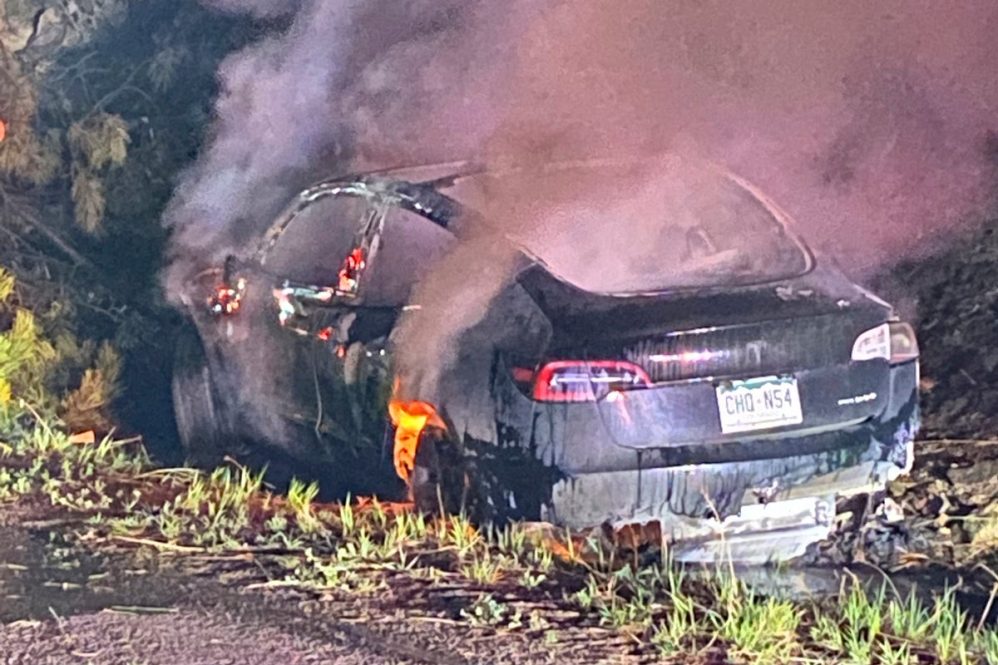
Tesla is pushing back against another lawsuit tied to its driver-assistance technology, this time arguing that a fatal crash involving a Model 3 had nothing to do with Autopilot, and everything to do with driver behaviour.
In a newly filed motion in a Colorado federal court this week, the automaker is seeking to have a wrongful death lawsuit dismissed, citing vehicle data and official reports that it says directly contradict the plaintiff’s claims. The case stems from a May 2022 crash involving a 2021 Tesla Model 3 driven by 33-year-old Tesla employee Hans Von Ohain.
According to the lawsuit filed by his wife in 2024, Autopilot was allegedly engaged and malfunctioned, steering the vehicle off the road and into a tree. The complaint claims Von Ohain “fought to regain control of the vehicle, but, to his surprise and horror, his efforts were prevented by the vehicle’s Autopilot features, leaving him helpless and unable to steer back on course.” (via Law360)
However, Tesla says the data tells a very different story. According to telemetry retrieved from the vehicle’s event data recorder (EDR), which logs detailed information about vehicle systems and driver inputs, Tesla says that data shows Autopilot had been disengaged roughly 10 minutes before the crash occurred.
While this is the first time Tesla has officially responded to the lawsuit with this information, it is not the first time the company has revealed their driver-assist software was not engaged. In 2024, Elon Musk refuted claims that FSD was engaged saying it was never downloaded to the vehicle.
He was not on FSD. The software had unfortunately never been downloaded. I say “unfortunately”, because the accident probably would not have happened if FSD had been engaged.
— Elon Musk (@elonmusk) February 14, 2024
Toxicology results further complicate the plaintiff’s case. Reports indicate Von Ohain’s blood alcohol level was more than three times the legal limit at the time of the crash. Tesla argues this level of impairment was the primary cause of the accident, not any defect in its driver-assistance systems.
In addition, investigators with the Colorado State Patrol found the vehicle was traveling at 88 mph (142km/h), nearly 40 mph (64 km/h) over the posted speed limit, just seconds before leaving the roadway and striking a tree.
In its filing, Tesla stated the EDR data “definitively proved that Autopilot was not engaged at the time of the accident,” adding that the evidence had been available long before the lawsuit was filed.
Tesla further told the court that the plaintiffs’ legal team has now confirmed they are no longer “pursuing an Autopilot defect claim.”
The case is Nora Bass, et al., v. Tesla, Inc., et al., filed in the U.S. District Court for the District of Colorado.