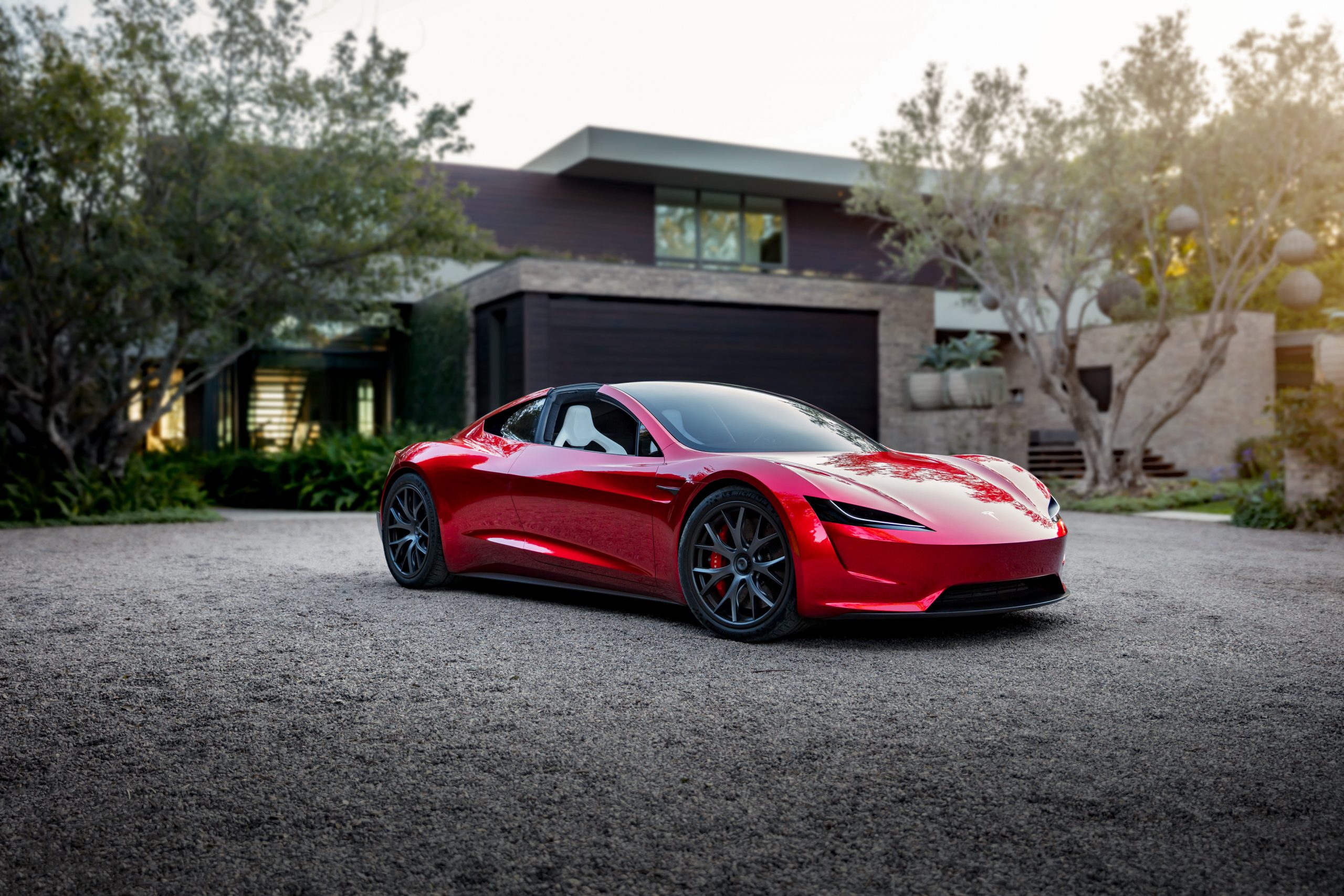
Tesla may have just revealed a key piece of technology destined for its long-awaited next-generation Roadster. A newly published patent application outlines a simplified vehicle seat design built around a single continuous composite frame, a concept that could significantly reduce complexity, weight, and manufacturing time.
The patent, published on March 5, 2026 and titled “Vehicle Seat System,” describes a seat structure that replaces the many individual parts found in conventional automotive seats with a single integrated component.
A seat built from one continuous structure
Traditional car seats are surprisingly complex assemblies. They typically rely on multiple metal frame pieces, brackets, hinges, foam layers, and trim components that are bolted or welded together. These parts allow the seat to recline, slide, and adjust, but they also introduce additional weight, potential noise, and manufacturing complexity.
Tesla’s patent, first shared by @seti_park on X, describes a dramatically simpler approach. Instead of multiple frame pieces connected by hinges, the company proposes a single-piece composite frame that integrates the seat base, backrest, headrest, and even the hinge section into one unified structure.
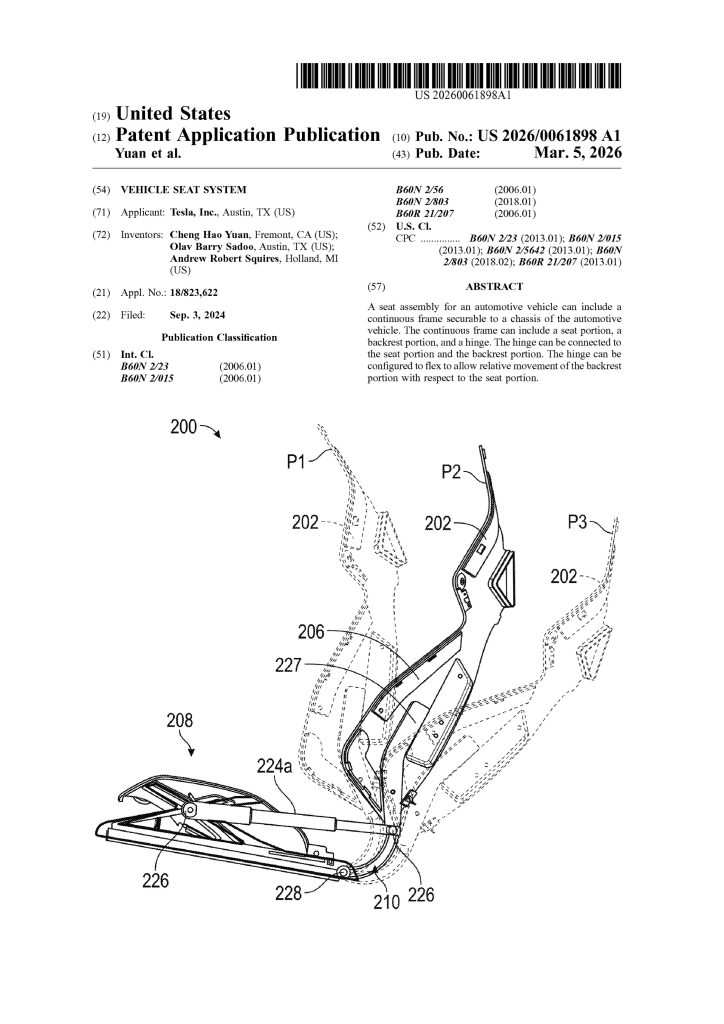
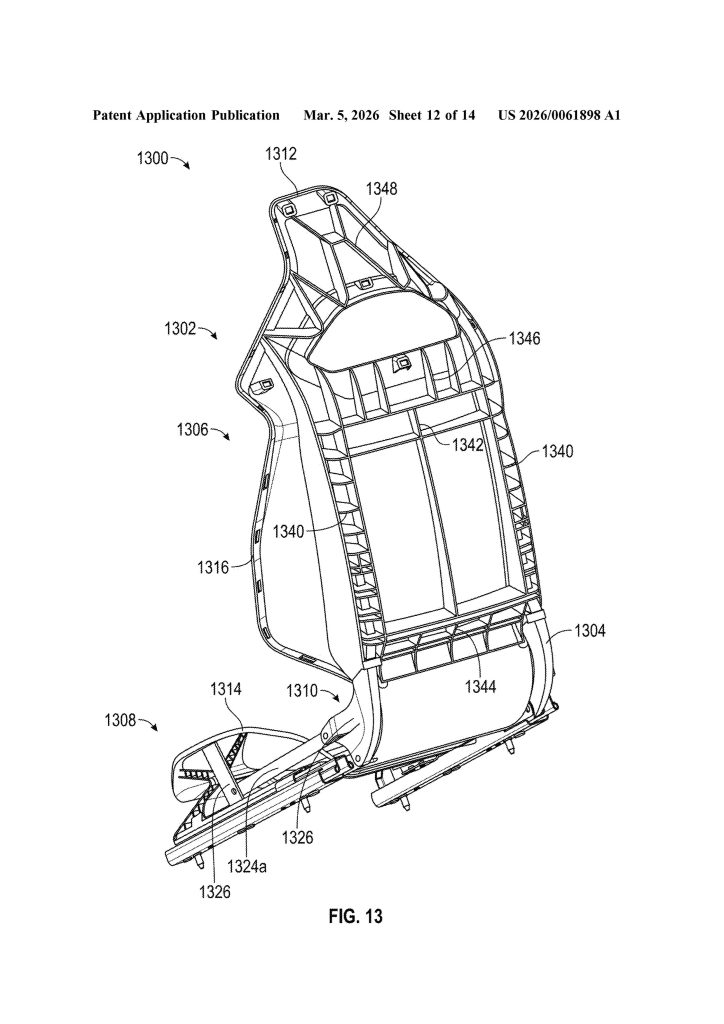
Tesla explains the limitation of current designs in the patent, writing:
“Typical seat assemblies include a rigid frame covered in foam and surrounded by a trim layer (often fabric or leather). Some seat assemblies can be configured to move or tilt. Such moving seat assemblies typically include multiple pieces connected by a hinge or linkage allowing movement of a backrest portion to a seat portion. However, such seat assemblies can be relatively time consuming to build and assemble and may not provide sufficient lower back support where the backrest connects to the seat.
This disclosure helps to address these issues (among others) by providing a seat assembly including a single continuous frame including a seat portion, a backrest portion, and a hinge. The hinge can allow the backrest portion to move or tilt with respect to the seat portion such that the continuous frame, though being formed of a single component, can move or flex to allow the seat assembly to be adjusted, as desired by a user or passenger in the automotive vehicle.”
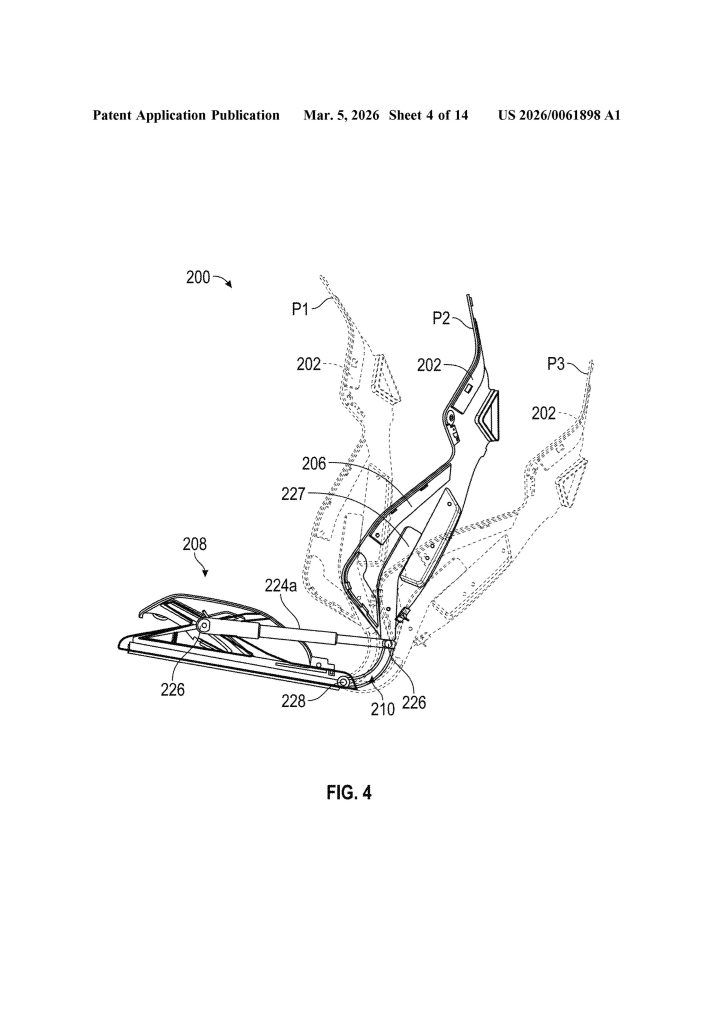
Flexible hinge built into the material
One of the most interesting elements of the design is how Tesla handles seat reclining. Instead of relying on a traditional mechanical hinge with gears or linkages, the seat frame itself incorporates a flexible hinge region.
By carefully controlling the thickness and composition of the composite material in specific areas, Tesla can create zones with different stiffness levels. This allows the seat to remain rigid where support is needed while still bending in the hinge area to allow the backrest to recline.
The patent also describes reinforcing structures that help define the pivot point and maintain durability over time.
Performance-focused design
The seat design shown in the patent also appears far more aggressive than anything currently offered in Tesla vehicles. The integrated side bolsters wrap tightly around the driver, suggesting the design could be intended for a high-performance vehicle.
That has fueled speculation the technology could debut in the upcoming next-generation Roadster, which Tesla has teased with hypercar-level performance targets, including acceleration from 0-60 mph in under two seconds.
Using composites such as carbon-nylon, Kevlar-nylon, or fiberglass-nylon would also align with a lightweight performance strategy. Reducing seat weight helps improve acceleration and efficiency while also maximizing interior space in a low-slung sports car.
Potential beyond the Roadster
Although the patent could point to the Roadster’s interior design, Tesla’s filing covers any automotive vehicle, suggesting the concept could eventually expand across the lineup.
Simplifying seat structures fits well with Tesla’s broader push toward manufacturing efficiency, similar to how its megacasting technology consolidated dozens of structural components into single large castings.
Whether the Roadster ends up being the first vehicle to showcase the design remains to be seen, but if implemented at scale, Tesla’s one-piece seat concept could reduce part counts and streamline assembly.