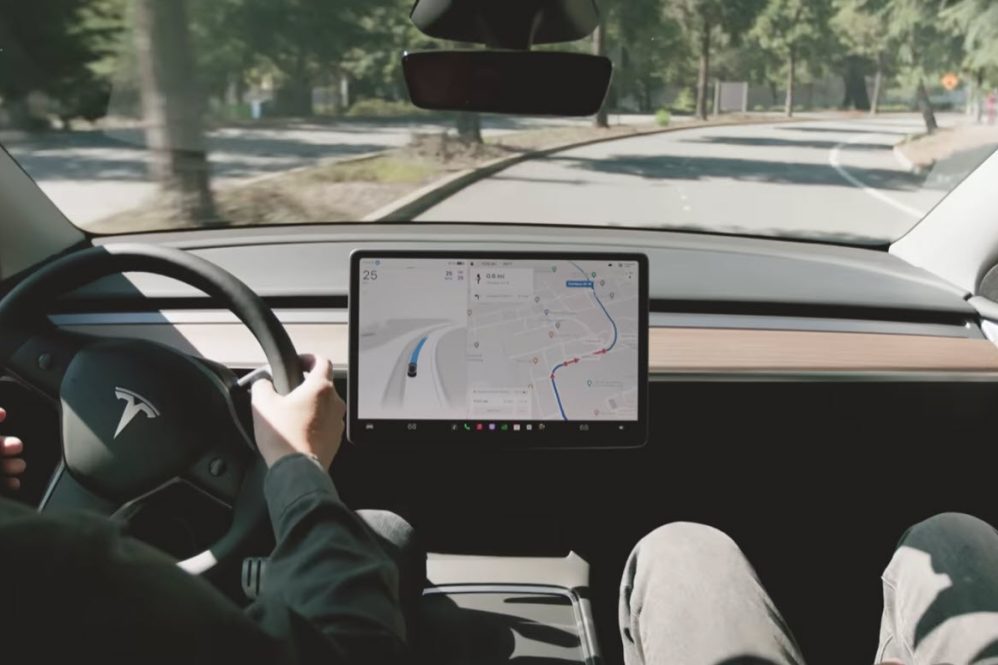
Tesla’s Full Self-Driving (FSD) technology has come out on top in a recent internal evaluation conducted by Hyundai. The test, which benchmarked multiple self-driving systems using the same dataset and methodology, ranked Tesla well ahead of both Hyundai’s in-house solution and several major competitors.
In the internal assessment, based on data provided by sources that spoke with the Korean outlet TheElec, Tesla’s FSD (Supervised) system received a score of 90 out of 100, the highest result among all technologies tested. By comparison, systems from Huawei scored 70, while solutions from Mobileye and Momenta each earned 50.
Hyundai’s own autonomous driving technology, known as Atria AI, lagged far behind with a score of just 25.
The testing was carried out by Hyundai’s Advanced Vehicle Platform (AVP) division and reportedly relied on the widely used Waymo Open Dataset to measure performance. The dataset is widely used across the industry because it provides standardized scenarios for tasks like perception, object detection, motion prediction, and planning.
By using a common dataset, companies and researchers can more directly compare the technical sophistication and performance of different autonomous driving technologies, which is why it is often chosen for internal evaluations and head-to-head benchmarking like Hyundai’s recent testing.
As for Hyundai, Atria AI has been under development for roughly a year by 42dot, a subsidiary of the automaker focused on software and mobility technologies. However, momentum behind the project may be slowing. Earlier this month, Hyundai appointed Minwoo Park as head of the Advanced Vehicle Program (AVP) and CEO of 42dot. Park previously spent nine years at Nvidia, which has recently announced its own autonomous driving platform, Alpamayo. Hyundai is now reportedly evaluating it as a potential alternative.
According to sources cited by TheElec, Hyundai’s low score for Atria AI reflects both architectural and data limitations. The system reportedly relies only partially on convolutional neural networks, while key control elements were designed using more traditional rule-based approaches.
In contrast, Nvidia’s Alpamayo platform is said to feature more than 10 billion parameters and has been trained on driving data collected from over 2,500 cities worldwide, highlighting the growing importance of scale and data diversity in modern autonomous systems. That data advantage has long been cited as a key reason Tesla remains difficult to match in real-world autonomous performance, even as rivals invest heavily in hardware and AI talent.
While Hyundai’s research into Alpamayo platform is reportedly still in its early stages, the report suggests the automaker could move toward Nvidia’s system if future tests show strong results. There are also internal discussions about potentially retaining the Atria AI brand while using Nvidia’s technology as a foundational model.