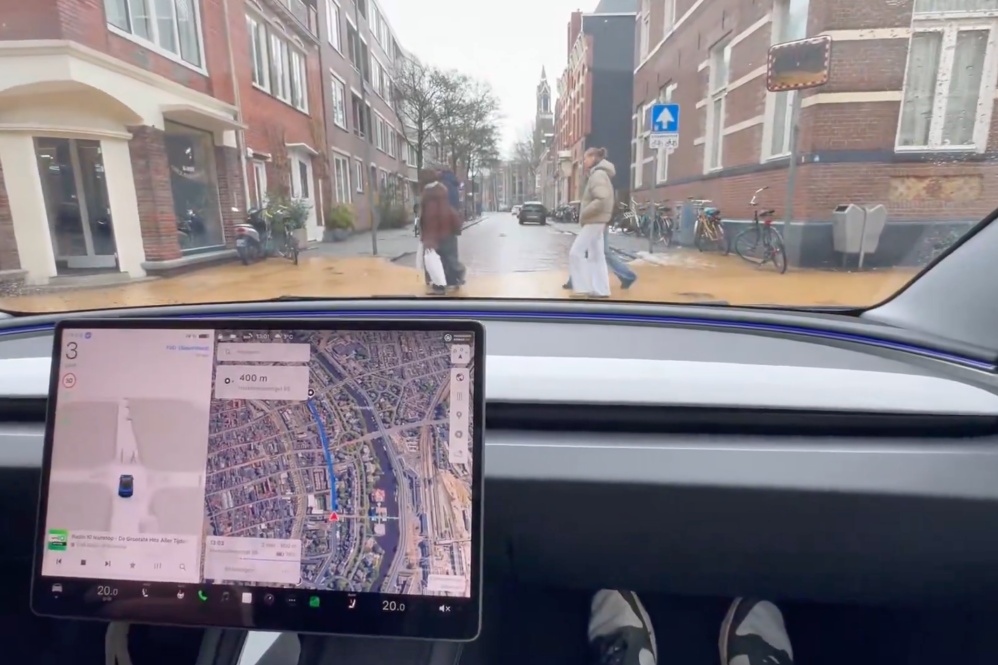
Tesla is one step closer toward finally launching Full Self-Driving (Supervised) in Europe. On Friday the automaker confirmed it has completed the final testing phase and submitted all required documentation for regulatory approval in the Netherlands.
In a post from Tesla’s Europe, Middle East and Africa account on X, the company said it has been working closely with the Dutch vehicle authority RDW to finalize the process. According to Tesla, regulators are now reviewing the full package of test results and compliance documentation, with an updated expected approval date of April 10, pushed back from the previously anticipated February timeline (and the many other expected timelines before that).
“Together with RDW, we have officially completed the final vehicle testing phase for Full Self-Driving (Supervised) and have submitted all documentation required for the UN R-171 approval + Article 39 exemptions,” Tesla said. “The RDW team is now reviewing the documentation and test results package internally.”
If granted, approval in the Netherlands could set off a chain reaction, as other European countries can recognize that decision at a national level, potentially accelerating deployment across the region.
Tesla also noted it is aiming for a broader EU-wide approval later this summer.
Extensive testing and validation efforts
The latest update highlights the scale of Tesla’s efforts to bring FSD to Europe, and also the bureaucratic hurdles Tesla has to overcome to bring it to reality. Over the past 18 months, the company has conducted extensive validation work, including:
- More than 1.6 million km (994,000 miles) of FSD testing on European roads
- Over 13,000 customer ride-alongs to evaluate real-world performance
- More than 4,500 controlled track test scenarios
- Thousands of pages of documentation covering 400+ compliance requirements
- Dozens of studies analyzing safety and system performance
These figures build on earlier disclosures that showed Tesla had already completed over one million kilometres of testing across 17 European countries while engaging regulators throughout the region.
— Sander Smit (@Sandersmit83) February 16, 2026
Regulatory strategy centered on the Netherlands
Tesla’s approach to Europe hinges on its work with RDW, which serves as a key approval authority within the EU framework. Rather than modifying FSD to fit existing rules designed for older driver assistance systems, Tesla has pursued exemptions under UN R171 and EU Article 39 to allow its AI-based system to operate as intended.
The company has previously argued that some European regulations are outdated and not suited for modern neural network-based driving systems, prompting a strategy focused on securing rule-by-rule exemptions while maintaining safety standards.
While the revised April 10 target introduces yet another delay, it keeps Tesla on track for its first European approval. As CEO Elon Musk joked on X, “Inevitably, this will be 4/20,” but for now, the long-awaited approval is slated for April10.
Together with RDW, we have officially completed the final vehicle testing phase for Full Self-Driving (Supervised) and have submitted all documentation required for the UN R-171 approval + Article 39 exemptions. The RDW team is now reviewing the documentation and test results…
— Tesla Europe, Middle East & Africa (@teslaeurope) March 20, 2026