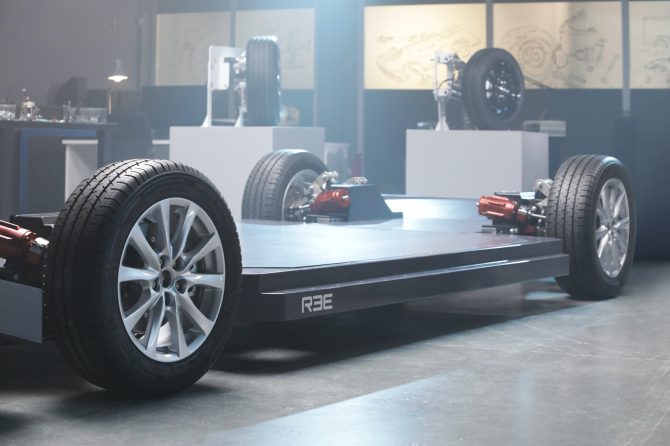

Ford has revealed new details about its upcoming Universal Electric Vehicle (UEV) platform, one that could mark a turning point not only for the company’s EV strategy but also for how it designs and builds electric vehicles (EVs) going forward.
Scheduled to launch in 2027, a US$30,000 midsize pickup will be the first model built on Ford’s all-new , a clean-sheet architecture focused on dramatically reducing costs, complexity, and weight.
A new platform designed to cut cost and complexity
The UEV platform was developed by an internal “skunkworks” team that grew to roughly 650 engineers. Their goal was simple: rethink EV development from the ground up.
Ford says the result is a platform that uses approximately 20% fewer parts than traditional Ford programs, with 25% fewer fasteners and 40% fewer assembly workstations. These changes translate directly into lower production costs and faster assembly times, helping Ford target a starting price of around US$30,000—roughly half the cost of many current electric pickups.
The new architecture also consolidates dozens of electronic control units into just five main modules, significantly reducing wiring. Ford says the truck’s wiring harness alone is more than 4,000 feet shorter and 22 pounds lighter than its earlier EVs.

Smaller battery, longer range
One of the biggest drivers of EV cost is the battery, which can account for up to 40% of a vehicle’s total price. The batteries also add weight, contributing as much as 25% of the EV’s total weight. To address this, Ford is using lithium iron phosphate (LFP) batteries, a lower-cost chemistry that eliminates expensive materials like nickel and cobalt.
The battery is also smaller, reducing weight, but Ford still expects the truck to deliver over 300 miles (483 km) of range thanks to improved efficiency, lighter construction, and aerodynamic optimization.

The 48-volt architecture, similar to what Tesla introduced with the Cybertruck, allows for thinner wiring, improved efficiency, and lower manufacturing costs while supporting more advanced vehicle electronics.
Built for efficiency
Aerodynamics played a major role in the truck’s development, with Ford claiming it is 15% more aerodynamic than competing pickups. Engineers even redesigned components like the side mirrors, reducing their size by 20% and adding measurable range improvements.

At the same time, Ford says the truck won’t sacrifice its traditional pickup appearance.
“It is similar in enough ways to a pickup truck that it is recognizable and that will attract some customers who have already bought pickup trucks,” Clarke said. “But I suspect the majority of our customers are going to come out of SUVs and cars, even used vehicles because of the low cost of it.”
The cabin will also be larger than many compact SUVs, targeting mainstream buyers rather than traditional truck owners.
A critical moment in Ford’s EV transition
Ford is investing billions into this next-generation platform as it seeks to compete with Tesla and rapidly growing Chinese automakers, while addressing one of the biggest barriers to EV adoption—price.
If successful, the $30,000 electric pickup could open the door to a new generation of affordable EVs and help accelerate the industry’s transition toward mass-market electrification.
With testing already underway, more details—including official specifications and final design—are expected closer to its 2027 debut.
Related Stories:
• Ford Targets Level 3 Eyes-Off Driving in 2028 on Affordable EV Platform
• Ford’s EV Deliveries Fall 52% in Q4 Despite Best Overall Sales Year Since 2019
• Ford Confirms F-150 Lightning Is Dead, Next Model Gets Gas Range Extender