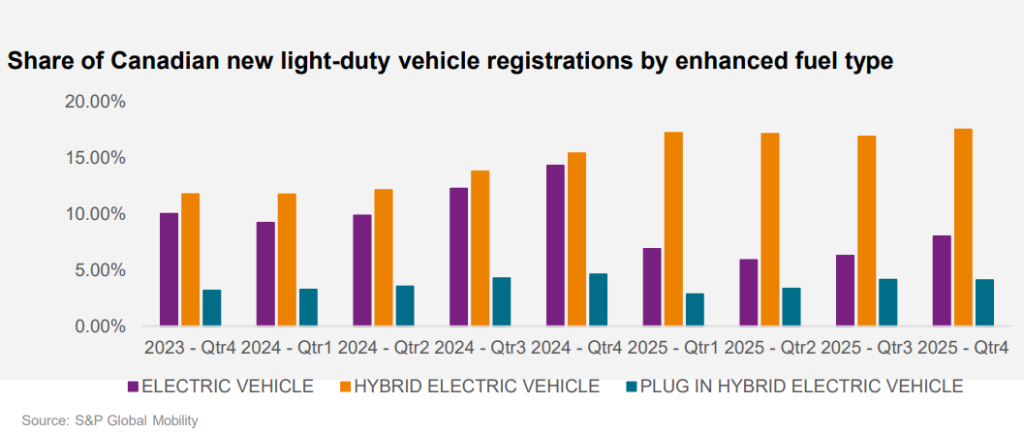
Canada’s transition to electric vehicles (EVs) hit a major speed bump in 2025, but the latest data shows the market may be stabilizing. According to new figures from S&P Global Mobility, zero-emission vehicles (ZEVs) accounted for 12.1% of new light-vehicle registrations in the fourth quarter of 2025, a modest improvement from 10.4% in Q3.
While that quarterly increase suggests the market may be adjusting to changing conditions, the bigger story is the dramatic shift in consumer preferences throughout 2025. With federal and provincial EV incentives reduced or paused, buyers increasingly turned to hybrid vehicles instead.
Hybrids become the dominant electrified powertrain
Hybrid vehicles emerged as the clear winner in Canada’s powertrain mix last year. Full and mild hybrids combined reached 17.5% market share in Q4 2025, capping off a year that saw the segment grow more than 31% compared to 2024.
For the full year, hybrids captured 17.2% of the Canadian market, up significantly from 13.3% the previous year. The growth was driven largely by full hybrid models, which alone accounted for 13.0% of new vehicle registrations.
This surge was part of a broader consumer shift toward technologies that offer improved fuel efficiency without requiring charging infrastructure or higher upfront costs. With incentives reduced, many buyers appear to be choosing hybrids as a more affordable step toward electrification.
ZEV market contracts sharply in 2025
Despite the small rebound in the fourth quarter, the overall ZEV market shrank significantly last year. The share of battery-electric, plug-in hybrid, and hydrogen vehicles fell from 15.4% in 2024 to 10.3% in 2025, representing a 31.9% decline.
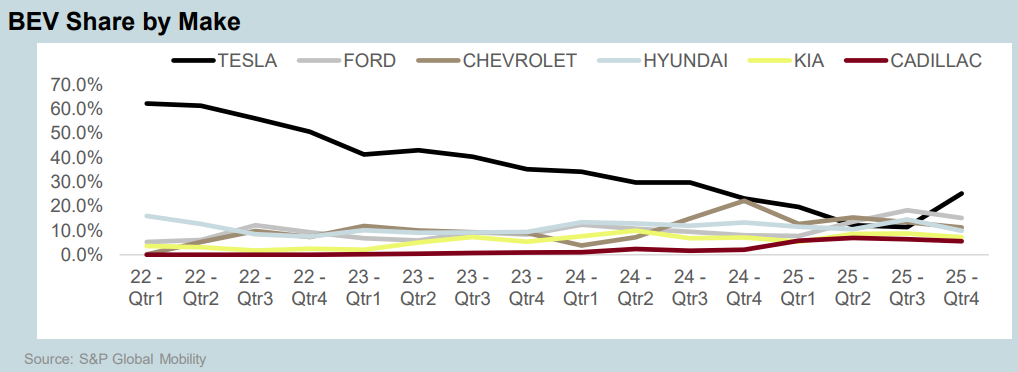
Battery-electric vehicles were hit hardest. Their market share dropped from 11.4% in 2024 to just 6.7% in 2025, a decline of more than 40% year-over-year.
The pullback was widely felt across the industry. Tesla was the hardest hit, seeing a significant 64% decline in sales volume, while automakers with strong hybrid lineups gained ground as consumers adjusted to the new pricing landscape.
Even so, BEVs still represented 8.0% of new vehicle registrations in Q4, contributing to the modest quarterly recovery in ZEV adoption.
Quebec and British Columbia see the biggest corrections
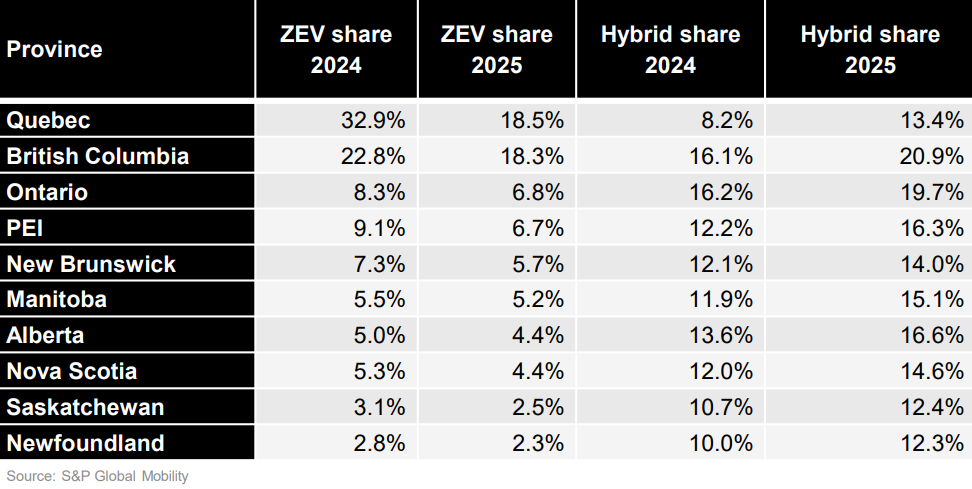
The market shift was especially pronounced in the provinces that had previously led Canada’s EV transition. Quebec’s ZEV adoption rate dropped from 32.9% in 2024 to 18.5% in 2025, while British Columbia saw its share fall from 22.8% to 18.3%. In both cases, much of the lost EV demand shifted toward hybrids.
BC now has the highest hybrid adoption in Canada, with hybrids accounting for 20.9% of new vehicle registrations, surpassing the province’s ZEV share.
Ontario, meanwhile, continues to lag in EV adoption but has become a major hybrid market. ZEVs represented just 6.8% of new vehicle registrations in 2025, while hybrids climbed to 19.7%.
Canada’s electrification path continues to evolve
The 2025 data highlights a key shift in Canada’s transition. Rather than abandoning electrification, many consumers appear to be taking a more gradual approach by adopting hybrid technology first.
With ZEV incentives uncertain and vehicle prices still relatively high, hybrids are increasingly acting as the bridge between traditional internal combustion vehicles and fully electric models.
The modest rebound in Q4 suggests the EV market may be beginning to adjust to these new realities, but the numbers also show that Canada’s path to widespread electrification may look different than previously expected.