Canada’s electric vehicle (EV) strategy is undergoing a dramatic shift. Prime Minister Mark Carney has announced the federal government will repeal the EV sales mandate and replace it with a new system centered on emissions standards. At the same time, the federal EV rebate program will return, but with some major changes.
The Return of ZEV Rebates, But With Stricter Rules
According to Carney, the ZEV rebate program is officially returning with$2.3 billion in funding over five years, after the previous program ran out of money in early 2025 due to overwhelming demand. Beginning February 16, Canadians will once again be eligible for rebates of up to $5,000 on qualifying EVs and up to $2,500 on plug-in hybrid models, the same amount as under the previous program.
Importantly, that rebate amount will decrease over time, dropping to $4,000 in 2027, $3,000 in 2028 and 2029, and $2,000 in 2030 for EVs. Hybrid rebates will drop to $2,000 in 2027, $1,500 in 2028 and 2029, and $1,000 in 2030.
Additionally, eligibility requirements have tightened. To qualify, vehicles must be priced below $50,000 and manufactured in countries with free trade agreements with Canada. This condition excludes EVs produced in China, even though Canada has recently opened its market to limited Chinese EV imports.
Canadian-built electric vehicles will receive special treatment, as they are exempt from the $50,000 price cap. Currently, the only Canadian-built ZEVs are the Chrysler Pacifica Hybrid and Dodge Charger Daytona.
The previous version of the iZEV rebate program had a price limit of $55,000, but allowed rebates to apply to higher trims of the same vehicle up to $65,000, opening the door for many more models to be eligible for the rebate.
Which Tesla Vehicles Qualify For Canada’s New EV Rebate
For Tesla, this new structure means only the Model Y Rear-Wheel Drive (RWD), previously known as the Model Y Standard RWD, is potentially eligible for the new rebate. It is priced at $49,990, and produced in Germany, which currently has a free trade agreement with Canada.
While it meets those requirements, we use the words potentially eligible as the government had previously indicated Tesla would be excluded from any EV rebate program in the future. There was no information released today specific to Tesla, or a list of eligible vehicles.
The Model 3 was eligible under the previous program, but with tariff-inflated prices, the base model now starts at $79,990, well above the price threshold.
UPDATE: It looks like the Model Y RWD won’t qualify for the new federal EV rebate after all – here’s why.
The previous iZEV rebate had a MSRP cap of less than $55,000. According to the government’s press release today, the new program uses different and very specific wording – “final transaction value of up to $50,000.”
This means the vehicle has to be under $50,000 after all fees and options, but before taxes. With the Model Y RWD at $49,990, even the $26 tire fee pushes it above the cap.
Tesla could end up lowering the price to make it qualify, we’ll have to wait until Feb 16 to find out.
EV Sales Mandate Eliminated
Along with the return of EV rebates, Canada is also eliminating the previous requirement that all new vehicle sales be zero-emission within the next decade. In its place, new stricter greenhouse gas emission rules are being introduced for model years 2027 through 2032, with the goal of encouraging automakers to expand their lineup of zero-emission vehicles (ZEVs) without mandating specific sales quotas.
Despite abandoning the mandate, the federal government still expects EVs to dominate the market in the coming years. Officials estimate the new framework could result in EVs accounting for approximately 75% of all new vehicle sales in Canada by 2035.
EV Charging Infrastructure
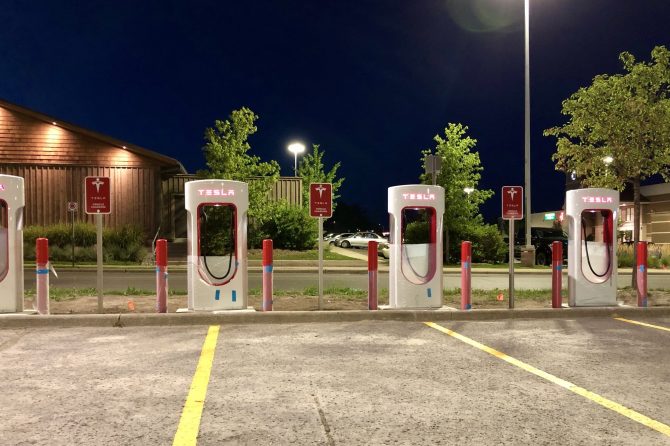
Beyond rebates and scrapping the EV mandate, the federal government is also investing in charging infrastructure. A new $1.5 billion initiative will fund the expansion of public charging stations nationwide.
The broader strategy also includes billions in additional support for Canada’s automotive sector, including funding to help manufacturers diversify exports and mitigate the impact of U.S. tariffs.