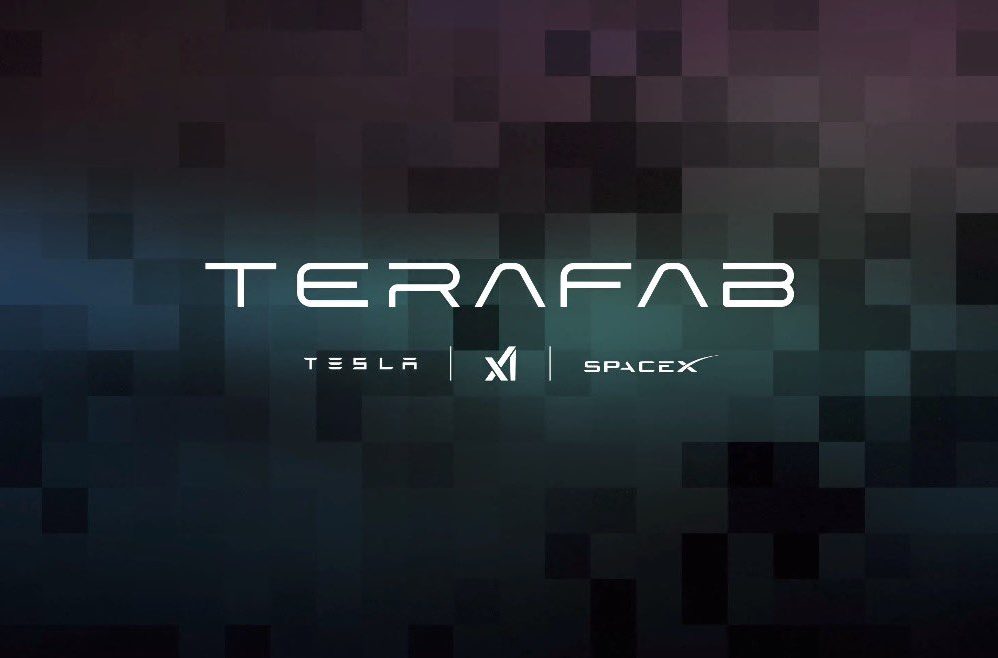
Elon Musk has outlined plans for a new semiconductor manufacturing facility in Austin, Texas, as part of a broader effort to secure chip supply for Tesla, SpaceX, and xAI. The proposed project, called Terafab, would be a joint venture focused on producing chips for artificial intelligence, robotics, and other compute-intensive applications across Musk’s companies.
First announced last week, the proposed “Terafab” facility would be built in Austin, Texas, and operated as a joint effort between Tesla, SpaceX, and xAI. The goal is straightforward but ambitious: produce chips at a scale large enough to support Musk’s rapidly expanding AI ecosystem, from Full Self-Driving to humanoid robots and orbital data centers.
Driving the decision to build a Terafab is a growing concern shared across the tech industry—there simply may not be enough chips to meet future demand. Musk made that point clear, stating, “We either build the Terafab or we don’t have the chips, and we need the chips, so we build the Terafab.”
A vertically integrated chip strategy
Unlike traditional semiconductor models that rely on specialized foundries like TSMC or Samsung, Terafab is envisioned as a fully integrated facility. Musk described a system capable of designing, manufacturing, testing, and refining chips all under one roof—an approach that could significantly accelerate development cycles.
The factory would produce two primary types of chips: one for terrestrial applications like Tesla vehicles, Optimus robots, and AI training systems, and another designed specifically for use in space. These space-hardened chips are expected to play a key role in Musk’s broader vision of deploying solar-powered AI infrastructure in orbit.
According to the presentation, the facility could eventually manufacture between 100 billion and 200 billion chips annually, potentially surpassing the combined output of today’s global industry.
Powering a terawatt-scale AI future
Musk also outlined the sheer scale of computing power he believes Terafab could unlock. The long-term target is to produce up to one terawatt (TW) of compute capacity per year, with an even more ambitious goal of expanding that capability into space-based systems.
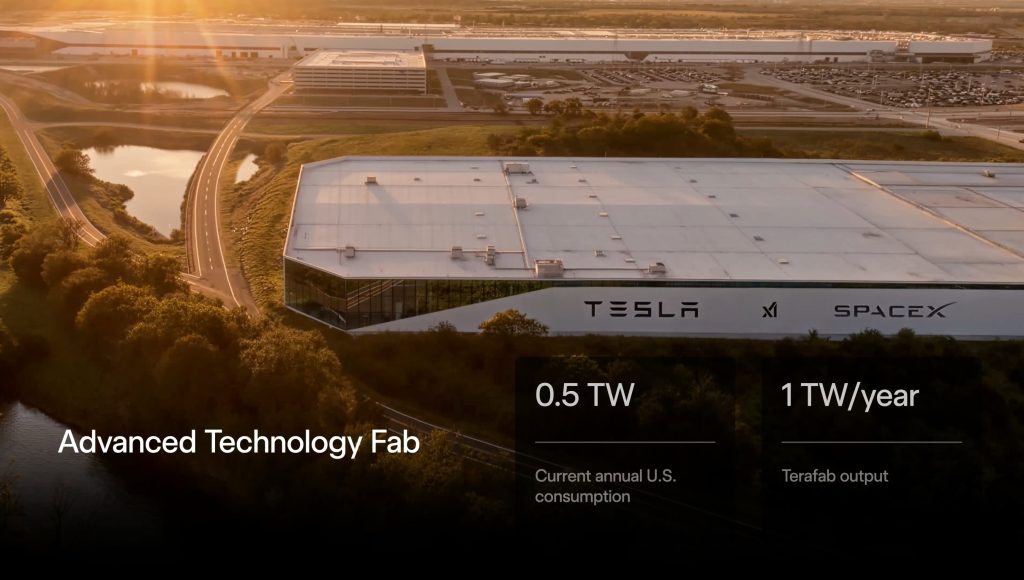
This ties directly into SpaceX’s previously proposed orbital data centers—massive constellations of satellites designed to handle AI workloads using constant solar energy. By moving compute off Earth, Musk argues the industry could bypass limitations related to land, power, and cooling.
Electromagnetic launch systems and lunar logistics
Another component of Musk’s long-term vision involves electromagnetic mass drivers—essentially railgun-like systems designed to launch payloads from the Moon without the need for traditional rockets.
Powered by solar energy and coordinated by advanced AI chips produced at Terafab, these systems could accelerate cargo to escape velocity using electromagnetic force instead of chemical propulsion. The concept would dramatically reduce the cost of moving materials off the lunar surface, enabling high-frequency launches of equipment, raw materials, or even spacecraft components.
Electromagnetic mass drivers on the Moon pic.twitter.com/NNDY6L2jSx
— SpaceX (@SpaceX) March 22, 2026
Big vision, big challenges
Despite the bold vision, significant hurdles remain. Building a semiconductor fabrication plant is one of the most complex and capital-intensive undertakings in modern manufacturing, often requiring tens of billions of dollars and years of development.
Musk has acknowledged the scale of the challenge but has yet to provide a clear timeline for when Terafab might come online. That uncertainty, combined with his track record of ambitious timelines, has led some analysts to approach the announcement with caution.
Still, the underlying strategy is clear: reduce reliance on third-party suppliers and secure the computing backbone needed for Tesla’s next phase of growth.
If successful, Terafab could position Tesla and its affiliated companies at the center of the AI hardware race—while also laying the groundwork for a future where computing extends far beyond Earth.
You can watch the full Terafab presentation below.
Announcing TERAFAB: the next step towards becoming a galactic civilization https://t.co/xTA70LOU0e
— SpaceX (@SpaceX) March 22, 2026

Always get the latest - make Drive Tesla your preferred source on Google
Are you buying a Tesla? If you enjoy our content and we helped in your decision, use our referral link to get three months of Full Self-Driving (FSD).Drive Tesla uses affiliate links, which means we may earn a commission if you make a purchase through them, at no additional cost to you. Thank you for your support.