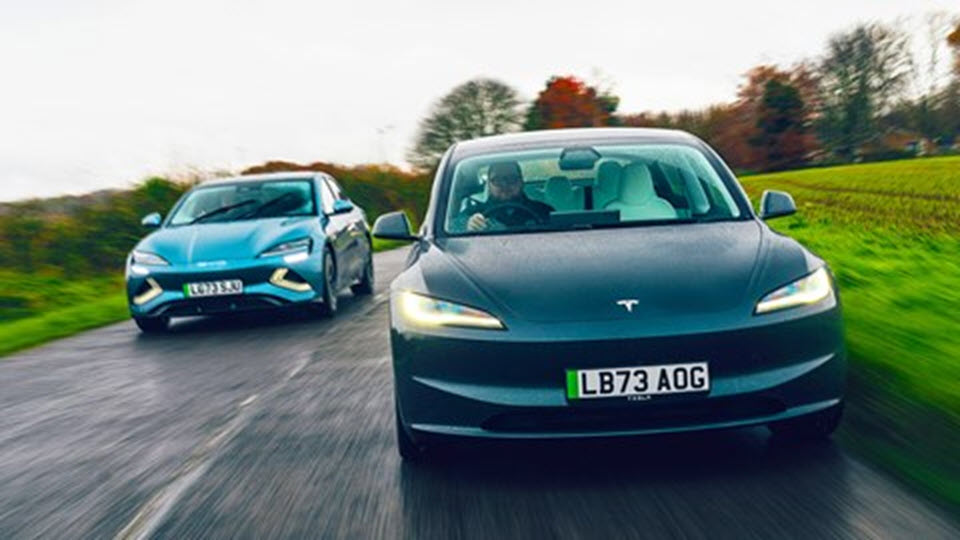
Canada is shifting gears on its approach to Chinese electric vehicles (EVs), moving away from a 100% tariff that has been in place over the last two years. Following talks in Beijing, Ottawa has agreed to a tariff-quota system that reopens limited access to Chinese-built EVs, lowering duties dramatically but while still keeping overall volumes capped.
Canada Reopens the Door to Chinese EVs
Under the agreement, Canada will allow up to 49,000 Chinese-made EVs per year to enter the country at a 6.1 per cent tariff, matching the standard duty that applied to vehicles imported from China prior to the implementation of the 100% tariff.
The annual import cap would rise to 70,000 vehicles by the fifth year of the agreement. The federal government also said that as part of the deal it “anticipates” that 50% of these 70,000 vehicles “will be affordable EVs with an import price of less than $35,000.”
According to Prime Minister Mark Carney, this quota-based structure is designed to reopen the market without triggering a sudden surge of imports, emphasizing that the cap represents less than 3% of Canada’s annual auto sales.
What This Means for Tesla in Canada
For Tesla, the implications are significant. With the tariff on Chinese-built vehicles now reduced to 6.1%, the same level it was as in 2024, Tesla could regain the option to source the Model 3 for Canada from Giga Shanghai. Currently Tesla is faced with a 25% tariff on imported vehicles from the United States, a move which forced them to raise prices on the Model 3 by 20%.
As for the Model Y, Tesla has already side-stepped the 25% tariff by importing the electric SUV from Giga Berlin. Unfortunately, the Model S and Model X are only made at Tesla’s Fremont factory in California, so those vehicles will still be priced with tariffs taken into account.
UPDATE 9:45am PT: There appears to be a lot of misinformation circulating that Tesla won’t qualify to import the Model 3 under the agreement. To clarify:
• Official government communications (1, 2) indicate that 49,000 vehicles can be imported in year one, rising to 70,000 vehicles by year five.
• The agreement also states that by year five, 50% of imported vehicles will have an import price below $35,000.
• Based on what’s been released so far, this appears to be a phased-in agreement, meaning that in years one and two, the share of sub-$35,000 vehicles will likely be significantly lower, gradually increasing to year five’s 50%.
• Even under these limits, Tesla would still have room to import a meaningful number of Model 3, at least 24,500, and potentially far more in the early years.
The Arrival of Chinese EV Brands
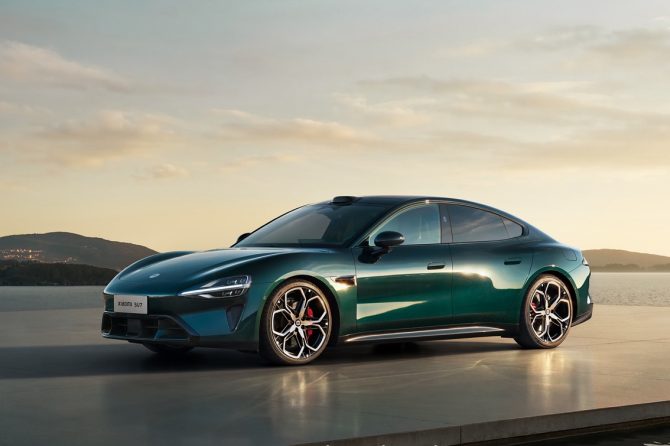
The deal also raises the real prospect of Chinese brands finally entering Canada. Companies like BYD and Xiaomi—both known for aggressive pricing and fast product development—now have a viable path into the market.
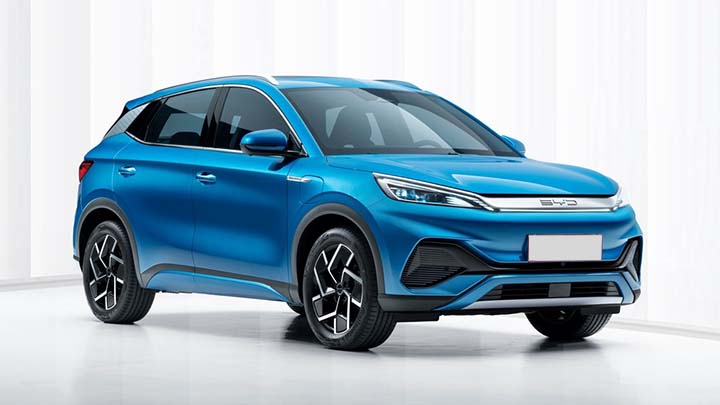
BYD, now the world’s largest EV seller, already sells vehicles in dozens of international markets. One of its most likely Canadian candidates would be the Atto 3, a compact electric SUV roughly the size of a Model Y but positioned at a lower price point. In overseas markets where the Atto 3 is sold, the compact SUV typically starts in the upper C$30,000s to low C$40,000s range.
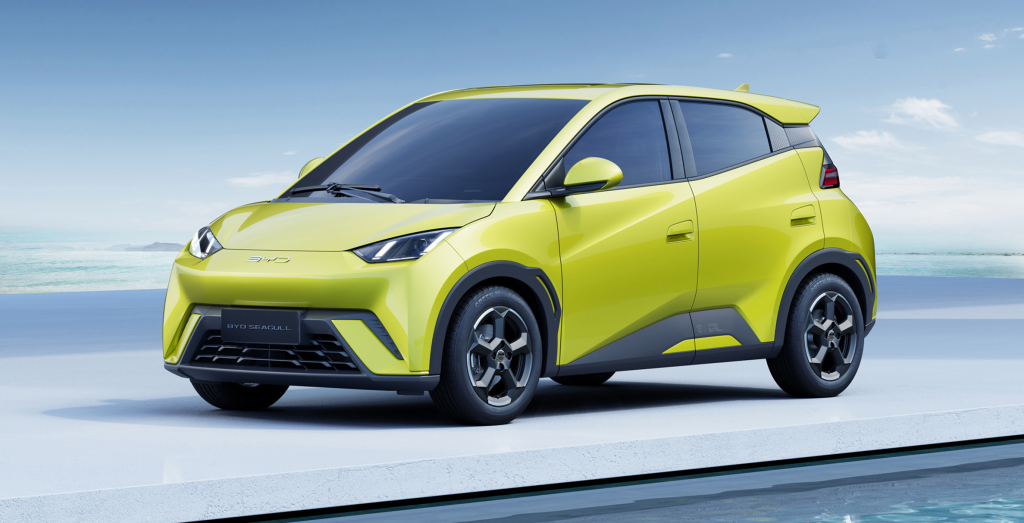
At the more affordable end, BYD’s smaller hatchbacks and sedans—such as the Dolphin or Seagull—demonstrate how aggressively the company can price vehicles. The Seagull is one of BYD’s smallest and cheapest electric cars. In China, it has been priced extremely low, with starting prices as low as about C$11,000 to C$17,000 on the local market.
If it were available in Canada under the new tariffs, the Seagull could still sell for under C$20,000 — which would make it significantly cheaper than not only every other EV sold in Canada, but also most internal combustion engine (ICE) vehicles.
Domestic Pushback
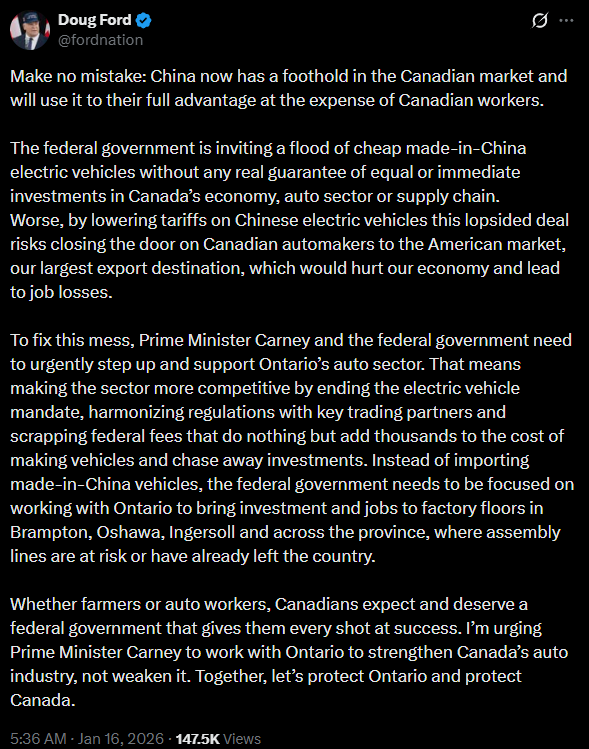
Not everyone in Canada is cheering on the deal. Ontario Premier Doug Ford warned on X the agreement risks giving China a foothold in Canada’s auto market and could complicate access to the U.S., Canada’s largest export destination. He argued the deal threatens Canadian manufacturing jobs unless paired with stronger protections for domestic automakers.

Always get the latest - make Drive Tesla your preferred source on Google
Are you buying a Tesla? If you enjoy our content and we helped in your decision, use our referral link to get three months of Full Self-Driving (FSD).Drive Tesla uses affiliate links, which means we may earn a commission if you make a purchase through them, at no additional cost to you. Thank you for your support.